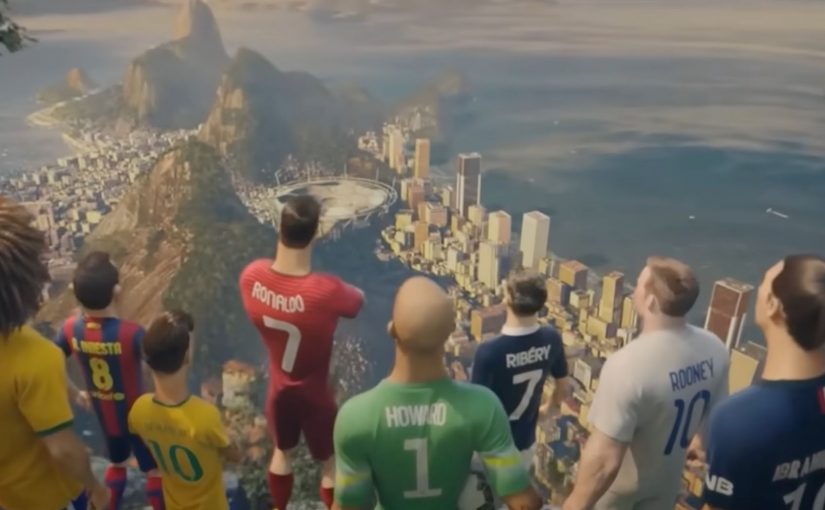
In a build up to the first match of the 2014 FIFA World Cup, Nike Football released a five minute animated film that features some of the world’s greatest footballers on a mission to save football from the hands of a villainous mastermind, The Scientist.
In a future where brilliant football has ceased to exist and the game has become almost extinct, Brazilian legend Ronaldo (O Fenómeno) decides enough is enough and goes on a mission to reignite the game with brilliant football with the help of a re-assembled group of the world’s most brilliant players.
In the final minutes of the film, Cristiano Ronaldo, Wayne Rooney, Neymar Júnior, Zlatan Ibrahimović, Andrés Iniesta, David Luiz, Franck Ribéry, Tim Howard and Ronaldo (O Fenómeno) are seen battling the “perfect” football clones in a winner take all match.
How the plot carries Nike’s platform
The film pits “brilliant football” against a future of optimized, risk-free play, so “Risk Everything” reads like a choice between creativity and extinction. Here, a brand platform means the recurring campaign idea that frames the work.
In global tournament marketing, this kind of work competes with entertainment, not other ads.
The real question is how you turn a tournament moment into a story people choose to watch and share, even when they do not care about the sponsor.
Why this story structure is so effective
By giving creativity a face (the players) and safety a face (The Scientist and his clones), the film turns an abstract brand message into a clear, watchable conflict.
Extractable takeaway: If your platform is an attitude, dramatize it as a choice with consequences, then let the audience feel the outcome instead of explaining it.
- It turns a brand platform into a myth. “Risk Everything” translates naturally into a fight for football’s soul.
- It uses a clear villain to sharpen the message. The Scientist represents control, safety, and sameness. The players represent creativity and individual brilliance.
- It makes the product message implicit. You do not need to be told that creativity wins. You watch it win.
What marketers can take from “The Last Game”
When you have a cultural moment as big as the World Cup, the winning work often behaves like entertainment first. Nike built a mini-universe with stakes, characters, and a simple conflict. That gives the story a reason to be shared beyond football fans, and it gives the brand a clear point of view without sounding like advertising.
- Lead with stakes. Make the outcome matter before you ask anyone to share.
- Give the tension a face. A clear opponent sharpens what you stand for, and what you stand against.
- Keep the product message implicit. Show the behavior you want to reward, then trust viewers to connect the dots.
A few fast answers before you act
What is Nike Football “The Last Game”?
It is a five-minute animated film released ahead of the 2014 FIFA World Cup where Ronaldo (O Fenómeno) and a group of top players try to save football from The Scientist and his “perfect” clones.
Who are the players featured in the final match?
Cristiano Ronaldo, Wayne Rooney, Neymar Júnior, Zlatan Ibrahimović, Andrés Iniesta, David Luiz, Franck Ribéry, Tim Howard and Ronaldo (O Fenómeno).
What is the core idea behind the villain “The Scientist”?
He represents a future of controlled, optimized, risk-free football. The film positions creative, brilliant play as the antidote.
Why does this work so well ahead of a tournament?
It amplifies the emotion people already bring to the World Cup and gives them a shareable story that feels like culture, not a commercial break.