
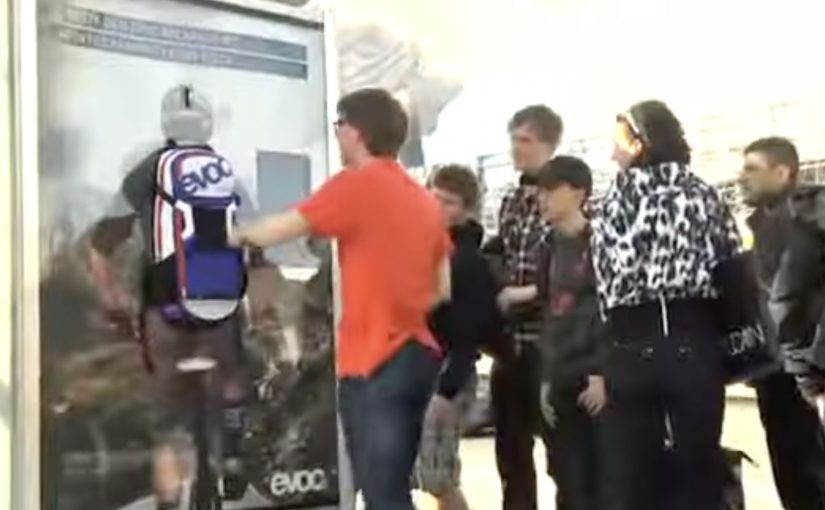
EVOC: The Indestructible Billboard

A backpack is mounted into a bus stop billboard. People step up, throw their hardest punch, and a display instantly shows the force of the hit and how much of it the backpack absorbs.

EVOC wanted to highlight its LITESHIELD protective technology, positioned as shock absorption with everyday wearing comfort. Publicis Munich created a billboard that lets passers-by physically test the backpack’s impact absorption. The unit also ties into Facebook, described as photographing participants and posting the image so they can tag and share their attempt.

The hardest recorded punch is reported as 11.30 kN. Definition-tightening: kN, kilonewton, is a unit of force, so the number is the proof-point for how much impact the demo measured, not a vague “strong” claim.

A product demo disguised as street entertainment

The mechanism is simple. Turn the product into the interface. The billboard does not claim protection, it measures an impact in public and shows both the hit and the absorbed portion in real time.

In performance-driven consumer categories, an outdoor experience that converts a spec into a felt moment can create belief faster than any explanation panel ever will.

Why the Facebook loop matters

The punch is the hook, but the share is the multiplier. By capturing the moment and attaching a score, the activation creates a lightweight competition mechanic, then hands people a reason to post that is about them, not about the brand.

Extractable takeaway: Proof travels when the moment is both measurable and share-ready, so design the interaction and the publishing loop as one system.

Reported results from coverage include around 97 hits per hour and a 220% increase in Facebook fan activity during the campaign window. Those figures are part of the story because they show what happens when the product truth is both playable and publishable.

What EVOC is really buying

This is credibility and recall. If you let someone try to break your protective promise in public and the product holds, the brand earns a kind of trust that polished messaging struggles to achieve.

The real question is whether your proof moment is verifiable at a glance, or whether it reads like a gimmick.

Proof-led stunts are worth doing only when the measurement is instantly legible and the audience feels it cannot be faked.

Proof-led activation moves worth copying

  • Instrument the claim. If you say “absorbs impact,” measure impact and show the absorbed portion.
  • Make the demo social by default. Photo plus score is a repeatable share trigger.
  • Keep the interaction one-step. No instructions wall. One obvious action, one immediate payoff.
  • Design for bystanders. Watching someone else punch is part of the persuasion.

A few fast answers before you act

What is EVOC’s “Indestructible Billboard”?

An interactive bus stop billboard in Berlin that lets people punch an EVOC backpack, then displays the measured force and the absorbed portion as a live product demonstration.

What does LITESHIELD refer to?

EVOC’s protective backpack technology, positioned around impact absorption and back protection while still being wearable for sport use.

Why add Facebook to an outdoor activation?

Because it turns a one-off street moment into shareable content. A photo plus a score gives participants a reason to post and compare attempts.

What does “11.30 kN” mean in plain language?

It is a reported peak force reading from the activation. kN is a unit of force, so the number is meant to quantify the strongest recorded hit.

What is the biggest risk with “proof” stunts like this?

If the measurement is unclear or feels fake, trust collapses. The display must be instantly readable and the interaction must feel authentic.
Newcastle Brown Ale: Shadow Art Billboard

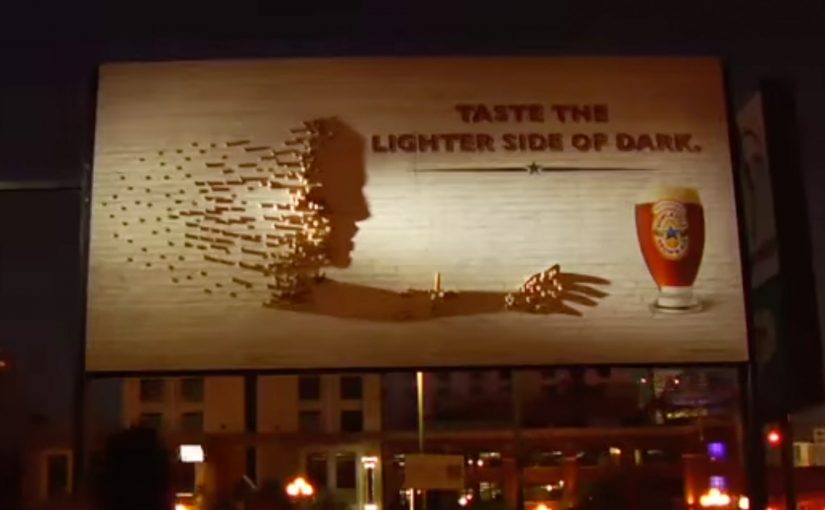
Newcastle Brown Ale’s Shadow Art has debuted in San Diego’s nightlife hub, the Gaslamp district, now through the end of September. Using only a single light source and thousands of Newcastle Brown Ale bottle caps, two New York shadow artists partnered with Newcastle to bring to life a shadow sculpture spanning 128 square feet. Shadow art is an installation that reads abstract until a specific light angle casts a deliberate image.

How it works when the sun goes down

By day it reads like an abstract field of caps. By night, the light angle does the magic. The caps become a pixel grid, and the shadow resolves into a clear image that connects directly to the brand world and the “Lighter Side of Dark” idea. Because the image only resolves under the right light angle, it invites a second look and conversation in a noisy street.

In dense entertainment districts where outdoor media competes with movement, neon, and noise, physical interactivity that rewards a second look beats anything that needs time to decode.

The real question is whether your outdoor idea earns a second look without asking for extra attention.

Why it lands

It makes the reveal the reward. The billboard does not shout at you. It waits until the conditions are right, then surprises you with an image that feels like you discovered it.

Extractable takeaway: Out-of-home becomes memorable when the medium changes state based on real-world conditions like light and viewpoint. If the message only appears when the environment cooperates, the audience feels like they unlocked it.

It uses the product as raw material. Bottle caps are not a metaphor. They are literally the building blocks, which makes the craftsmanship feel inseparable from the brand.

It turns a static surface into a time-based experience. You do not just “see an ad”. You experience a transformation. That shift is what creates talk value in public spaces. Talk value here means it gives people a simple reason to bring it up to others in the moment.

Borrow from Shadow Art billboards

  • Design for a two-stage read. First glance should intrigue. Second glance should reward with clarity.
  • Make the material part of the story. When the build uses brand-native ingredients, the proof feels baked in.
  • Choose locations where “stop and stare” is natural. Nightlife zones work because people are already scanning, wandering, and socializing.
  • Anchor the payoff to one simple brand line. The reveal should resolve into a message people can retell in a sentence.

A few fast answers before you act

What is “shadow art” in an advertising context?

An installation that looks abstract from one angle or in one lighting condition, but becomes a clear image when a specific light source and viewpoint create the intended shadow.

Why use bottle caps instead of printed graphics?

Caps add texture, depth, and authenticity. They also turn the build into a craft story that people talk about, photograph, and share.

What makes this work in a place like the Gaslamp district?

Because it competes with nightlife the right way. It creates a moment people can discover and show to friends, rather than trying to out-shout the environment.

What is the business intent behind an installation like this?

To generate earned attention and brand distinctiveness by creating a public experience that feels “worth a look”, then “worth a share”.

What is the most transferable lesson?

Build a reveal that is conditional on the real world. Light, angle, and time can do the targeting for you without any data.

Chang Soda: Fizzy Billboard

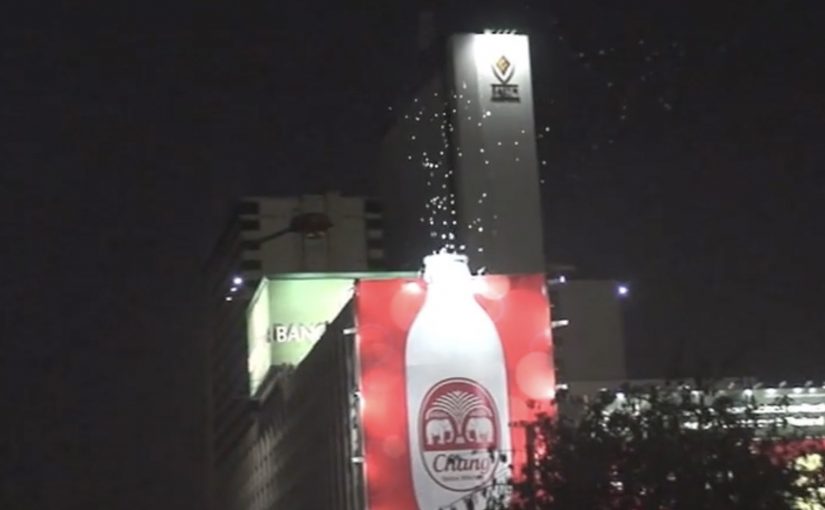
A giant Chang Soda bottle towers over a busy Bangkok shopping area. At the right moment, the cap “pops” and a burst of white balloons shoots out like carbonation escaping from a freshly opened drink.

Seeking new ways to create an impact in today’s sea of daily ad bombardment while taking into account shrinking budgets is quite a challenge. Chang’s Fizzy Billboard did just that, described as a reminder of how effective a great billboard idea can be when it turns a product truth, a single attribute the product can credibly own, into a public spectacle.

This is an outdoor activation that uses a physical effect, balloons released from the bottle, to dramatize “fizz” in a way that can be understood in a single glance.

The mechanism that makes it memorable

The creative leap is not the billboard. It is the “fizz”. Balloons are cheap, visible from far away, and they behave like bubbles in motion. Because of that, the claim becomes tangible even for people who only catch the moment in passing.

In FMCG categories where products are hard to differentiate at shelf, a single unmistakable physical metaphor in public space can outperform a week of polite messaging.

Why it lands as a shareable street moment

The payoff is time-based. People hear that “something happens” and they wait. When the burst comes, it reads instantly and creates a crowd reaction that becomes part of the communication. The effect also photographs well, which helps the idea travel beyond the street.

Extractable takeaway: If you want OOH to earn sharing, build a visible cause-and-effect that people can describe in one sentence, then make the payoff repeatable enough to be worth waiting for.

What the brand is really buying

This is a salience play. The goal is to make “Chang equals fizzy” stick through a short, repeatable spectacle, and to borrow the credibility of a real-world stunt rather than relying on a purely filmed illusion. The real question is whether you can turn one attribute into a repeatable moment people will stop for and retell. If you have to choose, back one literal, repeatable effect instead of spreading budget across polite static placements.

Steal-worthy rules for spectacle OOH

  • Make one product truth physical. Choose the one attribute you want remembered and build the effect around it.
  • Design for distance. If it does not read from across the street, it will not earn attention.
  • Use a predictable moment. A scheduled payoff creates anticipation and word of mouth.
  • Keep the metaphor literal. People should get it before they think about it.

A few fast answers before you act

What is Chang’s “Fizzy Billboard”?

An outdoor activation for Chang Soda where a giant bottle billboard appears to “pop” and release balloons like fizz, turning carbonation into a public spectacle.

Why use balloons for a soda message?

Balloons are inexpensive, highly visible, and they move like bubbles. That makes “fizzy” readable in one second from a distance.

What makes this kind of billboard more effective than a standard print-only OOH?

It creates a moment, not just an image. A time-based spectacle earns attention, crowd reaction, and secondary sharing that static posters rarely trigger.

What business outcome is this designed to influence?

Brand salience and attribute ownership. It aims to make the brand strongly associated with “fizz” versus competitors.

What is the biggest execution risk with spectacle billboards?

If the payoff is unclear or inconsistent, people feel tricked. The effect must be obvious, repeatable, and easy to explain in one sentence.