
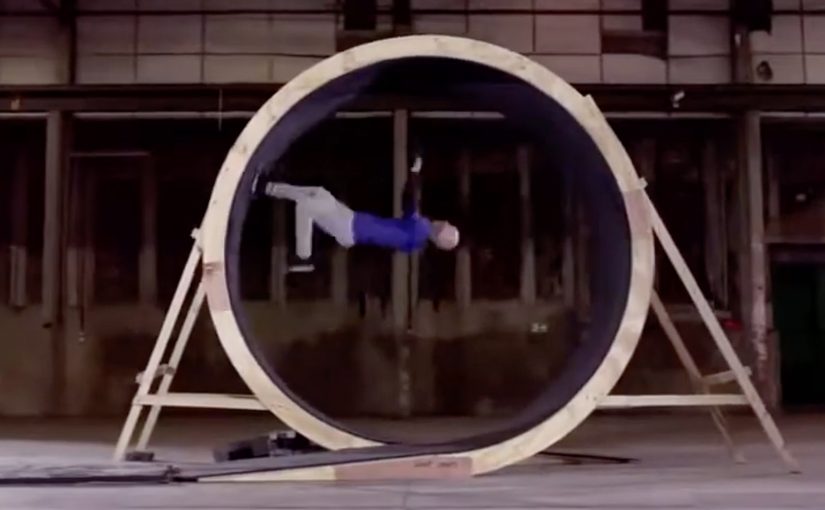
Pepsi Max: Human Loop

Last year, Pepsi Max for its ongoing #LiveForNow campaign created an unbelievable bus levitation stunt. Now continuing this “unbelievable feats and experiences” brand positioning, they challenged daredevil stuntman, Damien Walters to do another unbelievable stunt for them. Here, positioning means the single promise the brand wants people to remember and retell.

Pepsi Max provided Damien with a human-sized loop-the-loop in an abandoned warehouse and then got him to defy gravity for them…

In global FMCG marketing, stunts like this earn value when they reinforce an existing brand platform, not when they try to create one from scratch.

Why this stunt fits the brand

The mechanism is simple. A clearly defined physical challenge, executed by credible talent, makes the “unbelievable” promise feel real because the payoff is visible without narration.

Extractable takeaway: If your positioning is a claim, design one repeatable moment that functions as proof, then film it so the viewer can verify it without explanation.

  • It commits to the promise. “Unbelievable” is not a line here. It is the product.
  • It is instantly legible. You understand the challenge in one second, then you watch to see if it is possible.
  • It is built for replay. Stunts invite rewatching, pausing, and sharing because people want to verify what they saw.

How to make the stunt behave like proof

The real question is whether your brand promise can be proven in one obvious moment on camera.

This kind of spectacle earns its keep only when it is a direct proof point for an ongoing platform, not a disconnected attempt at “random viral”.

If your positioning is about experiences, you need executions that behave like proof. This kind of spectacle works when the idea is simple, the talent is credible, and the payoff is visible without explanation.

  • Make the promise behave like proof. If positioning is about experiences, the execution should demonstrate it, not describe it.
  • Keep the idea simple and the payoff visible. The viewer should understand the challenge instantly and see the outcome without explanation.
  • Use credible talent, then shoot for replay. Stunts invite rewatching, pausing, and sharing when people want to verify what they saw.

A few fast answers before you act

What is Pepsi Max “Human Loop”?

It is a Pepsi Max #LiveForNow stunt featuring Damien Walters attempting a human-sized loop-the-loop setup inside an abandoned warehouse.

Why does a loop-the-loop stunt perform so well in video?

The challenge is obvious, the risk feels real, and the outcome is visually conclusive, which makes it highly shareable.

What is the core pattern behind this kind of campaign?

Make the brand promise measurable in one moment, then capture it cleanly so the viewer does not need context to understand it.

How do you keep stunts from feeling like “random viral”?

Anchor them to an ongoing brand platform, use consistent talent and tone, and make each execution feel like a credible next chapter.

When should you avoid a stunt-led proof moment?

Avoid it when the idea cannot be understood instantly, the talent is not credible, or the execution does not ladder up to an ongoing brand platform.

Pepsi Like Machine

You walk up to the Pepsi’s “Like Machine”, tap “Like” for Pepsi on Facebook using your smartphone or the machine’s touchscreen, and it dispenses a soda. Simple rule. Instant reward.

The Like Machine mechanic

Coca-Cola has created a whole bunch of innovative vending machines over the last couple of years. Pepsi, on the other hand, created only a couple. Now to add to that collection, Pepsi piloted its latest vending machine. Dubbed the “Like Machine”, it was programmed to dispense soda to fans who “Like” the brand on Facebook via their smartphone or via the touchscreen on the machine.

For brands using event-led FMCG activations, the value of this mechanic is that it turns a familiar digital action into a visible physical conversion point.

The business logic is clear: tie a low-friction social action directly to a branded product moment.

Where did Pepsi pilot it

Pepsi piloted the machine at a Beyonce concert in Antwerp, Belgium and received a good response. So do not be surprised if you see more of them popping up nearby.

Why “Like” works as currency here

The exchange is clear. A lightweight social action becomes the trigger for a real-world payoff. The behaviour is familiar, the barrier is low, and the moment is easy to understand even in a noisy live-event setting. The real question is whether the action feels effortless enough to be worth doing on the spot. This is a smart activation rule because it converts a familiar digital gesture into an immediate physical reward, which reduces hesitation and lifts participation.

Extractable takeaway: When a brand uses a familiar low-friction action as the price of entry, more people complete the interaction because they understand the trade instantly.

What to steal from a like-for-reward mechanic

  • Make the exchange instantly legible. One action. One reward. No interpretation required.
  • Use a behaviour people already do. “Like” is familiar, so the barrier to participation stays low in a live setting.
  • Keep the payoff immediate. The shorter the gap between action and reward, the higher the completion rate.
  • Measure conversion, not just buzz. Track attempts, successful dispenses, and incremental social lift during the activation window.

A few fast answers before you act

What is the Pepsi Like Machine?

It is a vending machine that dispenses a Pepsi to people who like the Pepsi brand on Facebook, either via their phone or on the machine touchscreen.

Why test this at a concert?

Concert crowds are already in a high-energy mindset and open to quick interactions. That makes participation fast and visible, which boosts word of mouth.

Why does this mechanic work so quickly?

Because the rule is easy to grasp and the reward is immediate. People do not need extra explanation to decide whether to participate.

What is the simplest lesson to copy?

Make the rule obvious, the action effortless, and the reward immediate. If any one of those is slow or unclear, participation drops.

What should you measure?

Participation rate per hour, completion rate (start to dispense), and the incremental social lift tied to the activation window.

Pepsi: Oh Africa Football Superstars

Football stars set to Akon’s “Oh Africa”

A Pepsi ad featuring Akon’s “Oh Africa” and football stars like Henry, Messi, Drogba, Arshavin, Lampard and Kaká.

How the spot is built: soundtrack plus star density

The mechanism is pure scale. A single anthem-like track sets the emotional tempo, then a rapid parade of elite players does the rest. That star density, meaning how quickly recognisable names appear on screen, plus the track acting as an audio spine, the one piece of music carrying the whole film, makes it feel bigger than a product message because the film is structured like a football event, not a traditional brand pitch.

In global FMCG sponsorship marketing, music and star power are used as compression tools to deliver tournament-level energy in seconds.

Why it lands: it turns a commercial into a moment

This works because the viewer already understands the code. Big match atmosphere, heroic framing, quick edits, and a track that signals “anthem”. Because the anthem-like track sets a shared emotional frame and the rapid star parade signals “event”, the brand does not have to over-explain anything and the audience fills in the meaning.

Extractable takeaway: When you borrow the codes of a real event, one clear audio spine plus fast recognisability can make a sponsorship film feel like culture first and branding second.

What Pepsi is really buying with “Oh Africa”

This is about cultural association, not product features. The “Oh Africa” release is also positioned as more than entertainment, with proceeds linked to helping underprivileged African youth via Akon’s Konfidence Foundation. That adds purpose framing to what could otherwise be a straight celebrity-sponsorship film.

The real question is whether you are sponsoring the sport, or sponsoring the feeling of being part of the sport.

Steal this structure for sponsorship-led spots

  • Use one strong audio spine. A recognisable track can carry mood faster than copy.
  • Front-load recognisable faces. Star density buys attention when the viewer is scrolling or channel-hopping.
  • Make the brand platform legible. If there is a “bigger than the ad” idea, thread it through the film rather than adding it at the end.
  • Keep the message simple. Sponsorship films win when they feel like culture first, brand second.

A few fast answers before you act

What is this Pepsi ad in one sentence?

A football-superstar Pepsi spot set to Akon’s “Oh Africa”, designed to feel like a World Cup-scale cultural moment rather than a standard commercial.

Which stars are featured?

The legacy post calls out Henry, Messi, Drogba, Arshavin, Lampard and Kaká as featured players.

What is the core mechanism that makes it work?

Star density plus a strong audio spine. Recognisable faces arrive fast, and the track carries mood without needing heavy explanation.

What sponsorship job is the film trying to do?

Transfer event energy to the brand by making the work feel like culture first and branding second, so the sponsorship reads as “belonging”.

What is the most transferable takeaway?

If you are building a sponsorship-led spot, keep the message simple, front-load recognisability, and use one cohesive audio-visual spine to carry the moment.