
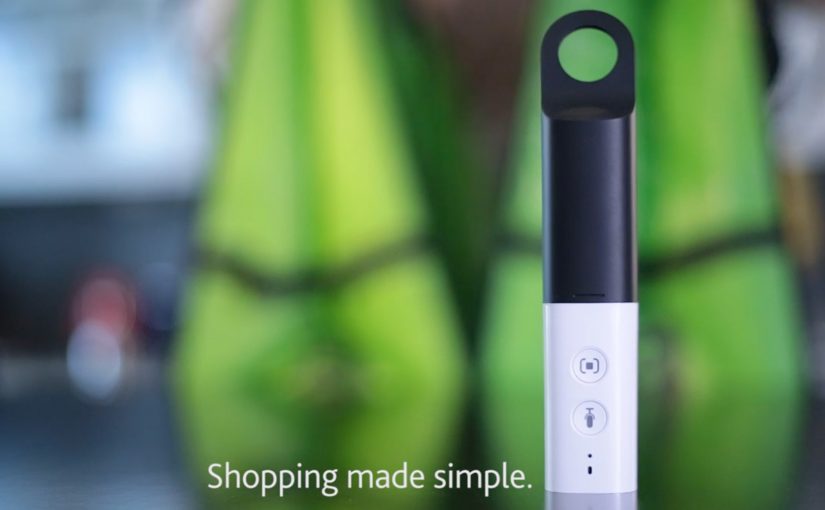
Amazon Dash: When Commerce Becomes a Button

A tiny button that quietly changes how buying works

When Amazon introduces Dash, it does not look like a revolution. No screens. No interfaces. No checkout flow.

Just a small physical button. One press. Reorder complete.

At first glance, Amazon Dash can feel like a gimmick. But in practice, it signals something more fundamental. A deliberate attempt to remove shopping itself from the act of buying.

What Amazon Dash does in the home

Amazon Dash, often described as the “Dash Button”, is a physical, Wi-Fi-connected button linked to a specific household product. Detergent. Coffee. Pet food. Batteries.

You place it where the need happens. On the washing machine. Inside a cupboard. Near the dog food bowl.

When you run out, you press the button. Amazon handles the rest.

No browsing. No comparison. No cart. No second thought.

Intent compression is the point, not the plastic

The button is not the story.

The real shift is intent compression. By intent compression, I mean collapsing need recognition, product choice, payment, and fulfillment into one trigger that requires almost no thought.

The real question is what happens to brand choice when reordering stops being a decision and becomes a reflex.

Dash is not a gimmick. It is a blueprint for default-setting commerce.

In replenishment categories like household essentials and other repeat-purchase goods, the winner is the brand or platform that becomes the default reorder, not the one that wins the next search.

Why “no interface” feels so good

Dash works because it removes cognitive load at the exact moment people are most willing to simplify. When a household runs out, the goal is not discovery. It is restoration. A one-press action fits the habit loop. Trigger, action, relief.

Extractable takeaway: If you can remove steps at the moment of need, you do not just improve conversion. You reshape behavior, because people repeat what feels effortless and reliable.

That same mechanism explains why Dash can feel uncomfortable. Accidental orders. Reduced price transparency. Loss of conscious choice. The discomfort is the point, because it reveals the boundary of how much control people will trade for frictionless convenience.

What Amazon is really buying with Dash

Dash compresses multiple steps. Need recognition. Product selection. Payment. Fulfillment. Into a single physical action.

Seen from that angle, Dash is less about buttons and more about locking demand upstream, before competitors even enter the consideration set.

Dash is also a learning system. It teaches Amazon about behavior, habit formation, replenishment cadence, and reorder economics, because the “moment of truth” becomes measurable and repeatable.

A signal to brands, not just consumers

For brands, Amazon Dash carries a subtle but powerful message.

If you win the button, you win the household. If you lose it, you disappear from the moment of need.

Traditional branding competes on shelves and screens. Dash shifts the battlefield into kitchens and cupboards. Physical presence becomes digital dominance.

Distribution is no longer only about visibility. It is about defaultness. Defaultness here means being the preselected choice a household reorders without revisiting the decision.

What to steal if you are not Amazon

The logic behind Dash is bigger than the hardware. Commerce keeps moving toward fewer decisions, fewer interfaces, more automation, and stronger platform pull.

  • Design for replenishment moments. Identify “run out” triggers and reduce the steps required to restore.
  • Compete for the default. Build experiences that make the second purchase easier than the first.
  • Make the trade-off explicit. Add lightweight safeguards (clear confirmations, simple cancellations, price-change visibility) so convenience does not feel like a trap.
  • Instrument the habit loop. Measure time-to-reorder, reorder frequency, and churn as first-class signals, not just conversion.
  • Protect trust. If the experience becomes invisible, reliability becomes the brand.

Sometimes, the future of shopping is just a button on a wall. The bigger story is what happens when buying becomes infrastructure.


A few fast answers before you act

Is Amazon Dash “just a button”?

No. It is a button plus an operating model that turns reordering into a near-automatic behavior.

What does “intent compression” mean in this context?

It means collapsing multiple steps. Recognize need, choose product, pay, and fulfill. Into one trigger with minimal deliberation.

Why does Dash matter even before voice becomes mainstream?

It proves the “no interface” ambition using a simple physical shortcut. It removes friction without needing new user behavior like talking to a device.

What is the strategic advantage for Amazon?

Dash moves competition upstream by capturing repeat demand before a shopper compares alternatives. That makes loyalty structural, not persuasive.

What is the core risk for brands?

If replenishment becomes default-driven, brands that are not the default become invisible at the moment of need, even if awareness is high.

What is the consumer downside, and what mitigates it?

The downside is reduced price awareness and accidental orders. Mitigations are clear confirmations, transparent price-change cues, and easy reversibility.
MTV Under The Thumb: second-screen TV for Europe

A social TV app that moves with you

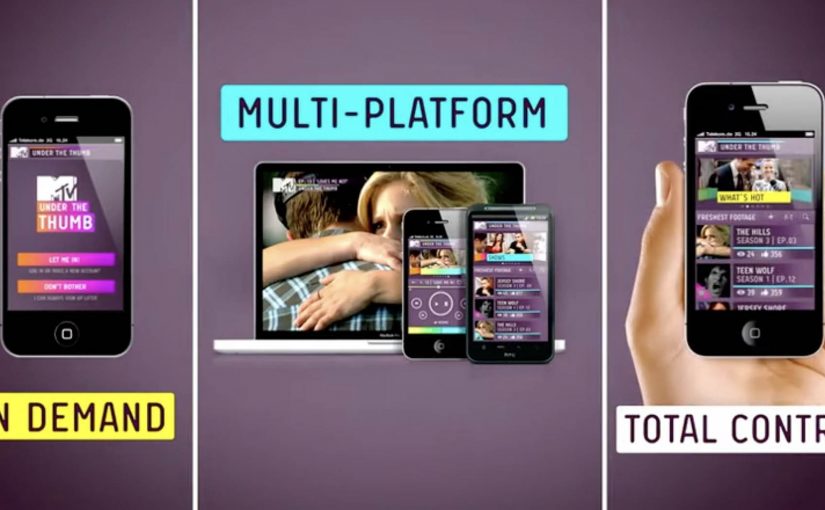
MTV’s Under The Thumb is positioned as an interactive platform that changes how Europe’s digital teenagers watch and share entertainment across devices.

One product, three viewing modes

When you’re out and about, MTV shows can be streamed on demand on your phone.

When you’re at home, the app turns into a remote control by pairing with a browser on a PC, laptop, or connected TV, so you can drive playback on a bigger screen from your phone.

When you’re feeling social, it syncs viewing with friends so you can watch the same show and chat together in real time, even when you are in different places.

Why the mechanism is the message

The “platform” claim only holds if the app earns repeat use in different contexts. The real question is whether it becomes a repeatable daily habit, not just a clever demo. Under The Thumb does that by bundling three habits into one interface: portable streaming, at-home viewer control, and co-viewing chat. Here, “second screen” means the phone acts as the controller while video plays on a larger display, and “co-viewing” means friends watch the same content in sync while chatting. That combination turns a media brand into something closer to a routine than a channel. This is a stronger product bet than treating second-screen features as a one-off gimmick.

Extractable takeaway: Under The Thumb combines on-the-go streaming, at-home phone-as-remote viewer control, and real-time co-viewing chat in one app, so the same service stays useful across the day.

In European youth entertainment, the phone is where attention, conversation, and control converge, even when video shifts to a bigger screen.

Launch momentum, before the ads even land

The app is unveiled at the Mobile World Congress in Barcelona. In the launch window, it is described as spreading fast among tech and TV audiences, with download velocity reported as strong even before MTV’s supporting advertising campaign fully kicks in.

For more visit www.mtvunderthethumb.com.

Second-screen patterns worth copying

  • Design for context switching. Keep the same service useful when people move from mobile bursts to a bigger screen at home.
  • Make viewer control the default. Let the phone run playback on the larger display so attention stays on the show, not on setup.
  • Layer in social without breaking flow. Sync co-viewing and chat so conversation stays aligned with what is on screen.

A few fast answers before you act

What is MTV Under The Thumb?

It is a social TV app for MTV that combines on-demand mobile streaming, second-screen remote control for larger displays, and co-viewing with chat.

How does the dual-screen remote feature work?

The phone pairs with a browser on a PC, laptop, or connected TV. Your phone then controls playback on the bigger screen while the service continues to run through the app experience.

What does “co-viewing” mean in this context?

Co-viewing means friends watch the same content at the same time while chatting in-app, with viewing synchronized so the conversation matches the moment on screen.

Why is this a smart move for a youth entertainment brand?

It follows real behavior. People watch in short bursts on mobile, shift to bigger screens at home, and want to talk while they watch. The app is designed to keep MTV present across all three situations.

What should product teams copy from this model?

Design for context switching. Make the same service valuable in multiple moments of the day, and give users clear viewer control plus a lightweight social layer that does not interrupt playback.

Mitsubishi: Test Drive From Your Browser

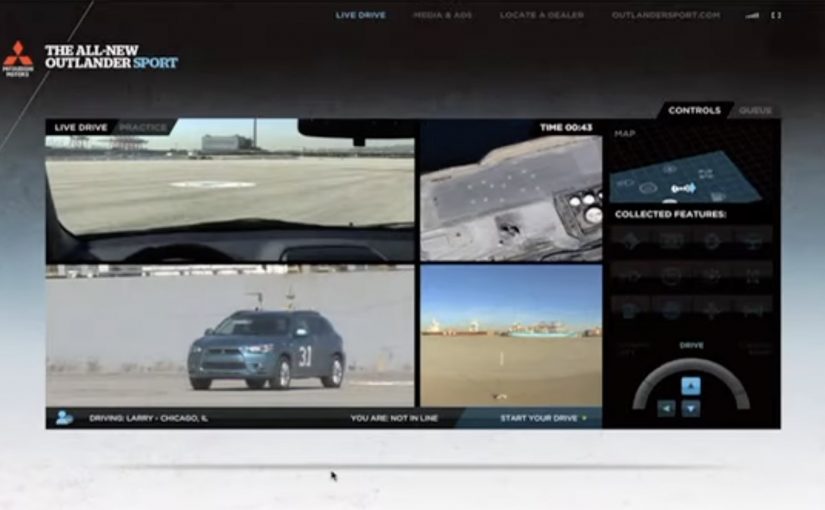
The future of test driving a car is here. 180/Los Angeles has hooked up the Mitsubishi Outlander Sport to a unique system allowing people to test drive it through their browser.

The interactive element, with the claim from the agency that it is the world’s first online test drive, is the first in a series of launch components in an integrated campaign that is running through January.

Working with production company B-Reel, 180 and Mitsubishi have developed a remote control system that will allow prospective buyers to take the Outlander Sport for a drive on a closed course, over the web.

Multiple cameras, in-car servos and GPS mapping, with the help of a robotics engineer, will keep the Outlander Sport on-course and responsive to online drivers’ commands.

Starting October 15th you can sign up (US residents only) for the test drive at www.outlandersport.com.

How the remote test drive is staged

The mechanism is a tight loop between live video and machine control. You watch the car from multiple camera angles. Your browser inputs translate into steering and pedal actions via servos. GPS mapping and safety logic keep the vehicle constrained to a closed course while still feeling responsive.

In automotive launches, reducing “dealership friction”, the time, travel, and commitment people associate with a showroom visit, is a reliable way to move people from curiosity to consideration.

Why it lands

This works because it reframes a test drive as an event. It is not only “learn about the car”. It is “drive it now” from wherever you are. That live control loop matters because the moment people see the car respond to their own inputs, the demo stops feeling like content and starts feeling like proof. The closed-course constraint does not weaken the idea. It actually signals seriousness, safety, and engineering intent.

Extractable takeaway: If you can let people control a real-world object remotely, even within strict guardrails, you turn a product demo into a personal story. That story is easier to share and harder to forget than a standard video.

What the campaign is really selling

Beyond features, this sells confidence in the brand’s relationship with technology. The real question is whether the launch gives people a reason to move from passive viewing to active participation. It also creates a strong reason to register and show up at a specific time. That turns passive awareness into an active lead moment without forcing an immediate dealership visit.

Steal this pattern

  • Make the product controllable: remote control, configurators, live demos. Anything that turns viewers into participants.
  • Use guardrails, not free-for-all: closed courses and constraints can increase trust and reduce risk while keeping the thrill.
  • Design for “I have to try this”: the premise should be understandable in one sentence and irresistible in the next.
  • Pair novelty with capture: registration and scheduling turn a stunt into measurable demand.
  • Ship proof, not promises: let the mechanism do the persuasion instead of piling on claims.

A few fast answers before you act

What is the “test drive from your browser” concept?

It is a remote driving experience where a real Mitsubishi Outlander Sport is driven on a closed course while participants control it over the web and watch via multiple cameras.

How does it stay safe and on-course?

The setup combines in-car servos, GPS mapping, and production controls that keep the vehicle constrained to a defined route while still responding to user commands.

Why do this instead of a normal video or configurator?

Because control changes attention. A controllable demo creates involvement, and involvement creates memory and sharing.

Is “world’s first online test drive” the important part?

It is the headline hook. The transferable value is the format: a real product experience delivered remotely with live feedback.

What is the main marketing benefit?

It turns awareness into action. People register, show up, and participate. That makes the launch measurable and builds intent without requiring an immediate dealership visit.