Volvo In-Car Delivery

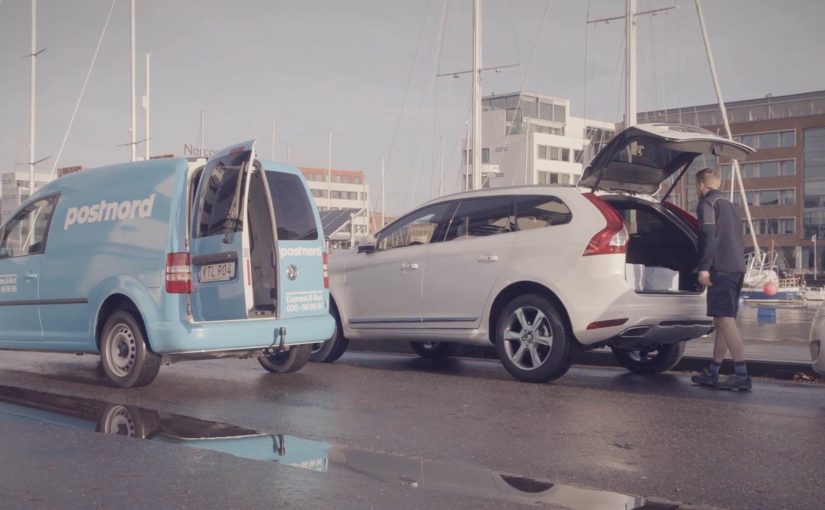
It is late November. You order groceries and Christmas gifts online. You park your Volvo somewhere in Gothenburg. While you are still at work, a courier finds your car, unlocks it once, drops the package into the boot, locks it again, and leaves. You receive a notification. When you drive home, your shopping is already waiting in your car.

That is the core idea behind Volvo’s in-car delivery service. It is available to customers who subscribe to Volvo On Call and live in Gothenburg, Sweden. For the Christmas period, deliveries come from two online retailers. Lekmer.com and Mat.se. PostNord handles the delivery. The courier uses a special one-time access digital key to open the car, place the package in the boot, and re-secure the vehicle.

Why “deliver to the car” is a bigger move than it sounds

At first glance, in-car delivery reads like convenience marketing. Skip missed deliveries. Avoid the “where is my package” loop. Reduce the need to be at home.

But the real shift is structural. The car becomes a secure delivery endpoint. Not your home address. Not a parcel shop. The vehicle itself.

That matters because it turns connected car capability into a service layer that can be monetized and extended. The value does not end when the car leaves the dealership.

The mechanism that makes it work

This service only becomes credible when the access model is precise. The logic is simple:

  • The courier does not get your physical key.
  • The courier gets a one-time digital key that grants limited access for a single delivery.
  • The car becomes the controlled handover point. The boot is the practical drop zone.

This is not “keyless” as a gadget feature. This is access as a managed entitlement, designed for commerce and logistics.

Why Volvo is telling a marketing story through engineering

Volvo often wins when the innovation is concrete and utility-driven. In-car delivery is exactly that. It is a clean demo of connected technology that saves time, reduces hassle, and fits real family behavior during peak shopping season.

The brand story is also clear:

  • Connected car tech is not an abstract dashboard feature.
  • It changes how everyday logistics works.
  • It makes the car useful even when it is parked.

That is a stronger narrative than “we have an app.” It is a capability that people can visualize immediately.

The strategic signal to other industries

In-car delivery is also a quiet message to adjacent ecosystems:

  • Retailers get a new delivery option that reduces failed deliveries.
  • Logistics players get a new category of secure handover.
  • Carmakers get a template for post-sale services that can scale through partnerships.

In short. Volvo is experimenting with moving beyond simply building and selling cars, by tapping into connected technologies that keep creating value after purchase.


A few fast answers before you act

Q: What is Volvo In-Car Delivery in one sentence?
A service that lets packages be delivered directly into your car using a one-time digital key, instead of delivering to your home.

Q: Who can use it in this pilot?
Customers in Gothenburg, Sweden who subscribe to the Volvo On Call telematics service.

Q: Which retailers and logistics partner are involved?
Online retailers Lekmer.com and Mat.se. Deliveries are handled by PostNord.

Q: What is the key innovation behind the experience?
A one-time access digital key that allows the courier to open the car for a single delivery and place goods in the boot.

Q: Why is this more than a convenience feature?
Because the car becomes a secure delivery endpoint. That turns connected car capability into a service layer and partnership platform.

Amazon Dash: The Button That Rewrites Loyalty

A one-click purchase is not the point. Default is.

Amazon Dash Button looks simple. A branded button you stick near the place of usage. You press it. The same item arrives again.

But the strategic move is not “one click.” It is making the reorder the default behavior.

Dash Button turns repeat buying into an ambient habit. It shifts commerce away from discovery and toward automation. It pushes the battle for the customer from the shelf and the screen to the home.

What the Dash Button does

Dash Button is a small connected device tied to one specific product, and often one specific pack size. You link it to your Amazon account. You place it where the need occurs.

Examples are obvious in everyday life:

  • Detergent button near the washing machine
  • Coffee button in the kitchen
  • Pet food button near the feeding area

When the product runs low, you press. Amazon confirms the order, typically via app notifications, and ships.

The experience is intentionally narrow. That narrowness is the innovation.

In consumer convenience products, loyalty is often less about love and more about default.

Why the narrowness matters

Dash Button removes three high-friction moments that brands fight over every day:

  1. Search. The customer does not type a query.
  2. Comparison. The customer does not see alternatives.
  3. Persuasion. The customer does not view ads, ratings, or promotions in the moment.

In other words, the customer does not shop. They simply replenish.

Once a household adopts replenishment behavior, the role of branding changes. The brand becomes less about persuasion and more about being the chosen default.

The hidden bet. Repeat purchases are the real moat

Dash Button is a physical expression of a platform strategy.

If Amazon captures replenishment categories, it wins the durable, high-frequency part of retail. The items that quietly drive recurring revenue and predictable logistics.

The button also functions as a data instrument. It reveals how often a household needs a product, where it is used, and which categories are truly habitual versus occasional.

That insight feeds subscriptions, predictive delivery, and future interface removal.

What this signals to CPG and retail leaders

Dash Button compresses marketing into an upstream decision.

The question is no longer “How do we win at the point of purchase?” It becomes “How do we become the configured default before the point of purchase even exists?”

For CPG leaders, this forces uncomfortable clarity on loyalty, pack architecture, trade visibility, and availability. For retailers, it signals a shift in power toward whoever owns the reorder interface.

The consumer tension. Convenience vs control

Dash Button introduces a trust tradeoff.

Consumers value convenience, but they also worry about accidental orders, loss of price checks, oversimplified choice, and dependence on a single platform.

Those tensions do not invalidate the model. They clarify what platforms must solve through better confirmations, clearer reorder states, and smarter replenishment rules.

The bigger story. Interfaces disappear

Dash Button fits a broader direction in commerce. Buying moves away from screens and toward contexts.

The pattern is consistent: less explicit shopping, more embedded intent, more automation, and more default-driven brand outcomes.

Dash Button is not the endpoint. It is an early, tangible step toward commerce that feels invisible.


A few fast answers before you act

What was Amazon Dash?

Dash was a physical reorder button that let customers buy a specific everyday product with one press, removing browsing and checkout steps.

What is the core mechanism?

Turning replenishment into a default action. One button equals one SKU. The interface collapses choice into speed and habit.

Why does this change loyalty dynamics?

Because the reorder interface becomes the brand decision. If the button exists, switching requires extra effort, so the default compounds over time.

What is the business intent?

Increase repeat purchase frequency and reduce churn by owning the replenishment moment and lowering friction to near zero.

What should other brands steal?

Design for the reorder moment. If your category is habitual, the winning move is to remove steps, make the default easy, and earn repeat behavior through convenience.

iBeacons: Context as the Interface

From proximity to context

iBeacons introduce a simple but powerful idea. The physical world can trigger digital behavior.

A smartphone does not need to be opened. A user does not need to search. The environment itself becomes the signal.

At their core, iBeacons enable proximity-based awareness. When a device enters a defined physical range, a predefined digital action can occur. That action may be a notification, a content change, or a service trigger.

The evolution is not about distance. It is about context.

What iBeacons enable

iBeacons are small Bluetooth Low Energy transmitters. They broadcast an identifier. Nearby devices interpret that signal and respond based on predefined rules.

This creates a new interaction model. Digital systems respond to where someone is, not just what they click.

Retail stores, public spaces, machines, and even wearable objects become programmable environments. The physical location is no longer passive. It actively participates in the experience.

Why proximity alone is not the breakthrough

Early use cases focus heavily on messaging. Push notifications triggered by presence. Alerts sent when someone enters a zone.

That framing misses the point.

The real value emerges when proximity is combined with intent, permission, and relevance. Without those elements, proximity quickly becomes noise.

iBeacons are not a messaging channel. They are an input layer.

From messaging to contextual experience design

As iBeacon use matures, the focus shifts away from alerts and toward experience orchestration.

Instead of asking “What message do we send here?”, the better question becomes “What should adapt automatically in this moment?”

This is where real-world examples start to matter.

Example 1. When a vending machine becomes a brand touchpoint

The SnackBall Machine demonstrates how iBeacons can turn a physical object into an interactive experience.

Developed for the pet food brand GranataPet in collaboration with agency MRM / McCann Germany, the machine uses iBeacon technology to connect the physical snack dispenser with a digital layer.

The interaction is not about pushing ads. It is about extending the brand experience beyond packaging and into a moment of engagement. The machine becomes a contextual interface. Presence triggers relevance.

This is iBeacon thinking applied correctly. Not interruption, but augmentation.

Example 2. When wearables make context portable

Tzukuri iBeacon Glasses enable hands-free, glance-based, context-aware information.

The Tzukuri iBeacon Glasses, created by Australian company Tzukuri, take the concept one step further.

Instead of fixing context to a location, the context moves with the person.

The glasses interact with nearby beacons and surfaces, enabling hands-free, glance-based, context-aware information. The interface does not demand attention. It integrates into the wearer’s field of view.

This example highlights a critical shift. iBeacons are not limited to phones. They are part of a broader ambient computing layer.

In modern product and experience design, “context” is slowly replacing “screen” as the interface.

Why these examples matter

Both examples share a common pattern.

The user is not asked to do more. The system adapts instead.

The technology fades into the background. The experience becomes situational, timely, and relevant.

That is the real evolution of iBeacons. Not scale, but subtlety.

The real evolution. Invisible interaction

The most important step in the evolution of iBeacons is not adoption. It is disappearance.

The more successful the system becomes, the less visible it feels. No explicit action. No conscious trigger. Just relevance at the right moment.

This aligns with a broader shift in digital design. Interfaces recede. Context takes over. Technology becomes ambient rather than demanding.

Why iBeacons are an early signal, not the end state

iBeacons are not the final form of contextual computing. They are an early, pragmatic implementation.

They prove that location can be a reliable input. They expose the limits of interruption-based design. They push organizations to think in terms of environments rather than channels.

What evolves next builds on the same principle. Context first. Interface second.


A few fast answers before you act

What are iBeacons in simple terms?

iBeacons are small Bluetooth Low Energy transmitters that let phones detect proximity to a location or object and trigger a specific experience based on that context.

Do iBeacons automatically track people?

No. The experience usually depends on app presence and permissions. Good implementations make opt-in clear and use proximity as a trigger, not as silent surveillance.

What is the core mechanism marketers should understand?

Proximity becomes an input. When someone is near a shelf, a door, or a counter, the system can change what content or actions are offered, because the context is known.

What makes a beacon experience actually work?

Relevance and timing. The action has to match the moment and reduce friction. If it feels like random messaging, it fails.

What is the main takeaway?

Design the experience around the place, not the screen. Use context to simplify choices and help people complete a task, then measure behavior change, not opens.