
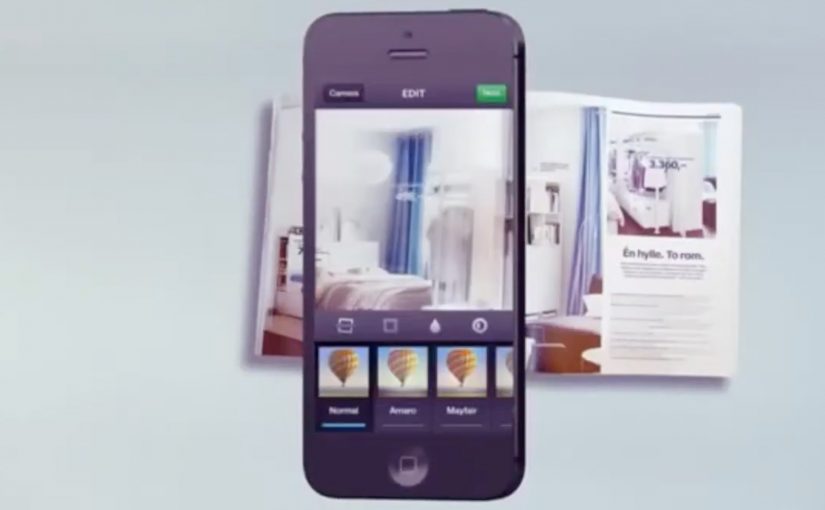
Ikea Social Catalogue

IKEA has been innovating every year with their classic paper catalog. In Norway they decide to take this classic paper catalog and make a social media version of it. With zero budget, they ask their 130,000 Facebook and Instagram fans to post the page of their favourite product on Instagram and add the hashtag #ikeakatalogen, for the chance of winning that product.

How the Social Catalogue works

The mechanic is intentionally lightweight. Here, “mechanic” means the single action IKEA asks for. One public photo of a catalogue page plus one hashtag. IKEA asks fans to pick their favourite item from the catalogue, photograph the page, and post it publicly so the product becomes discoverable through personal networks. Over time, more and more items get documented and shared by real people, effectively recreating the catalogue as a social feed.

In retail and consumer brands with large owned distribution like catalogues, the cheapest growth loops come from turning existing browsing moments into public signals.

The real question is whether your owned channel can become a prompt people want to publicly share, instead of a one-way broadcast they only consume.

Why print is the trigger, not the limitation

Most brands treat print as a one-way broadcast. Here, print is the starting gun. The physical catalogue becomes the prompt that drives people online, and the content that fuels sharing is already in consumers’ hands. Print is not the limitation. It is the trigger when you design the handoff into social indexing.

Extractable takeaway: If you can turn an owned, offline touchpoint into a simple public posting behaviour, you get both social proof and a self-building product index without paying for equivalent distribution.

The growth loop is built into social behaviour

The “social” part is not a slogan. It is distribution mechanics. The hashtag makes individual posts browsable beyond the poster’s own network, so every new post increases discoverability for the next one. When someone posts their chosen page, their network sees it. That drives curiosity, repeats the behaviour, and compounds reach without buying equivalent media.

What to steal

  • Use an owned asset as the trigger. The catalogue is already shipped. The campaign rides that distribution.
  • Make participation effortless. One photo and one hashtag, then you are in.
  • Let the audience do the indexing. Fans effectively organise and surface products through what they choose to share.
  • Reward desire, not trivia. The prize is the exact thing the person already wants.

A few fast answers before you act

What is the IKEA Social Catalogue?

A campaign that turns the printed IKEA catalogue into a social feed by asking people to photograph and share their favourite pages with #ikeakatalogen for a chance to win the featured product.

What is the core behaviour it uses?

People naturally share things they want. The campaign turns that impulse into distribution and product discovery.

What does the hashtag do in this mechanic?

It collects individual posts into one browsable stream, so products stay discoverable beyond the original poster’s friends and followers.

Why is this effective for retail?

Because it turns product browsing into social proof, and social proof into incremental reach, without asking people to learn a new behaviour.

What is the simplest version to replicate?

Pick one existing owned channel, define one shareable action, and reward the exact item the person publicly chooses.

Media Markt “Money Trucks”

A security team clears the street in a quiet neighborhood. Neighbors step outside. Then a tiny convoy rolls in. 193 miniature “money trucks”, each loaded with 1-cent coins, drives up to the winner’s home and unloads one million cents into a growing pile in the driveway. It is a cash delivery staged like a movie scene, except the payoff is real.

The idea in one line

Celebrate a social milestone by turning “one million” into a physical spectacle people can watch, share, and retell.

What Media Markt does to mark 1 million Facebook fans

Over the last couple of years I have seen a handful of brands reach the 1 million fans milestone. To celebrate, most of them create really nice and innovative thank-you videos. A good example is Tic Tac “Likes” Matt. Media Markt hits the same milestone, but takes a very different route. It turns the number into a physical stunt people can watch, share, and retell.

Media Markt on reaching 1 million fans on Facebook launched a contest: “How many small trucks do you need to transport 1,000,000 cents?” The activation was created by Ogilvy & Mather Frankfurt.

The business intent is simple: turn a fan milestone into participatory attention that travels beyond the Facebook page itself.

How the campaign plays out

Step 1. Start with a guess that feels simple and sticky

The mechanic is deliberately basic: one question, one number, one prize framed as a million small units. It is easy to participate, and easy to share.

Step 2. Make the prize physically absurd

The winner does not receive a bank transfer. She receives €10,000 as 1-cent coins, delivered using the exact number of miniature trucks the contest asks people to estimate.

Step 3. Turn delivery into content

The delivery is filmed as a “cash-in-transit” moment: security clearing streets, convoy arriving, coins dumped into a heap. The documentation becomes the story asset that travels beyond Facebook.

In retail and mass-market marketing, milestone campaigns travel further when the audience can see the scale in the real world, not just read the number on a screen.

The numbers that make it feel “earned”

  • The correct answer is 193 trucks.
  • The winner is in Saßmicke (western Germany), and the stunt is played as a neighborhood event, not a private handover.

Why it works

This works because the mechanic turns an abstract fan count into a visible, countable spectacle people can grasp in seconds.

Extractable takeaway: If a brand milestone matters to you, convert it into a physical event with one simple unit people can instantly understand and retell.

It converts an online number into a physical reality

“One million fans” is abstract. One million coins is instantly legible, and the convoy makes the number feel even bigger.

The stunt is engineered for repeatable media beats

Announcement. Guessing phase. Winner selection. Convoy “journey” updates. Final delivery video. The campaign creates multiple moments people can follow, not one single post.

It is brand-consistent in one glance

Electronics retail competes in a world of deals and hype. This behaves like a deal, but acts like a story. The spectacle fits the loud, “big gesture” brand posture without needing product claims.

The deeper point

The real question is how to turn a passive social milestone into a public event people want to witness and retell.

This is a better move than another thank-you video because it makes participation and spectacle do the distribution work.

If you want people to care about a community milestone, do not announce the number. Stage the number. Make it participatory, then make the payoff visual enough that the community wants to distribute it for you.

How to stage a milestone people retell

  • Turn a milestone into a game: “1 million fans” becomes a concrete challenge with one guessable number.
  • Make the prize a proof object: Delivering “1 million cents” as physical trucks makes the claim visual and press-friendly.
  • Use a single, memorable unit: “Cents” is simple. People instantly understand the scale without explanation.
  • Let the reveal be the content: The answer plus the delivery moment is the story, not a brand speech.
  • Design for retelling: If someone can summarize it in one sentence, it will travel.

A few fast answers before you act

What is the campaign mechanic?

A Facebook contest asks fans to guess how many miniature trucks are needed to transport one million cents.

What is the actual prize?

€10,000 delivered as 1,000,000 one-cent coins, transported by 193 miniature trucks.

Why does the “193 trucks” detail matter?

Because it closes the loop. The answer is not just “correct”. It becomes the logistics and the spectacle of the payout.

Who creates the campaign?

Ogilvy & Mather Frankfurt.

What is the reusable pattern?

Turn a social milestone into a simple prediction game, then make the reward delivery so visual that it becomes the main distribution asset.

IKEA Klippbok

IKEA Australia wanted to create a utility that IKEA customers could regularly use to help inspire them in their home. So they created an iPad app called Klippbok (Swedish for “scrapbook”) that gave users access to IKEA products all year round. With easy-to-use design functionality, users were able to mix and match IKEA products and create collages, swatchbooks (material and color sample sets), roomsets (simple room mockups) and more.

Making inspiration feel hands-on, not aspirational

The mechanism is straightforward. You drag IKEA products into a blank canvas, experiment with combinations, and build a visual “plan” you can refine over time. It takes the part people enjoy most in-store, imagining how it could look at home, and makes it repeatable on a device. Because the output is something you can revisit and refine, the interaction is more likely to earn repeat use.

In retail marketing, the strongest “always-on” utilities are the ones that turn browsing into making.

By “always-on utility”, I mean a tool customers can use between campaigns, not a one-off catalogue drop.

Why the scrapbook metaphor is the right UX

Calling it a scrapbook is not just a name. It sets expectations. This is playful, remixable, and personal. That framing lowers the pressure of “designing a room” and replaces it with “trying ideas”, which is a much easier behavior to sustain. This framing choice is the right move when the goal is repeatable inspiration, not a single perfect plan.

Extractable takeaway: If your tool makes “show someone” the natural next step, build sharing into the flow, because that social loop turns a private utility into a brand platform.

Business intent: stay present between store visits

Klippbok’s real job is frequency. Instead of only showing up when a catalogue drops or when someone is already planning a store run, the app gives IKEA a year-round touchpoint that keeps products in consideration while customers are still forming preferences.

The real question is whether your utility gives customers a reason to return when they are not yet in buy mode.

Reported outcomes and craft credits

The app was created by The Monkeys and built by Nomad. In industry reporting around the work, Klippbok is credited with roughly 53,000 downloads across 100+ countries and reaching number two in the Australian iTunes Lifestyle category.

What to steal if you want customers to return regularly

  • Turn your range into a creative system. Let people assemble, not just browse.
  • Design for quick wins. Fast collages beat perfect room planners for repeat usage.
  • Make sharing a native next step. If “show someone” is easy, your users do your distribution.
  • Build for year-round relevance. Inspiration tools age better than campaign landing pages.

A few fast answers before you act

What is Klippbok, in plain terms?

Klippbok is an IKEA iPad app that lets people create mood boards, collages, swatchbooks, and roomsets using IKEA products, so they can plan and experiment with home ideas.

Why does an inspiration app matter for a retailer like IKEA?

Because the purchase journey is rarely one session. If you can keep customers playing with ideas between store visits, you stay in the consideration set longer and influence what ends up on the shopping list.

What is the key mechanism that drives engagement?

Drag-and-drop creation. The user is making something of their own, not consuming content, which increases time spent and makes sharing more likely.

What is the biggest mistake with “catalogue as app” launches?

Copying print into a screen. The app has to behave like a tool, not a PDF, or it will not earn repeat use.

How do you measure whether an inspiration app is working?

Return frequency, creation rate, share rate, and the percentage of users who save or revisit projects. If you can connect it, track downstream indicators like store visits or product adds-to-list after app sessions.