
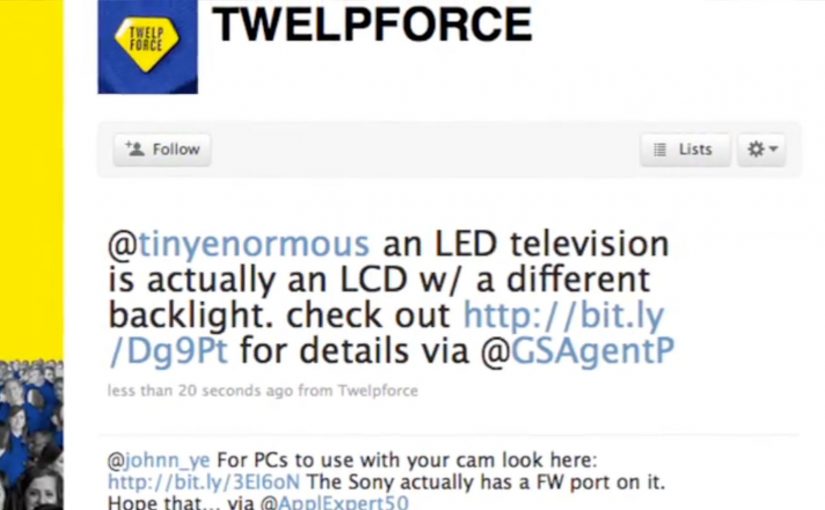
Best Buy: Twelpforce on Twitter

Here is a truly new-age way of addressing customer needs in real time by harnessing Twitter. Instead of pushing promotions, Best Buy puts help in the timeline and lets customers pull value when they actually need it.

A help desk that lives in public

Twelpforce is built on a simple premise. Twelpforce is Best Buy’s Twitter-based customer support program, built to connect customer questions with employees who can answer them. The people who know the answers are already inside the company. Put them on Twitter, let them respond directly, and make the answers visible to everyone else with the same question.

It turns customer service into a living knowledge base. Every reply is both a resolution for one person and reassurance for the next hundred who are watching.

How Twelpforce works

The mechanic is straightforward:

  • Customer asks a question on Twitter.
  • Trained employees respond in real time from within their area of expertise.
  • The conversation stays public, so answers become searchable and shareable.
  • Trust compounds, because the brand is seen helping, not just selling.

In consumer electronics retail, service is often the fastest signal of trust and competence.

The real question is whether public, real-time help can build more trust than another stream of promotional posts.

Why it lands: help is a stronger hook than hype

Most brand communication tries to create desire. Twelpforce starts with a different human truth. When something breaks or confuses you, you want a competent person, quickly. The campaign meets that moment and makes the brand useful on demand. This is a stronger brand move than another promotional burst, because visible help makes expertise tangible at the exact moment of need.

Extractable takeaway: If your category creates frequent questions, treat support as a scalable content engine. Public answers reduce repeat effort, improve perceived expertise, and create credibility that paid media struggles to buy.

That publicness is the multiplier because one useful answer reduces uncertainty for the asker and for everyone else who sees it. A private call solves one case. A public answer signals, repeatedly, that the brand shows up when it matters.

Recognition that follows the idea

The campaign is credited to Crispin Porter + Bogusky for Best Buy. It goes on to win a Gold Clio Award in Interactive, under the “Innovative Use of Technology” category.

What to steal for your own social support play

  • Design for repeat questions: build templates and escalation paths so answers stay fast without becoming robotic.
  • Make expertise discoverable: route topics to specialists, not a generic handle that slows everything down.
  • Write for the invisible audience: every reply should help the original asker and anyone who finds it later.
  • Set clear guardrails: define what can be solved publicly and what must move to private channels.
  • Measure more than volume: track time-to-first-response, resolution rate, sentiment shift, and deflection of repeat issues.

A few fast answers before you act

What is Twelpforce in one sentence?

It is a Twitter-based customer help program where employees answer questions publicly in real time, turning support into a visible brand asset.

Why does public support change the marketing equation?

Because every answered question doubles as proof. People trust what they see a brand do for others, especially when the moment is unscripted and timely.

What makes this “interactive” rather than just social posting?

The customer initiates the experience with a question, and the brand responds in a two-way exchange that creates a usable outcome, not just awareness.

What is the biggest operational risk?

Inconsistency. If response times, tone, or accuracy vary widely, the same public visibility that builds trust can also expose gaps.

How do you know if a program like this is working?

Look for faster response times, high resolution rates, fewer repeated questions, improved sentiment, and a growing perception that the brand is genuinely helpful.
3D Holograms: Two Marketing-World Examples

3D holograms are a great way to attract and engage consumers. Here, “3D holograms” refers to hologram-style displays that use animation to create a depth illusion in a physical setting. They can be quite effective if your brand is having trouble getting noticed or if your product’s capabilities can best be described using images and animation.

Though brands find it daunting to venture into this, there are still some brands out there bold enough to try it. Here are some nice examples.

Why holograms can cut through

The strength of a hologram-style display is that it behaves like moving product theater. Because it behaves like moving product theater, it can stop people mid-walk, and it can compress a lot of “show, do not tell” explanation into a few seconds. In retail aisles and brand events, it competes against the surrounding noise, not against other media placements.

Extractable takeaway: Use depth and motion only when they reduce explanation time or make the core action instantly legible. If depth is not doing work, you are paying for novelty.

The real question is whether motion plus depth makes the story easier to grasp than a flat screen or static print. When the answer is yes, the format can earn attention fast.

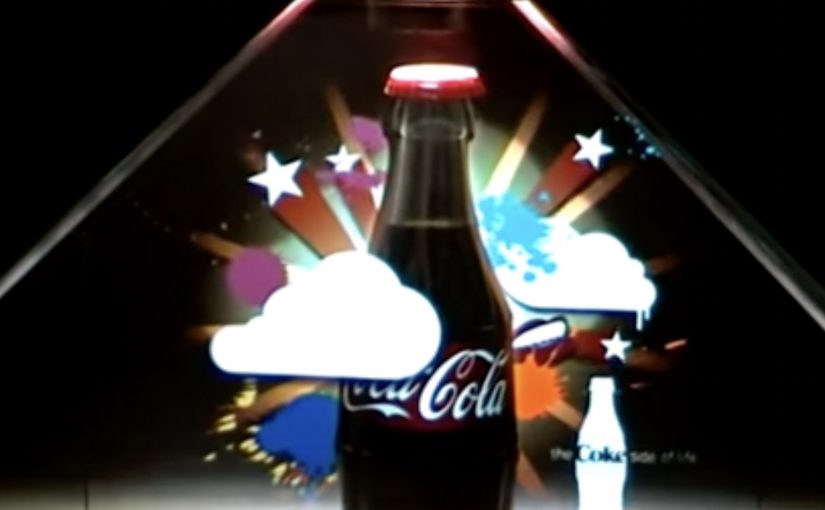
Coca Cola In-Store Display

This example shows how a hologram-style display can work as an in-store attention magnet. The content is pure visual storytelling, which makes it easy to understand at a glance and easy to remember later.

Samsung Jet Launch

At launches, holograms can do a different job. They help dramatize product capability and create a sense of spectacle that standard stage content often struggles to match. That spectacle then becomes a shareable proof that something “big” happened.

What to steal if you are considering holograms

  • Pick one message that benefits from depth. If depth is not doing work, you are paying for novelty.
  • Design for walk-by comprehension. People should get it in under three seconds.
  • Keep the loop tight. Short, repeatable sequences beat long narratives in retail and event contexts.
  • Make the hero action visible. If the product feature is the star, animate that feature, not abstract brand graphics.

A few fast answers before you act

When do 3D hologram displays make sense for marketing?

When you need fast attention in a physical space, or when animation plus perceived depth explains the product better than flat media.

What is the main advantage over a normal screen?

Presence. The illusion of depth makes the content feel more like an object in the space, which can increase stop power and recall.

What is the biggest execution risk?

Paying for the format without a story that needs it. If the creative is not designed around depth and motion, the result feels like expensive wallpaper.

How should success be measured?

Dwell time, footfall impact near the unit, assisted recall, and any downstream action that matters to your context, like store inquiry, trial, or social amplification.

What is a practical way to keep cost under control?

Start with one hero unit and a short content loop, then scale only if you can prove incremental attention and understanding versus simpler formats.

BrandAlley: Oxford Circus FlashWalk

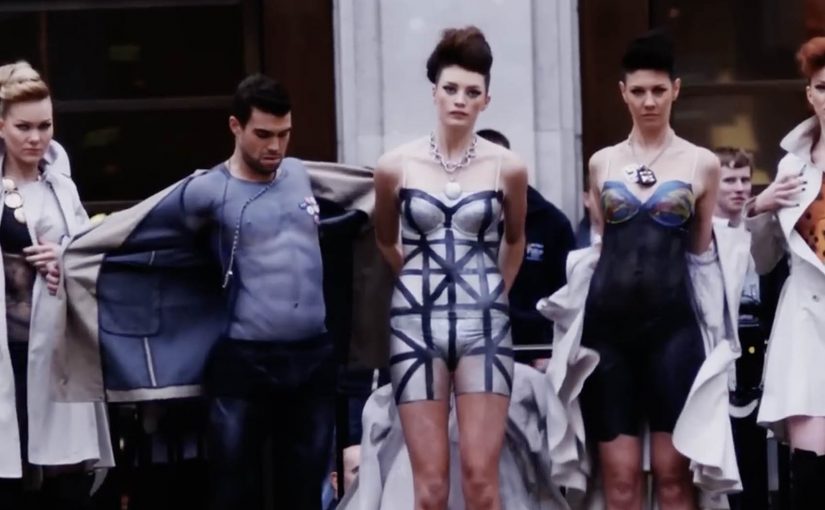
Shoppers hit Oxford Circus and suddenly the crossing becomes a runway. A quick catwalk appears, cameras come out, and the crowd freezes because this is not what people expect in the middle of a busy high street.

BrandAlley’s FlashWalk, a pop-up runway walk staged in public, uses a simple escalation. Models walk a catwalk route in public, styled with body paint rather than clothing, and the spectacle does the rest. It is designed to stop people mid-stride and turn street attention into store intent.

Why this breaks through retail clutter

In high-footfall retail streets, the strongest activations turn a familiar place into a short, unmistakable moment that people feel compelled to witness. Most retail messages compete on price and repetition. This competes on surprise. The catwalk format is instantly readable, so the idea does not need explanation. The audience understands what is happening in seconds, then stays for the contrast between a polished runway and an everyday street.

Extractable takeaway: If you can turn a familiar public space into an instantly recognisable format, you can earn attention before you spend on persuasion.

What BrandAlley is really buying

The real question is whether the moment gives people a story they want to repeat immediately. This is a footfall play built on earned attention. The real “media” is the crowd that gathers, the photos that get taken, and the story people tell immediately afterwards. The brand gets remembered because the moment was unusual, not because the copy was persuasive. If you can stage it safely and legally, a live street moment beats another static poster for first-time attention.

How to turn a street moment into footfall

  • Pick a location that already concentrates your audience. If the street is busy, your stunt scales faster.
  • Use a format people recognise instantly. A catwalk reads at a glance, which reduces friction.
  • Design for documentation. If the crowd films it, distribution becomes automatic.
  • Link the spectacle to a clear next step. The moment should point to the store or the sale without needing a second campaign to explain it.

A few fast answers before you act

What is the BrandAlley Oxford Circus FlashWalk?

It is a street-level catwalk stunt at Oxford Circus designed to stop passers-by and drive attention and footfall to BrandAlley, using a runway-style “flash walk” moment.

Why use a catwalk format for retail marketing?

Because it is instantly legible. People understand “runway” without instructions, so the stunt grabs attention fast and creates a crowd effect.

What makes this different from a typical outdoor ad?

Outdoor ads ask you to notice. This asks you to watch. The experience turns the street into the medium, which tends to generate photos, sharing, and conversation.

What is the biggest risk with shock or surprise stunts?

If the spectacle does not connect back to the store or the offer, you get attention without action. The link to the retail goal must be obvious on the day.

When does a footfall stunt outperform a discount campaign?

When you need cut-through, not only conversion. A stunt can reintroduce the brand to people who have tuned out price noise, then the offer does its job afterwards.