
Yellow Pages: Location Based Banner

Here is the next generation of interactive web banners. Tel Aviv agency Shalmor Avnon Amichay/Y&R promoted the Yellow Pages augmented reality location-based app by creating a banner that does the same thing. Here “location-based” means it surfaces nearby businesses based on where you are.

The banner opens your webcam and lets you see the businesses around you. Wave your hand to switch between businesses. Click a business to jump straight to its Yellow Pages listing.

A banner that behaves like the product

The clever part is that this is not “interactive” for decoration. It is a working demo of the core value proposition. If the app helps you find what is near you, the banner proves that promise immediately, inside the placement, without asking you to imagine anything. Utility products should be advertised by demonstrating usefulness, not by describing features.

The mechanic: webcam as context, hand wave as UI

The flow is intentionally simple. Turn on the camera. Overlay nearby business options. Use a wave to move through results. Use a click to convert curiosity into action via the listing page.

In local discovery experiences, the strongest persuasion is a live, context-matched preview of usefulness rather than a feature claim.

Why it lands: it removes the “so what” gap

Most directory and local-search advertising dies in the space between promise and proof. The real question is whether your ad can turn a promise into proof without leaving the page. This banner collapses that gap, because it starts with your own context, then shows results, then lets you act. The interaction is the explanation.

Extractable takeaway: The fastest way to make a utility app feel essential is to let people experience the “aha” moment before they ever leave the page they are on.

What Yellow Pages is really trying to achieve

The business intent is to reposition Yellow Pages as modern, digital, and situationally useful, not just a legacy directory brand. The banner also creates a clear performance path. Engagement inside the unit, then click-out to a listing that can drive calls, visits, or follow-on app consideration.

Steal the demo-first local discovery pattern

  • Mirror the product in the ad. If the product is a tool, make the ad behave like the tool.
  • Use one gesture people understand. A wave as “next” is instantly legible. No tutorial needed.
  • Keep the ladder of commitment short. Preview. Browse. Click through. No extra steps.
  • Make the experience readable for bystanders. Obvious motion plus clear on-screen change sells the mechanic in shared environments.
  • Watch privacy optics. If you turn on a camera, be explicit that it is for interaction and context, not identification.

A few fast answers before you act

What is a “location based banner”?

It is a banner ad that adapts its content to the user’s situation, typically location or environment cues, so the ad can show relevant nearby options instead of generic messaging.

How does this Yellow Pages banner work?

It opens a webcam view, overlays nearby business options, lets you wave to cycle through businesses, and lets you click a result to open the corresponding Yellow Pages listing.

Why use a webcam at all?

Because it makes the experience feel immediate and personal. The ad becomes a live “finder” interface rather than a static claim about finding things.

What makes gesture-controlled banners risky?

Friction and variability. If the gesture detection fails or is unclear, users assume the ad is broken. The interaction must be forgiving and the feedback must be instant.

What is the safest way to replicate the idea today?

Keep the mechanic to one simple input, provide clear on-screen feedback, and ensure the user can still get value even if they do not enable the camera.

The Expendables: YouTube Takeover

This is the latest campaign element for the launch of The Expendables movie. A YouTube takeover that plays like an “interrupted interview” with Sylvester Stallone, where the film breaks into the page and turns the platform itself into part of the spectacle. In campaign terms, a YouTube takeover is a custom page experience that changes how the video and surrounding interface behave, so the platform becomes part of the creative, not just the player.

The fun is in the escalation. What starts like a normal promo interview quickly flips into a chaotic on-page moment, with the surrounding YouTube environment becoming the canvas for the film’s tone. It is not just a trailer. It is a takeover that behaves like a scene.

When the page is the stage

The mechanic is simple to understand and hard to ignore. The interview drives the narrative, but the “takeover” is the real payload. The experience makes YouTube feel temporarily owned by the movie, which is exactly what you want on launch week when everything competes for attention.

It also sidesteps the usual ad fatigue problem. People do not feel like they are being “served” something. They feel like they discovered a disruption, and discovery is what drives sharing.

In blockbuster entertainment marketing, interactive takeovers work best when they turn passive viewing into a moment of viewer control that still feels native to the platform.

Why interruption works better than interruption marketing

Most pre-roll is an interruption that people resent. This is an interruption that people watch because it is designed as entertainment first. The twist is that the platform is part of the joke, so the format is the message. It also gives viewers a clean decision point. Keep watching because it is funny. Close it because you are not interested. Either way, the brand moment is delivered fast.

Extractable takeaway: If you must interrupt, make the interruption itself entertaining and easy to exit, so attention feels chosen instead of imposed.

What the studio is really buying

The business intent is talkability at scale. A standard trailer competes with every other trailer. A takeover creates a story about the trailer. That distinction is what earns press pickup and social forwarding without requiring extra explanation.

The real question is whether your launch asset creates a platform-native story people can retell in one sentence, not just another piece of media to skip.

For a short, noisy launch window, a platform-native takeover is the stronger play than adding more standard trailer impressions.

Short-window launch moves to copy

  • Make the format do the selling. If the medium changes, people lean in.
  • Build a one-sentence retell. “Stallone destroys YouTube during an interview” is easy to repeat.
  • Use escalation. Surprise, then bigger surprise, then payoff.
  • Stay platform-native. The takeover should feel like it belongs on that site, not pasted onto it.

A few fast answers before you act

What is a “YouTube takeover” in campaign terms?

It is a custom YouTube page experience that changes how the video and surrounding interface behave, so the platform itself becomes part of the creative, not just the player.

Why does the “interrupted interview” trope work so well?

Because it starts in a familiar format, then breaks the rules quickly. The contrast creates surprise, and surprise is the fastest path to attention and sharing.

What is the main advantage over running a normal trailer?

A normal trailer is content. A takeover is content plus a story about the content, which increases earned pickup and social forwarding.

What is the biggest risk with platform takeovers?

Annoyance. If the takeover feels forced, slow, or hard to exit, people turn against it. The experience needs to be quick, optional, and satisfying.

What should you measure for a takeover?

Completion rate, replay rate, and earned mentions. If people describe the mechanic accurately when they share it, the concept is working.

Lexus LFA: Scrollbroaaaar

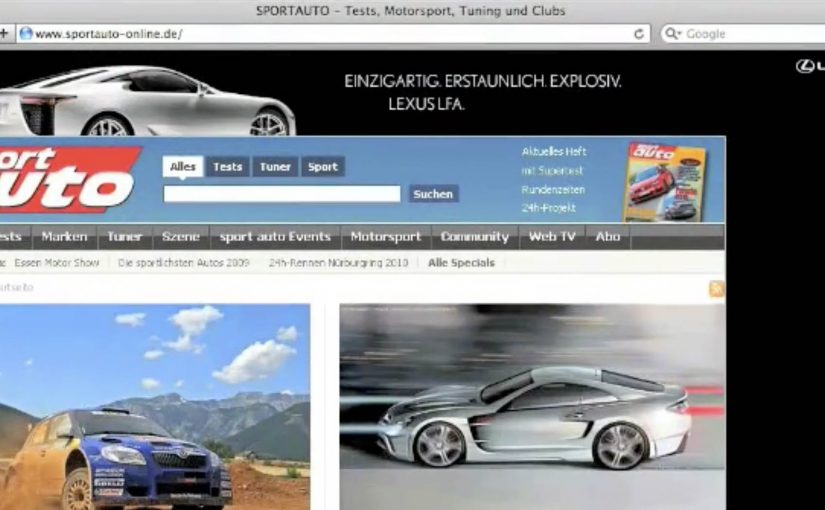
Saatchi & Saatchi Germany has created a clutter-breaking execution for the Lexus LFA on the Sport Auto website by turning a familiar interface element into the ad itself.

When the ad is the interface

The idea is disarmingly simple. Instead of fighting for attention inside a banner slot, the execution is described as a custom scrollbar experience on Sport Auto, shifting the user’s focus to the one thing everyone touches when they move through a long page.

How “Scrollbroaaaar” works

Mechanically, the work hijacks the expected behavior of scrolling and reframes it as a brand moment for a high-performance car. The name “Scrollbroaaaar” signals the point. Here, “Scrollbroaaaar” means the scrollbar itself becomes the branded ad unit. Scrolling becomes a sensory cue for speed and engine attitude, not just a way to navigate content.

In performance automotive marketing, using interface behavior as media can outperform traditional display formats because the user triggers the moment themselves.

The real question is whether you can turn a default UI habit into branded sensation without stealing time from the content.

Why it lands as clutter-breaking

This works because it does not ask for permission. It meets the user inside muscle memory. A scrollbar is invisible until it changes. The second it does, attention spikes. That moment of surprise is the whole value exchange.

Extractable takeaway: If you can attach your product truth to a UI habit the audience already performs, you get attention without demanding a click.

What the brand is really buying here

Beyond impressions, the intent is distinctiveness. Lexus gets a “did you see this” story that is native to the environment where car enthusiasts already browse. The experience also borrows the credibility of a specialist publisher context while keeping the brand in control of the punchline. This is a smarter bet than buying another standard display slot and hoping anyone notices.

What to steal for your own digital creative

  • Make the interaction the media. If a user action triggers the payoff, recall tends to be higher than passive formats.
  • Choose the smallest possible hack. One altered UI element can be more powerful than a page full of widgets.
  • Design for surprise, then exit fast. The novelty works best when it is immediate and does not overstay.
  • Match the mechanic to the product truth. Speed, sound, and control cues belong to a halo performance car.

A few fast answers before you act

What is “Scrollbroaaaar” in one line?

A web takeover that turns the page’s scrollbar into the ad, so scrolling itself becomes the Lexus LFA moment.

Why is it considered clutter-breaking?

Because it bypasses banner blindness by changing a core interface behavior users already rely on, creating instant surprise and attention.

What is the main creative principle behind it?

The principle is viewer control. The user’s action triggers the brand payoff instead of asking them to click away from what they came to do.

When should you use this pattern?

When you have a simple product truth that can be expressed through a single behavior change, and you want memorability more than message density.

What is the biggest risk with interface-as-ad?

If the mechanic slows the page, breaks expected controls, or feels like it traps the user, the surprise turns into frustration and the brand pays for it.