
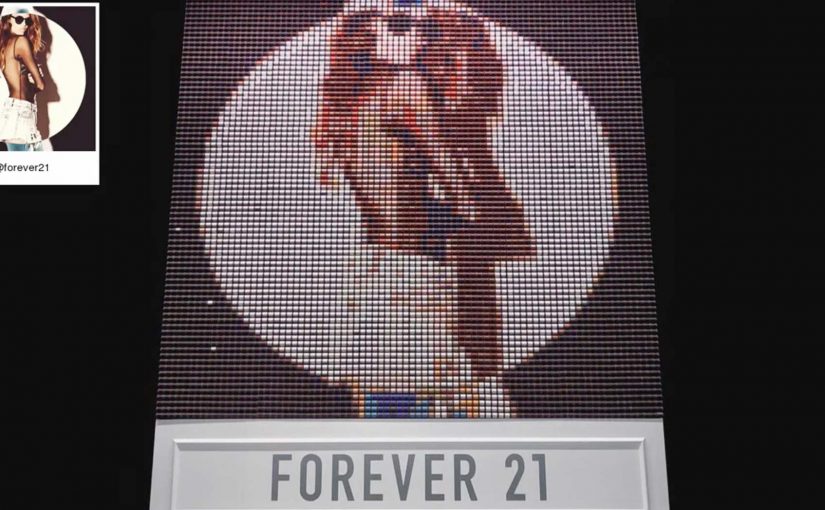
Instagram Powered Thread Screen by Forever 21

The F21 Thread Screen is a 2,000 pound machine that uses 6,400 mechanical spools of thread to display Instagrams hashtagged with #F21ThreadScreen. Melding fashion and technology, the Thread Screen is truly beautiful and unique. Hashtag an Instagram of you and your friends and see yourselves in a way unlike anything you’ve seen before…

Why this installation is so compelling

The idea is simple. Post with a hashtag. But the output is unexpected. Instead of a screen showing pixels, you get a physical, mechanical interpretation that feels handcrafted, even though it is powered by a heavy machine.

  • Digital input, physical output. A social post becomes a tangible display.
  • Participation is effortless. The only requirement is a hashtag, which fits existing behavior.
  • It creates a new kind of “share”. People share twice. First on Instagram. Then again when the installation shows them back in a surprising format.

The reusable pattern

Take a familiar social mechanic and change the medium of the reward. When the payoff is materially different from what people expect, it increases curiosity, dwell time, and the likelihood that participants bring others to see it.


A few fast answers before you act

What is the Forever 21 Thread Screen?

It is a large-scale mechanical installation that uses thousands of thread spools to display Instagram posts tagged with #F21ThreadScreen as a physical, moving thread-based image.

How does a visitor participate?

They post an Instagram photo with the hashtag #F21ThreadScreen, which the installation then pulls into the display.

Why is this effective for retail and fashion brands?

It turns social participation into an in-store spectacle, giving people a reason to engage, watch, and share again from the physical experience.

What is the key takeaway?

Do not just “display social”. Transform it. The more unexpected the medium, the more memorable the experience becomes.
Ford Escape Routes

Ford wanted to launch the new Escape in a way that would give people something they had never experienced before in branded entertainment. Billed as an industry first, Ford took the small screen to the second screen by combining TV with social media and mini-gameplay to create a prime time Social TV show called Escape Routes.

Six teams took on daredevil stunts while enlisting online fans as Virtual Teammates (VTMs), whose real-time support helped determine who crossed the finish line each week. Viewers did not just watch. They participated, recruited, chatted, and played along, with the online layer shaping outcomes and amplifying the show’s moments.

How the mechanic works

Escape Routes is structured like a competitive reality series. The TV episode delivers the narrative and the physical challenge. The second screen delivers the leverage. Fans act as VTMs and influence teams through live participation, social activity, and interactive challenges running alongside the broadcast.

The “branded” part is not only the vehicle on screen. The product story gets embedded into the stunts, the travel, and the weekly goals, so the car becomes the enabling tool inside the format, not a separate ad break.

In mass-market automotive launches, Social TV formats can convert broadcast reach into participation, and participation into measurable signals of demand.

Why it lands

It gives people viewer control without asking them to leave the entertainment. Participation is optional, but the invitation is clear and time-boxed. If you want to help your team, you can. If you want to just watch the show, you still get a complete experience.

It also creates a natural social engine. Teams are selected and rewarded for building a following, so they have an incentive to mobilize fans every week. That turns the audience into a distribution channel, not a passive rating.

What the brand is really buying

The business intent is pre-launch momentum at scale. A primetime run delivers reach. The second-screen layer delivers engagement, social lift, and a sustained reason to talk about the Escape over multiple weeks.

In Ford’s own reporting at the time, the social buzz was described as exceeding benchmarks, including a reported 1,033% increase in @FordEscape Twitter followers and a 50% increase in Facebook Likes.

Later trade coverage around awards credited Escape Routes with broader volume metrics across the run, including 7.65 million viewers, 64 million Facebook impressions, more than 65,000 Facebook Likes, and 3.4 million incremental user-generated video views, alongside the claim that it boosted share of voice in the small SUV segment with large-scale social activity.

What to steal if you want “reach plus action”

  • Design a format where the audience can matter. If participation cannot change anything, it will not sustain across weeks.
  • Make the second screen additive, not distracting. Keep actions short, timed, and tied to moments people already care about.
  • Give participants a role name. “Virtual Teammates” is a simple identity hook that makes participation feel legitimate.
  • Build weekly arcs. Multi-episode structure creates repeat engagement and compounding social momentum.

A few fast answers before you act

What is a Social TV show in marketing terms?

A Social TV show is a broadcast format that is designed to be experienced with a second screen, where social participation and interactive actions are part of the content loop, not a separate campaign layer.

What does “second screen” mean here?

It means the viewer uses a phone, tablet, or laptop while watching TV, and that device provides live interactions like voting, mini-games, chats, or challenges that are synchronized to the broadcast.

Why do “virtual teammate” mechanics work?

They turn spectators into contributors. Helping a team win creates emotional investment, repeat behavior, and social recruiting, because your participation has a clear purpose.

What is the biggest failure mode of second-screen activations?

Over-complexity. If the interaction takes too long, needs too much explanation, or competes with the main story, people drop it and the second screen becomes noise.

What metrics matter beyond views?

Registration and repeat participation per episode, share of voice during airtime windows, audience conversion into followers or opted-in communities, and any downstream indicators tied to shopping intent.

The Silent Song Contest

People are known to let loose and sing like crazy in their cars. So for the launch of the new Renault Clio, Belgian ad agency, Boondoggle turned this curious human behavior into a Facebook game.

A series of online videos were posted on Facebook that had various Clio drivers singing…the only catch being the sound had been removed. To participate, players had to lip read and guess the correct song as quickly as possible. The player with the most correct guesses at the end of the promotion won the Clio!