

Skip to content
SunMatrix Ramble

SunMatrix Ramble

What Matters in Marketing and Digital Innovation

  • ABOUT
  • CONCEPT INDEX
  • CONTACT

Categories

Tag: social sharing

Tourism Australia: Giga Selfie

People all over the world are obsessed with taking selfies. So Tourism Australia launched the “Giga Selfie” campaign to help tourists take bigger and better selfies that include the environment around them.

The campaign targets Japanese visitors, reported as one of Australia’s largest inbound markets. To take a Giga Selfie, tourists look out for designated selfie spots and capture a shot to send back home.

How the Giga Selfie works

The mechanism is a scale trick. You trigger a remote high-resolution camera from a marked spot. The capture starts close enough to read as a selfie, then pulls back to reveal the full scene around you. It keeps the human moment, but it restores what most selfies delete: the destination.

In destination marketing, the fastest way to earn organic reach is to make the visitor the creator and the landscape the co-star.

Why it lands

This works because it solves a real tension in travel sharing. People want themselves in the frame, but they also want proof of place. By engineering a “selfie” that automatically includes the backdrop, the campaign makes the content more impressive, more personal, and more likely to be shared back home. That pull-back works because it preserves the self-expressive instinct behind the selfie while restoring the environmental context that gives the image social value.

Extractable takeaway: If your category depends on scenery, do not fight selfies. Redesign the capture moment so the default behavior produces the kind of content your brand actually needs.

What the business intent looks like

Behind the novelty, the intent is straightforward. Increase conversation in Japan by giving visitors a repeatable content format that feels new, branded by experience (not logos), and easy to distribute to friends and family. The real question is how to turn a personal travel habit into public proof of place. The smarter move is to upgrade the selfie, not to ask tourists to abandon it.

What destination marketers should steal

  • Create a “designated moment”. A marked spot turns a vague idea into an action people can complete in seconds.
  • Give people a better version of what they already do. Upgrading a habit beats trying to replace it.
  • Engineer shareable proof of place. Build the destination into the capture, not into a caption.
  • Make the output feel personal. The visitor should look like the author, not the brand.

A few fast answers before you act

What is Tourism Australia’s “Giga Selfie”?

It is a travel promotion that helps visitors capture an ultra-wide selfie-style shot that includes both the person and the surrounding landscape, triggered from designated spots.

Why target Japanese tourists specifically?

Because Japan is reported as a major inbound market for Australia, and the campaign is designed to spark shareable “I was there” content back home.

What makes this different from a normal selfie?

It uses a remote camera and framing to keep the person in the image while revealing much more of the environment than a typical phone-front-camera selfie.

What is the key behavior change?

It shifts selfies from tight face shots to destination-forward images, without asking tourists to stop taking selfies.

How can another brand apply this pattern?

Identify a habit your audience already repeats in public, then create a designated trigger that reliably produces a higher-quality shareable output aligned to your message.

Posted on September 11, 2015March 6, 2026Categories Marketing Strategies, Mobile, Power of Online, Social MediaTags destination marketing, destinations Australia, Experiential Marketing, Giga Pixel Selfie, Giga Selfie, Giga Selfie Campaign, Japan, Japanese Tourists, outdoor activation, panoramic photography, remote camera, selfies, social sharing, Tbwa\hakuhodo, Tourism Australia, Tourism Australia Selfie Campaign, Travel marketing, User Generated Content

McDonald’s Pay With Lovin’

McDonald’s puts a simple idea on the biggest stage. Instead of paying with money, selected customers can “pay” for their meals with small acts of love, like calling their mother, hugging, doing a dance, or praising friends and family.

The mechanic starts February 2 and runs through February 14, aligned to Valentine’s Day. Here, the mechanic is the rule of the promotion. For selected orders, an act replaces cash.

In global quick-service restaurant marketing, the counter moment is one of the few places where a brand promise can become visible behavior.

Why this lands as a live, in-restaurant activation

This is not a message about love. It is love turned into a participation currency inside the restaurant. Here, “participation currency” means the customer’s action is the payment.

Extractable takeaway: If you want a brand value to feel real, turn it into a low-friction action people can complete in seconds at the moment of transaction.

It also keeps the barrier to entry low. The “payment” is something almost anyone can do immediately, without preparation, without downloading anything, and without needing a special environment.

The real question is whether you can turn a stated value into something customers will actually do, out loud, in a real place.

The role of the Super Bowl spot

This is a stronger use of the Super Bowl than another sentimental film because it commits the brand to real, in-store behavior. The TV ad functions as the public promise. It tells people what McDonald’s is about to do in stores, and it primes viewers to expect real interactions rather than another brand film.

A pattern worth reusing

If you strip it down, the model is straightforward.

  • Declare the behavior. Announce a simple, socially shareable behaviour.
  • Make it instant at the counter. Make it executable in the moment, at the point of sale.
  • Time-box it. Tie it to a clear time window so it feels special, not permanent.

A few fast answers before you act

What is “Pay With Lovin’”?

A McDonald’s promotion where selected customers pay for meals through small acts of love instead of money.

What counts as “lovin’” in this execution?

Examples shown include calling your mother, hugging, doing a dance, or praising friends and family.

When does it run?

From February 2 through February 14, aligned to Valentine’s Day.

Why pair it with a Super Bowl spot?

It works as a public promise that primes people for real in-store interactions, not just another brand film.

What category of marketing is this, in practice?

A live, point-of-sale activation that turns a brand value into an on-the-spot customer action.

Posted on February 3, 2015February 24, 2026Categories Ads, Live Communication, Marketing Strategies, Shopper MarketingTags acts of love, brand activation, customer participation, Experiential Marketing, in-store marketing, Leo Burnett, McDonalds, Pay With Lovin, Point of sale, Retail activation, social sharing, Super Bowl, Super Bowl XLIX, Valentine's Day

One Man’s Dance Pushes Bon Jovi to Hot 100

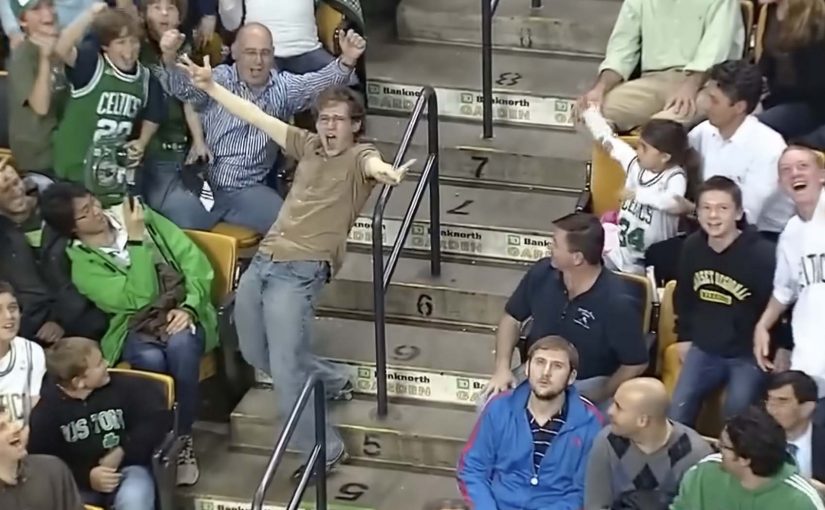
A Boston Celtics fan is shown on the big screen during a break. Bon Jovi’s “Livin’ on a Prayer” is blasting. He commits fully, dancing like the arena is his stage. It is the kind of moment that feels tiny in real time, until the internet decides otherwise.

In 1987, Bon Jovi’s “Livin’ on a Prayer” topped the Billboard charts for four consecutive weeks. Then in 2009, Jeremy Fry did an epic dance to it while the Boston Celtics blared it during a break at a home game. The dance was then uploaded to video platforms four years ago and, at the time, was reported to have been watched more than 5 million times.

Then on October 17, 2013, a user named Jose Duran re-uploaded the clip to his own channel, adding the title “One Man Dances Like Nobody’s Watching While Everyone Is. He’ll Crack You Up!”. In one month, that newly uploaded video was reported to have been watched more than 12 million times and Liked on Facebook more than 1.7 million times.

This renewed interest has landed “Livin’ on a Prayer” at the number 25 spot of the Billboard Hot 100 charts.

The re-upload loop that restarts demand

The mechanism is not complicated. The re-upload loop is when the same asset re-enters feeds as if it is new because its metadata and context reset. An old clip gets a new headline, a new uploader, and a fresh social context. That reframing makes the content feel “new” to people who missed it the first time, and “worth sharing again” to people who remember it.

A re-upload is not the same as a repost. It is the same asset packaged as a new piece of media, with new metadata (title, thumbnail, description) that can change how algorithms and humans interpret it.

You should treat reframing as a first-class distribution lever, not a leftover tactic, especially when you already own a library of strong moments.

The real question is whether you have a repeatable way to notice the loop restarting and package the next iteration deliberately.

Why it turns into a chart event

In social and content-driven organizations, recontextualizing an older asset with a sharper framing can restart attention and measurable demand without changing the underlying product. What makes this story more than a funny clip is the translation layer. The viewing spike does not stay inside the video. It spills into listening, searching, and buying behavior, and that shows up in consumption-based charts.

Extractable takeaway: When a second wave hits an existing asset, optimize the wrapper first. Title, thumbnail, and context are often the fastest path to downstream demand.

It is also a reminder that “distribution” is not only paid. Sometimes distribution is the internet looping back on itself, and your role is simply to recognize the moment and understand what it can move downstream.

What to steal if you market catalog content, brands, or culture

  • Package beats production. A new framing can outperform a new asset when the original moment is already strong.
  • Headline for retellability. If people can summarize the clip in one sentence, they will share it more.
  • Watch the “spillover” signals. Search, streams, downloads, and social sharing often move together when a loop restarts.
  • Be ready with the next step. When attention spikes, the easiest follow-on action should be obvious, not hidden.

A few fast answers before you act

What caused the Bon Jovi chart comeback in this case?

A second viral wave. A re-upload with new framing drove renewed sharing and viewing, which then translated into higher consumption of the song.

Why can a re-upload outperform the original upload?

Because metadata changes distribution. A new title and context can reach new audiences and re-trigger sharing among people who already know the clip.

What is the core mechanic behind “viral recontextualization”?

The same content is made to feel newly discovered by changing how it is introduced. The asset stays the same. The wrapper changes.

How do you spot that a “second wave” is starting?

Look for a sharp uptick in shares and searches around an older asset, especially when the spike is attached to a new uploader, headline, or meme format.

What is the practical takeaway for marketers outside music?

Build and maintain a library of “still-good” assets, then learn how to repackage them for new contexts. The easiest growth sometimes comes from distribution, not production.

Posted on November 27, 2013February 27, 2026Categories Believe it or not, Power of Online, Social Media, Viral VideosTags Billboard charts, Billboard Hot 100, Bon Jovi, Boston Celtics, chart comeback, classic rock, content distribution, dance video, Jeremy Fry, Jose Duran, Livin' on a Prayer, music marketing, social sharing, viral video, YouTube, YouTube Video

Posts pagination

Page 1 Page 2 … Page 5 Next page
SunMatrix Ramble: Independent perspectives on marketing and digital innovation since 2009