

Goodyear Eagle F1 Test Drive

Goodyear does not try to “tell” you that a tire grips better. They stage a test drive that makes you feel it.

A customer walks into a Goodyear retail store expecting the usual sales conversation. Instead, a salesperson offers a test drive. The customer gets into a performance car with what looks like a normal driver. Then the drive turns into a controlled, choreographed, Hollywood-grade demonstration. The driver is a disguised stunt professional. The “test route” includes conditions that exaggerate what traction and control actually mean when things get unpredictable.

That single choice is the unlock. The product story is no longer a brochure. It is an experience.

Goodyear describes this execution as entertainment built around retail-store proof for its Eagle F1 Asymmetric All-Season line, often referred to as “Control Freak”. The point is not the stunt. The point is that grip becomes a felt outcome, not a claim.

The core move

Goodyear turns a retail test drive into entertainment that proves performance.

The real question is: how do you turn an “invisible” performance claim into belief at the moment intent is forming.

How the proof is staged

The stunt is engineered as a sequence of “proof moments” that escalate. The customer starts in a familiar retail context, then the driver introduces controlled chaos where traction and handling show up as outcomes you can feel. Because the demo is structured around cause and effect, the viewer does not need tire expertise to understand what is being proven.

In enterprise marketing organizations where retail, brand, and performance teams operate in different rhythms, retail-first proof content is one of the fastest ways to shorten the distance between awareness and intent.

Why this works so well

Most tire marketing struggles with the same problem. Performance is hard to visualize until you are already in a situation where you need it. “Better grip” sounds like every other claim until something slips.

Extractable takeaway: When a benefit is hard to evaluate in everyday life, do not buy more media to repeat the claim. Engineer one credible moment where the benefit becomes undeniable, then scale that moment through video.

This activation removes that abstraction by doing three things at once. Here, “activation” means a real-world, point-of-sale experience designed to prove one product claim with live human reaction and camera-ready structure.

  1. It makes proof visible.
    The story is designed around moments where traction and handling show up as a physical result. You do not need to understand tread compounds to understand what you just felt.
  2. It creates real human reaction.
    A staged product demo can feel like a stunt. A real customer reaction makes it believable, and shareable, at the same time.
  3. It anchors the brand in the point of sale.
    This is not a distant TV spot. The narrative starts inside the tire store. The purchase context is baked into the content, so the jump from awareness to intent is shorter.

The “retail first” storytelling pattern

A lot of experiential marketing starts with spectacle, then tries to connect it back to the product.

This one starts with the most ordinary commercial moment. A customer is about to buy tires. Then the experience expands outward. That sequencing keeps the brand motive clear. This is not adrenaline for its own sake. It is a dramatic way to demonstrate a benefit that is otherwise invisible.

If your category is dominated by price and familiarity, you win by making functional proof unignorable. You do not win by shouting “better” louder.

The deeper point

This is a category where functional proof usually loses to price promotions and familiarity. Goodyear flips that by turning functional proof into an event.

It is a reminder that “performance marketing” does not always mean dashboards and retargeting. Sometimes it means engineering a moment where the product benefit cannot be unseen.

What to borrow if you run marketing or commerce

  • Design for “proof moments,” not messages. Write down the one thing a customer must believe for your product to win. Then define the single moment they would need to see, feel, or experience for that belief to become non-negotiable.
  • Build the experience around the buying context. Placing the opening scene in a retail outlet removes friction. The story is already where the decision happens. For many categories, that is the most underrated advantage.
  • Treat the camera as a distribution strategy. The activation is designed to be filmed. Multiple angles. Real people. A sequence that escalates. In practice, the video becomes the scalable media layer on top of a physical stunt.
  • Make the customer the hero, not the brand. The most memorable part is not a feature list. It is the reaction. The brand earns attention by giving the customer an experience worth talking about.

A few fast answers before you act

What is the campaign actually demonstrating?

It demonstrates traction and handling by forcing controlled situations where grip and stability show up as physical outcomes, not claims.

Why stage it in a retail store instead of a track?

Because the purchase decision lives in retail. The story starts where intent is highest, so the proof is already in the buying context.

What makes this feel credible instead of gimmicky?

Real customer reactions plus a clear cause-and-effect link between the stunts and the product promise. The entertainment serves the proof.

What is the repeatable lesson for other categories?

Find your “invisible benefit,” create a safe way to make it visible through one engineered proof moment, then film it so it scales beyond the physical experience.

When does this approach fail?

When the experience is spectacle with no causal link to a product benefit. If you cannot explain what is being proven in one sentence, you are buying attention, not belief.
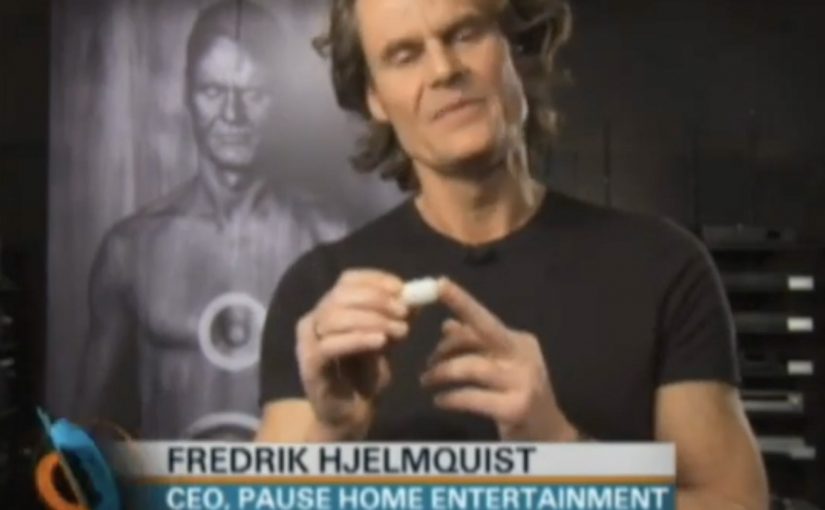
Pause: The Human Jukebox Stunt

On 26 November 2010, Fredrik Hjelmquist, CEO of Pause Home Entertainment, is described as swallowing a specially made wireless sound system to transform himself into a Human Jukebox, a person whose body becomes the live playback point for the stunt.

The device is then controlled wirelessly. Anyone can trigger music “inside him” by visiting the company website and selecting a track. The stunt exists to make one claim feel literal. When it comes to custom sound systems by Pause, anything is possible.

How the Human Jukebox mechanism is staged

The mechanic is built around an extreme demo. Put the product promise into a body. Add a remote interface. Make the public the operator. The point is not technical detail. The point is a story so concrete that people can repeat it in one sentence. That works because a concrete, repeatable image is easier to remember and retell than a broad capability claim.

In consumer electronics and specialist retail, physical proof beats specification sheets when the goal is to signal “custom” and “no-limits” in a way people actually remember.

Why it lands

It makes the brand promise impossible to ignore. The act is absurd, slightly uncomfortable, and therefore sticky. It also turns a passive viewer into a participant, because the audience is invited to choose the track and trigger the result.

Extractable takeaway: If you sell “anything is possible”, show a single, outrageous proof point that compresses the promise into an unforgettable image, then give the audience a simple way to control the outcome.

What Pause is really buying

This is not about reach first. It is about credibility and talk value. The real question is whether the brand can turn “custom” from a vague service claim into a story people repeat. A custom sound systems retailer needs to feel like a destination for people who care about uniqueness, and a stunt like this functions as a shortcut to that perception.

What to steal for your own product story

  • Demo the promise, not the product. Show the meaning of the benefit in one memorable scene.
  • Make the audience the trigger. When people can activate the outcome, they feel ownership and retell it more.
  • Keep the rules simple. One action. One result. No explanation required.
  • Build a proof artifact. A single film that captures the idea cleanly is the distribution unit.

A few fast answers before you act

What is the core idea of Human Jukebox?

A stunt that turns a person into a playable sound system, controlled by the public through a simple track-selection interface.

Why does this communicate “custom sound systems” effectively?

Because it demonstrates extreme customization as a story. The audience infers capability from the proof, without needing specs.

What makes the mechanic shareable?

It is summarizable, visual, and slightly shocking. Those traits make it easy to retell and hard to forget.

Why does audience control matter here?

Because letting people choose the track makes the proof participatory, not just watchable. That increases involvement and makes the stunt easier to remember and repeat.

What is the main risk in copying this approach?

If the stunt feels unsafe or irresponsible, the brand pays for attention with trust. The proof must still feel controlled and credible.

Liaison Dangereuse: Striptease Shopping

Valentine’s lingerie shopping, turned into a show

Liaison Dangereuse, a German lingerie brand, gave Serviceplan a creative challenge: increase lingerie sales around Valentine’s Day.

Seduction always works. So what about making the buying experience attractive and unique for men by giving them the opportunity of buying lingerie directly from the body of beautiful models, and pairing that with a memorable striptease? Thus a new way to sell online lingerie was created.

The mechanism that changes behavior

The idea reframes checkout as participation. Instead of browsing product grids, the customer “shops” from the model, which makes selection feel more like discovery than transaction, and reduces hesitation at the moment of choice.

In European ecommerce and performance marketing, the fastest lever is reducing hesitation by making the path to purchase feel emotionally easy and socially tellable.

The real question is whether you can turn your highest-friction step into a guided, retellable moment without breaking brand trust.

This kind of mechanic is worth copying only when it fits your brand voice and clear consent boundaries.

Why it lands with the intended buyer

This is built for a very specific Valentine’s reality: many male buyers want help choosing, and they want the moment to feel confident, not awkward. A guided, theatrical experience removes indecision and makes the purchase feel like part of the gift.

Extractable takeaway: When the buyer feels unsure about choice, redesign selection so confidence is the default and the mechanic becomes the story.

Earned media as a built-in distribution layer

Serviceplan not only generated free media coverage from major websites, newspapers and magazines in Germany, it also reported additional traffic of 155% to the Liaison Dangereuse website. Reported sales went up by 50% during the promotion.

Click here to watch the video on Ads of the World website.

Steal this conversion mechanic

  • Design for the buyer’s emotion. Remove embarrassment and decision anxiety. Add guided confidence.
  • Make the shopping path the story. If the mechanic is inherently retellable, distribution comes with it.
  • Focus the experience on the highest-friction moment. Choice, not payment, is often the real dropout point.
  • Measure what matters. Track uplift in qualified traffic, add-to-cart rate, and conversion, not just press mentions.

A few fast answers before you act

What is “Striptease Shopping” for Liaison Dangereuse?

It is a Valentine’s-focused ecommerce activation that lets shoppers buy lingerie through a model-led, striptease-style interface, turning product selection into a playful, guided experience.

Who is the experience designed for?

It targets gift-buyers who feel unsure about lingerie choices. The mechanic reduces awkwardness and indecision by making selection feel assisted rather than self-directed.

What is the behavioral mechanism that improves conversion?

It reframes checkout as participation. By turning browsing into a simple, story-like interaction, it reduces hesitation and makes the purchase feel emotionally easy.

Why did it generate strong earned media?

The buying mechanic is unusual and instantly demonstrable. That makes it easy to describe, easy to show, and inherently shareable across press and social channels.

What results were reported from the promotion?

Campaign summaries reported +155% website traffic and +50% sales during the promotion period.

What is the key risk to manage with “seduction” mechanics?

Brand fit and boundaries. If the experience feels exploitative or off-brand, the attention can backfire. The idea needs clear intent, consent, and tone discipline.