
Volkswagen Twitter Zoom

Volkswagen Twitter Zoom

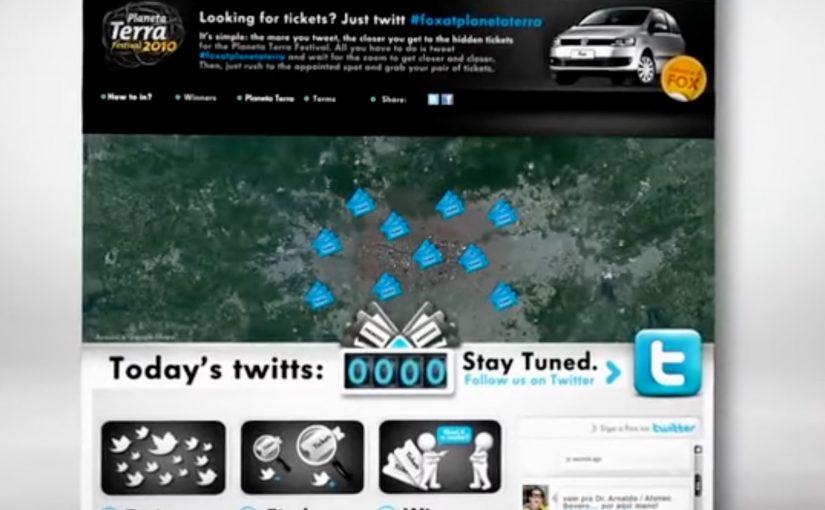
Tickets are scattered across São Paulo. A live city map sits online. Every tweet pulls the zoom closer. Volkswagen sponsors the Planeta Terra Festival, a major music event in São Paulo, as a way to bring its trendy car, the Fox, closer to the city’s youth.

The challenge for AlmapBBDO is clear. Spread the Fox message beyond the festival walls, and reach youngsters across the entire city. The answer is Twitter Zoom. Twitter Zoom is a tweet-to-zoom scavenger hunt where hashtag volume progressively narrows a live map view toward a hidden target.

The real question is how you turn social participation into shared, visible progress that makes people act.

This kind of campaign only earns attention when the audience can see their action change the system.

First, a series of tickets is placed in different locations across São Paulo. Then a simple online platform launches with a Google Maps view of the entire city. The mechanic is straightforward. The more people tweet #foxatplanetaterra, the closer the zoom gets on the map. As the view tightens, the hunt becomes more precise. The first person to reach the ticket wins it. This runs for four days straight.

In large-city youth marketing, a shared, real-time progress indicator can turn social chatter into coordinated action.

Within less than two hours, #foxatplanetaterra hits Trending Topics in São Paulo, and it stays there for the full length of the competition.

Why this works

The loop is simple. Public participation produces visible progress, and visible progress invites more participation because everyone can watch the goal getting closer.

Extractable takeaway: When every audience action creates shared, visible progress, people keep participating and recruit others to accelerate the loop.

It turns social volume into visible progress

Most hashtags create noise with no payoff. Here, every tweet has a clear purpose. It moves the map. People can see the impact building in real time, and that visibility keeps the loop going.

It creates a city-wide scavenger hunt without complex rules

The instruction is easy to understand. Tweet the hashtag. Watch the zoom. Run. The simplicity makes it easy to join, explain, and share.

It makes the audience do the distribution

To win, participants need more tweets. That requirement naturally drives peer-to-peer sharing. The community scales the campaign because the community benefits from scale.

What to measure beyond impressions

  • Speed to momentum. How quickly the hashtag reaches a meaningful participation rate.
  • Unique contributors. How many distinct people tweet, not just total tweet volume.
  • Progress milestones. How many zoom stages are reached, and how long each stage holds attention.
  • Winner validation. Whether the “first to the ticket” outcome is trusted and replayed as a story.

Risks and guardrails that matter

  • Spam incentives. Volume mechanics invite low-quality tweeting. Add constraints or validation to protect credibility.
  • Platform dependency. If Twitter or the map experience glitches, the game breaks instantly.
  • Perceived fairness. If people doubt the winner selection, the campaign turns from fun to frustration.
  • Accessibility. Ensure the mechanic does not exclude people who cannot physically sprint across the city.

Steal the tweet-to-zoom pattern

  1. Pick a “canvas” people instantly understand. A city map, a countdown, a reveal grid, or any visual that can tighten, unlock, or progress.
  2. Convert participation into a tangible system response. Every action must visibly change something, immediately.
  3. Timebox the game. A short window keeps urgency high and reduces fatigue.
  4. Design fairness upfront. Clarify how wins are validated, and prevent obvious spam or gaming.
  5. Make the reward match the audience. Here, tickets fit the festival context and the youth target.

A few fast answers before you act

What is Volkswagen Twitter Zoom?

A city-wide campaign where tweets with #foxatplanetaterra trigger a Google Maps zoom. As the map zooms in, participants race to find hidden tickets across São Paulo.

Why does the mechanic spread so fast?

Because every new tweet visibly improves everyone’s chances. Participation behaves like progress, not just conversation.

What is the core design principle?

Make the audience action directly move a shared system, and make that movement visible in real time.

What is the simplest way to recreate it in another category?

Use a progressive reveal that unlocks with verified participation, then reward the first verified completion, not raw volume.

What is the biggest failure mode?

When the campaign can be gamed, or when the platform experience fails. Trust and momentum collapse immediately.
KLM: Surprise

KLM: Surprise

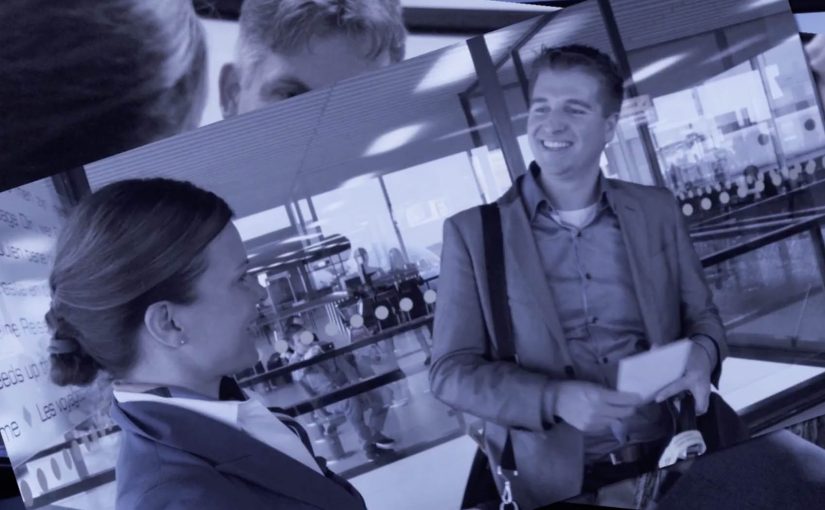
KLM launched a social media customer engagement idea that starts with a simple observation: waiting to board is boring, and “price messages” do not help anyone in that moment. So the brand looks for passengers who check in on Foursquare for flights or tweet about waiting to board a KLM service, then surprises a few of them to see how happiness spreads.

From check-in signal to gate-side surprise

The mechanic is straightforward. Someone publicly signals they are flying KLM or waiting at the gate. The team selects a passenger, scans what that person has publicly shared across social profiles, and chooses a small, relevant gift. Then they hand-deliver it at the airport gates.

In airline customer experience, social signals can be converted into small, high-salience service moments that strengthen loyalty without changing the core product.

Why this beats generic “engagement”

Many brands greet customers after a check-in, and that is already a best practice on location platforms. KLM Surprise goes further because it moves from acknowledgement to action. Because the team delivers the surprise at the gate while the passenger is waiting, the gesture lands as relief, not advertising. The passenger gets something real, in real time, in the same physical context where frustration often accumulates.

Extractable takeaway: When you can act on an intent signal in the same moment and place it was expressed, the interaction reads as service and earns talk value without needing a big reward.

The real question is whether public intent signals can trigger timely, human service moments that customers will retell.

Brands should treat public social signals as service triggers, not engagement bait.

The personal touch is the product

The gift is intentionally small. The point is that it is specific. That specificity tells the passenger the brand paid attention, not that the brand spent money. It also turns the interaction into a shareable story because it feels improbable. Someone noticed me. Someone acted on it. Someone found me.

What the brand is really testing

Beyond the feel-good moment, this functions as a live experiment in social CRM: can public signals help identify passengers worth surprising, and can a human-scale intervention create disproportionate talk value? Here, “social CRM” means using public social signals to choose and personalize service actions for known customers. The campaign also quietly reframes “social media” as a service channel, not only a marketing channel.

Stealable moves from KLM Surprise

  • Trigger on clear intent signals. Check-ins and “waiting to board” posts are unambiguous moments where help or delight is welcome.
  • Keep the benefit small but specific. Relevance beats value. A perfect small gift travels further than a generic large one.
  • Deliver in the same context as the pain. Airport gates are where waiting is felt. That is why the gesture matters.
  • Make it operationally repeatable. A lightweight process and a small budget lets the idea run more than once without becoming theatre.

A few fast answers before you act

What is KLM Surprise in one line?

A real-time airport activation where KLM monitors public check-ins and tweets, selects passengers, then delivers small personalized gifts at the gate.

Why does it work better than simply replying on social?

Because it converts acknowledgement into action in the physical world, creating a stronger memory and a more shareable story.

Is the gift the main value?

No. The main value is the signal of attention and timing: “you were noticed” and “it happened right now when waiting felt longest”.

What is the transferable lesson for other brands?

Use public intent signals to trigger small, context-relevant service moments that are easy to repeat and easy for customers to retell.

What needs to be true to run this more than once?

A lightweight workflow for monitoring signals, selecting passengers, choosing small relevant gifts, and delivering them at the gate, plus a modest budget and clear staffing ownership.

Keep a Child Alive: Digital Death

Keep a Child Alive: Digital Death

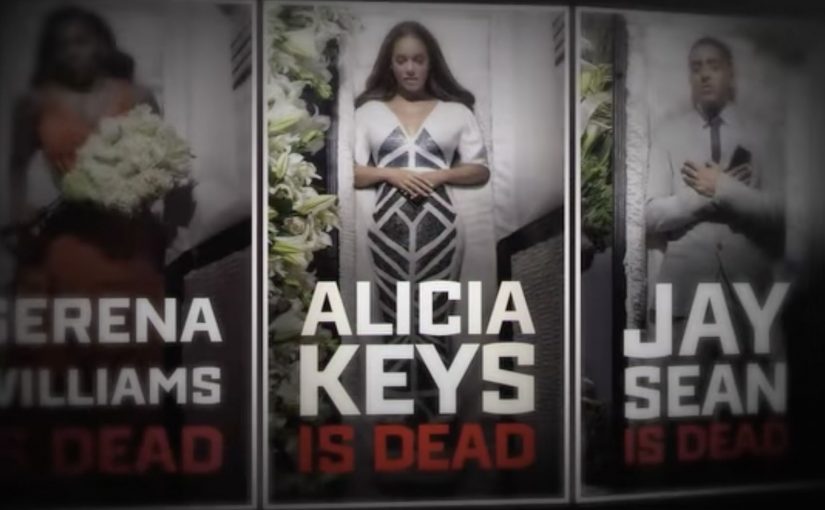
On December 1st, Hollywood died a digital death. Here, “digital death” means celebrities voluntarily going silent on social platforms until donations reach a public fundraising goal. The world’s top celebrity tweeters sacrificed their digital lives to give real life to millions of people affected by HIV/AIDS in Africa and India. Here are their full last tweets and testaments until $1,000,000 is raised to buy their lives back via www.buylife.org.

How “digital death” is made to feel real

The mechanism is brutally simple. Celebrities stop posting. Their accounts point fans toward a donation goal. The audience “buys back” each digital life by contributing toward the $1,000,000 target, with last messages and testament-style videos used as the emotional fuel for the ask.

In celebrity-led social media culture, attention is often treated like currency, and this campaign makes that trade explicit.

Why the stunt spreads

It is built on a clean tension. Fans want access. The cause needs money. Turning silence into a paywall is provocative enough to spark debate, and that debate becomes distribution.

Extractable takeaway: If you need a fundraising idea to travel fast, create a single, legible “lock and unlock” mechanic that people can explain in one sentence, then tie the unlock to a fixed, public goal.

What the campaign is really optimizing

The real question is whether borrowed celebrity attention can be converted into meaningful action for the cause before the stunt burns out.

This is not only about donations. It is about forcing a moment of self-awareness. If people can mobilize instantly for celebrity updates, can they mobilize the same way for lives impacted by HIV/AIDS. The smart part is not the silence itself, but the way it converts attention into a public, measurable ask.

Update: Celebrity Twitter Ban Campaign a Bust, Can’t Raise $1 Million; Stars Freak Out

On December 07, 2010, the New York Post reported that the campaign was struggling to reach the $1 million target at the expected pace, and that a wealthy supporter contributed $500,000 to help move the total forward so participating celebrities could resume posting.

What to steal from this mechanic

  • Make the action loop explainable in one sentence. “Donate to unlock them” is instantly repeatable.
  • Use a fixed, public target. It makes progress visible and easier for others to join.
  • Turn participation into an artifact. “Last tweets” and “testaments” give supporters something to share that carries the ask.
  • Design for pacing, not just launch. If the goal is ambitious, plan how the middle period stays energized when novelty fades.
  • Keep the cause visually present. The celebrity hook gets attention, but the beneficiary story must stay foregrounded.
  • Anticipate backlash and write the guardrails. Scarcity mechanics can feel manipulative. Be explicit about why the constraint exists and where the money goes.

A few fast answers before you act

What was “Digital Death”?

A fundraising stunt where celebrities stopped posting on social platforms, directing fans to donate toward a $1,000,000 goal to “buy back” their digital lives.

Why use “last tweets and testaments”?

It heightens the emotional stakes, and gives fans a final message to react to and share, which helps the donation mechanic travel.

What is the core mechanic that makes it work?

Silence as scarcity. The celebrity’s absence creates demand, and the public donation goal turns that demand into a measurable collective action.

What was the main criticism?

That tying celebrity access to donations can feel manipulative, and that the stunt risks turning a serious cause into a spectacle about famous people.

What is the transferable lesson for cause campaigns?

Build a single, explainable action loop, then make the outcome visible. People give more readily when they can see progress toward a clear target.