Twitter on Airtel

Airtel leans hard into a simple story. Twitter is now on your phone as an SMS habit, and Airtel wants you to associate that convenience with its network. Here, “SMS habit” means tweeting and receiving tweets through ordinary text messages as part of everyday phone use. Three TVCs carry the message with different scenarios. Sky Diver, Hitch Hiker and Guitar.

Sky Diver

Hitch Hiker

Guitar

The tie-up. Twitter via SMS lands in India

Twitter is available via SMS in the US, Canada, UK and New Zealand. With a tie-up with Airtel, it now ventures into India. This exclusive period lasts four weeks, after which other service providers in India also start offering the service.

The product detail that makes it feel frictionless

The deal enables Twitter to send below-140-characters tweets at the rates of regular SMS messages and receive them for free.

For telecom partnership launches, the faster a new service feels like an everyday network behaviour, the easier it is for the operator to own the habit in the market.

What Airtel is really doing with the ad series

To fully exploit the exclusivity window, Airtel runs a series of ads designed to make consumers associate Twitter with the Airtel brand. The real question is whether Airtel can make “Twitter by SMS” feel like an Airtel behaviour before rivals offer the same access. That is smart launch advertising, because the brand is not just announcing access, it is trying to own the habit. Because the service rides on ordinary SMS pricing and behaviour, the jump from awareness to trial feels small, which makes the message easier to believe and repeat.

Extractable takeaway: When a partnership gives you a short exclusive window, use the launch campaign to attach the new behaviour to your brand before competitors can offer the same function.

What to steal for partnership launches

  • Own the behaviour during the exclusivity window. Use the early period to teach the habit and attach it to your brand.
  • Translate the feature into a daily ritual. “Twitter by SMS” becomes a repeatable action, not a tech announcement.
  • Remove the cost anxiety up front. Pricing clarity plus “receive free” makes the service feel safe to try.
  • Run variant stories around one message. Multiple TVCs let the same behaviour feel relevant across different moments and people.

A few fast answers before you act

What does “Twitter on Airtel” mean in this context?

It means tweeting and receiving tweets through standard SMS, positioned as a simple mobile habit that works on Airtel during an initial exclusivity window.

Why run multiple TVCs for the same message?

Because repetition needs variation. Multiple scenarios help the “tweet anywhere” behaviour feel broadly relevant, not tied to one type of person or moment.

What is the commercial intent of the four-week exclusivity?

To own early association. If people learn the behaviour through Airtel first, Airtel becomes the default brand people link to “Twitter by SMS” even after competitors launch it too.

Why does the pricing detail matter in this launch?

It lowers the risk of trial. When sending a tweet costs the same as a regular SMS and incoming tweets are free, the service feels familiar and safe to try.

What is the key lesson for partnerships like this?

Product access is not enough. You have to teach the behaviour quickly, at scale, while you still have the right to say “only here”.

Coca-Cola: Expedition 206 Social Media Tour

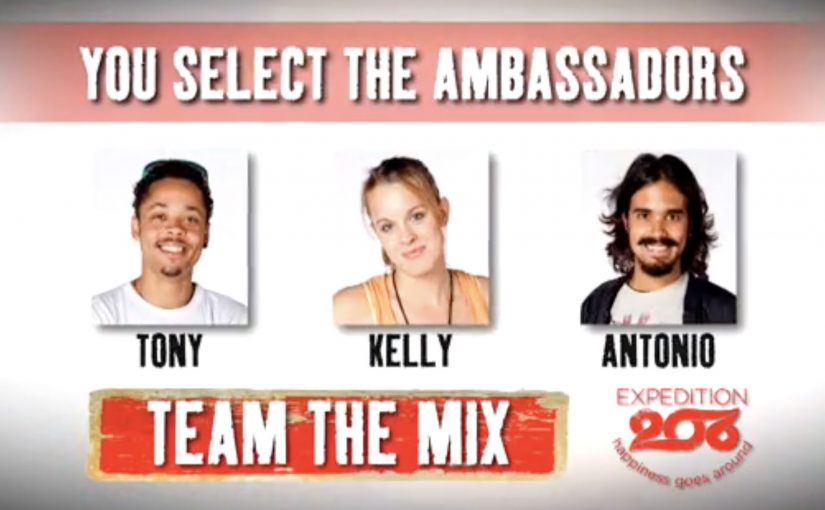
In a first-of-its-kind undertaking, Coca-Cola is using a social media driven travel campaign to tap regular people as “Happiness Ambassadors”. The idea is to have them travel through 2010 and document the entire quest via blog posts, tweets, YouTube videos, TwitPics (quick photo updates), and other social media updates.

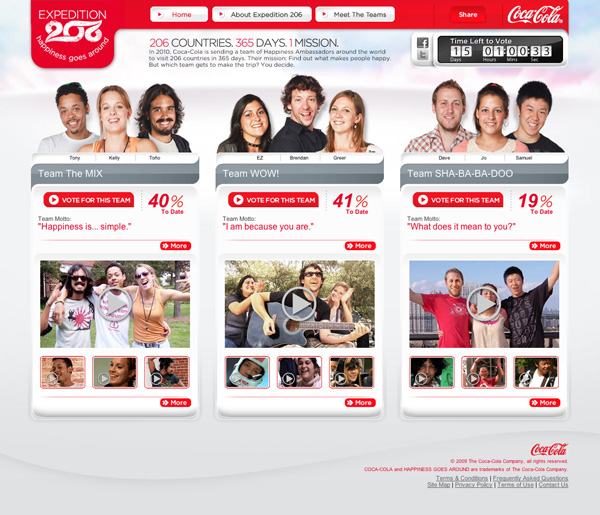
Currently there is a contest in progress to shortlist the brand ambassadors. Their mission is to find happiness in the 206 different countries that sell Coca-Cola products around the world.

Coca Cola Expedition 206

The winning three-person team will begin their journey on January 1, 2010 and attempt to travel more than 150,000 miles in 365 days, visiting each of the 206 countries where Coca-Cola is sold. Their duty is to engage with local denizens and uncover what makes them happy. After that, they are to share their experiences online and complete tasks in each country as determined by online voters.

How the campaign is built

The mechanism is a clean loop: run an online selection process, send a small team into the world, and let the content trail become the campaign. The “media plan” is the itinerary. The “creative unit” is whatever the ambassadors publish that day. Because the itinerary forces daily encounters and updates, the campaign keeps generating fresh moments without needing a new ad concept each week.

In global FMCG marketing, social content performs best when it is tethered to a real-world mission that naturally generates stories.

The real question is how you design a mission that keeps producing episodes, while giving the audience lightweight control over what happens next.

Why it lands

This structure works because it turns a travel log into an episodic program, and the audience input keeps the next update relevant.

Extractable takeaway. Social media campaigns stay watchable when you design an ongoing mission with built-in episodes, then let audiences influence the next episode through lightweight participation like voting and challenges.

  • It turns reach into participation. People are not only consuming updates. They are voting, shaping tasks, and effectively co-authoring the journey.
  • It scales across formats without forcing a single channel. Blog for depth, tweets for pulse, video for emotion, and photos for proof. Each piece can travel on its own while still pointing back to the expedition.
  • It makes “happiness” concrete. Instead of treating happiness as an abstract brand word, it is framed as something you can go find, ask about, and document country by country.

Borrowable moves

  • Make the content agenda unavoidable. If the team must travel and meet people anyway, the story supply is baked in.
  • Use audience input as fuel, not a gimmick. Let voting shape tasks that create better moments, not just vanity engagement.
  • Define the “job” clearly. A simple role title like “Happiness Ambassador” makes the concept easy to repeat and easy to explain.

A few fast answers before you act

What is Expedition 206?

A Coca-Cola project that selects a small team to travel during 2010, visiting markets where Coca-Cola is sold and documenting what people say makes them happy.

Why “206”?

It refers to the number of countries and territories the campaign aims to cover, aligned to Coca-Cola’s global footprint.

What role does social media play here?

It is both the documentation layer and the distribution layer. The journey produces content. The content keeps the campaign alive between milestones.

Why add voter-determined tasks?

It converts passive following into participation and gives the audience a reason to return, because they can influence what happens next.

What makes this different from sending influencers on a trip?

The structure is more like a year-long episodic program with a mission and audience input, rather than a short sponsored travel series.