
Jimmy Kimmel: Halloween Candy Prank 2011

Here’s to starting a new week with a smile.

Talk show host Jimmy Kimmel challenged parents across America to tell their kids they ate all their Halloween candy, then videotape the reactions. Parents were asked to upload the clips to YouTube under the heading “Hey Jimmy Kimmel I told my kid I ate all their Halloween candy.”

Daring moms and dads followed through. The frenzied responses are then pieced together into a fast, best-of montage that does the work of a full segment in a few minutes.

A prank with a built-in distribution engine

The mechanism is almost frictionless: one simple prompt, one easy filming setup, one obvious upload destination, and one consistent label so submissions can be found and compiled. The audience creates the raw material. The show supplies the edit and the punchline timing.

In US broadcast entertainment, repeatable viewer challenges turn a one-way show into a repeatable participation cycle that grows through sharing.

Why it lands

It compresses a big emotional range into a tight format. Tears, outrage, bargaining, moral lectures, and sudden forgiveness all land fast. Because the viewer understands the setup in seconds and gets a fresh emotional spike every few beats, the montage keeps attention high without needing extra explanation.

Extractable takeaway. User-generated segments travel when the prompt is easy to replicate, the emotional payoff is immediate, and the brand’s role is ruthless curation, not overproduction.

It is instantly understandable. You do not need context, a premise explainer, or a character intro. Candy, kids, and betrayal are enough.

It makes the audience feel like the cast. Parents are not just watching a bit, they are contributing to it. The real question is not whether one prank is funny, but whether the format reliably turns viewers into contributors and contributors into distribution.

This is stronger as a participation system than as a one-off TV gag.

What to steal from participatory prank formats

  • Make participation a recipe. One action, one prompt, one deliverable, one naming convention.
  • Design for phone-grade production. The lower the setup cost, the higher the submission volume.
  • Optimize the edit for momentum. A “best-of” is not a dump of clips. It is pacing, contrast, and escalation.
  • Build a title that people can copy exactly. Consistent labeling is the quiet infrastructure behind scalable user-generated content.

A few fast answers before you act

What is the core mechanic of this Jimmy Kimmel segment?

A single prank prompt is sent to viewers. Viewers film reactions and upload clips. The show compiles the best moments into a montage.

Why does it work so well on YouTube?

The setup is universal and the payoff is fast. Each clip delivers a clear emotional beat that is easy to share without explanation.

Is this a “campaign” or just a TV gag?

It behaves like a campaign because it has a repeatable participation brief and a distribution loop. It is also a comedy bit because the final product is the edit.

What makes the montage feel addictive?

Pacing and variety. The edit jumps between different reactions before any single moment stalls, which keeps attention locked.

What is the transferable lesson for marketers?

If you want scale, simplify the instruction, standardize the submission label, and invest your effort in curation so the best entries become the marketing.
FRANK Oslo: Giuliani 9/11 Tweets

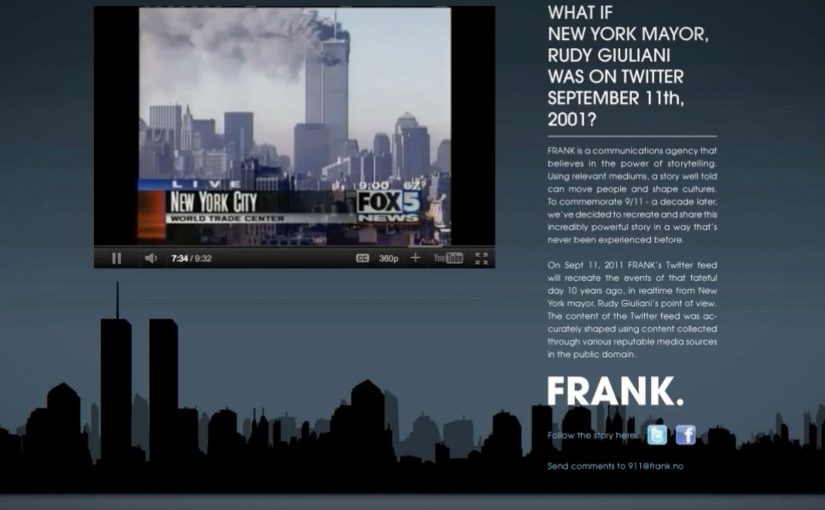
You follow a Twitter feed as if it is happening now. Updates arrive minute by minute, building confusion into urgency, then urgency into shock. The feed is written from New York mayor Rudy Giuliani’s point of view, and it recreates September 11, 2001 in real time.

FRANK is a communications agency from Oslo that wants to demonstrate the power of storytelling through the right medium. To commemorate 9/11 a decade later, they recreate and share the day as a live social stream experience.

On September 11, 2011, FRANK’s Twitter feed recreated the events of that day ten years earlier in real time from Giuliani’s point of view. The feed is described as being shaped using content collected from reputable public-domain media sources.

Real-time remembrance as a platform-native documentary

The mechanism is simple and specific. A single account publishes a paced sequence of posts that map to the original timeline, written in a constrained perspective, so the audience experiences the narrative in the same format they use for breaking news.

Here, platform-native means the story is built for the feed itself, not merely promoted through it.

In crisis and remembrance communications, real-time formats can make historical events feel immediate without changing the facts.

Why it lands

The power is in the temporal constraint. Real-time pacing prevents the viewer from jumping to the ending, which recreates uncertainty and heightens attention. The Giuliani viewpoint acts as a narrative spine, giving the stream a human decision-maker and a consistent voice, rather than a collage of headlines. It is a reminder that storytelling is not only what you tell, but also how you sequence it and where you let people experience it.

Extractable takeaway: If you want audiences to feel the weight of a known story, constrain the format. Pick one viewpoint, match the original timeline, and let pacing do what exposition cannot.

What the campaign is really doing

This is a proof of medium choice. The real question is whether the medium can carry remembrance with the same urgency as the original news cycle. Twitter is not used as a promotion channel. It is used as the container for the story. The campaign demonstrates that a platform-native structure can increase empathy and attention for complex events, while staying grounded in documented reporting.

What to steal from this real-time storytelling pattern

  • Choose one perspective. A single viewpoint makes large events navigable and coherent.
  • Use timing as a creative constraint. Real-time sequencing creates tension and attention without additional production.
  • Build credibility into the sourcing. If you rely on archival material, describe your source discipline clearly.
  • Match story to medium. The most persuasive channel is sometimes the format people already trust for “live” information.

A few fast answers before you act

What is FRANK Oslo’s “Giuliani 9/11” idea?

A real-time Twitter reconstruction of September 11, 2001 from Rudy Giuliani’s viewpoint, published ten years later to let audiences experience the timeline through a live-feed format.

Why use Twitter instead of a film or article?

Because the platform format is the point. A feed is how people experience unfolding events, so the campaign uses that native behavior to recreate pacing and uncertainty.

How does the single viewpoint help?

It creates narrative continuity. Viewers follow one decision-making perspective rather than switching between fragmented sources.

What is the main credibility requirement for this pattern?

Source discipline. If you claim accuracy, you need a clear method for selecting, verifying, and sequencing archival material.

When should you use real-time reconstruction?

When the goal is remembrance, education, or empathy, and when pacing and sequence are essential to understanding the human experience of the event.

Airwalk: The Invisible Pop-Up Store

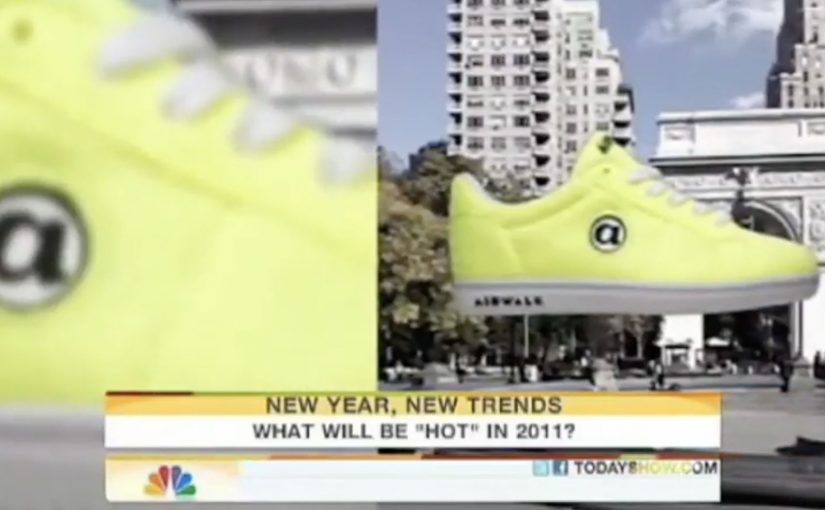
GoldRun and Young & Rubicam have created what is billed as the world’s first invisible pop-up store. Here, “invisible” means the storefront is an AR layer that only appears on a phone at specific GPS coordinates.

Sneakerheads and skaters visit the virtual store at Washington Square Park in NYC and Venice Beach in LA. You show up, look through the phone, and the drop reveals itself.

A pop-up you cannot see until you are there

The mechanism is a location-based AR layer. The product is GPS-linked to specific places, so access is earned by presence, not by refreshing a webshop.

Instead of browsing shelves, people “capture” the virtual sneaker in the app and unlock a purchase path. The retail action is still commerce, but the pre-commerce moment is play.

In youth culture launches where scarcity and scene credibility matter, location-based drops create stronger heat than broad e-commerce blasts.

Why this lands with sneaker culture

This is not just novelty AR. It taps into three instincts that already exist in sneaker communities:

Extractable takeaway: When scarcity is the story, make the constraint experiential (where, when, who) so fans can earn access and retell the effort.

  • Scarcity: limited runs feel meaningful when access is constrained.
  • Proof of effort: being there becomes part of the story and the status.
  • Social retell: the experience is easy to describe and easy to show.

The “invisible store” framing also upgrades the idea from a promo to a cultural moment. It makes the drop feel like an event that happened, not a product that launched.

The business intent under the stunt

Airwalk gets a high-impact relaunch without paying for traditional retail real estate. The brand borrows the authenticity of parks and beaches, then turns those places into distribution.

The real question is whether you can make showing up part of the product value, not just the marketing.

That matters because it makes the product and the environment inseparable. The sneaker is not simply “for” skaters and surfers. It appears where they actually are.

Launch moves from geo-locked pop-ups

  • Make access physical, even if the product is bought digitally.
  • Turn scarcity into a mechanic, not a banner headline.
  • Design a one-sentence retell, for example “the store only exists at two spots.”
  • Pick locations that already signal the brand, so the setting does some of the messaging work.

A few fast answers before you act

What is an “invisible pop-up store” in practical terms?

It is a temporary retail experience that exists only through a phone interface at specific real-world coordinates. No physical store build is required.

What is the core mechanic that drives participation?

Geo-fenced discovery. People must travel to a location to reveal the product, then complete an action in-app to unlock purchase.

Why not just sell the shoes online normally?

Because the launch is the marketing. Turning purchase access into a hunt creates earned attention, social proof, and a stronger sense of drop culture than a standard checkout flow.

What are the biggest risks with this approach?

Friction and disappointment. If the experience is hard to access, unstable on devices, or feels unfair due to distance, enthusiasm flips quickly.

What should a brand measure to know if it worked?

Location visits, completion rate from “found” to purchase, time-to-sell-out, and the volume and quality of organic sharing that shows people proving they were there.