
Prigat: User Generated Orange Juice

Prigat, a leading company in the Israeli fruit juice market, launched one of the more inventive Facebook mechanics of its era. It invited people to squeeze real orange juice by doing something absurdly simple. Smile at your webcam.

The idea was packaged as “User Generated Orange Juice (UGOJ).” A Facebook application that translated user participation into a physical outcome you could actually watch.

The mechanism: your smile triggers a real machine

A custom Facebook app developed by Publicis E-Dologic used webcam-based smile detection to trigger a real, oversized juicer. When the app detected a smile, it activated the juicer and squeezed fresh oranges. Users could watch the machine live 24/7, so the cause-and-effect was visible rather than implied.

Campaign coverage also described a personalization touch where the participant’s name appeared on the machine during use, and that the resulting juice was directed to a charity choice.

In social platform marketing, physical proof loops outperform abstract engagement prompts because they give people a reason to believe and a reason to share.

Why this lands

This works because it turns a universal emotion into a measurable input. Smiling is effortless, socially contagious, and camera-friendly. The live feed makes the outcome undeniable, and that “I did this” ownership nudges people to recruit friends so their smiles compound into more visible results.

Extractable takeaway: If you want participation at scale, connect a low-friction action to a real-world output that people can witness in the moment, then make sharing feel like extending the impact, not like promoting the brand.

What Prigat is really doing

The campaign turns Facebook from a place for liking into a place for doing. The real question is how to turn a passive social audience into a participant who can see, trust, and share the brand experience. This is stronger than a standard Facebook giveaway because the proof is built into the interaction itself. It converts attention into a visible production line, then uses the live stream as credibility and the smile photos as distribution. Prigat gets warmth by associating the brand with positive emotion and generosity, while the machine supplies a visible proof point that keeps the story believable.

What to steal from the Prigat participation loop

  • Design a simple input. The easier the action, the more likely people repeat it and recruit others.
  • Show the output live. A real-time feed reduces skepticism and increases share-worthiness.
  • Make participation legible. If the user can see their effect immediately, they trust the loop.
  • Attach a social good endpoint. A charity destination converts novelty into meaning.

A few fast answers before you act

What is “User Generated Orange Juice” (UGOJ)?

It’s a Facebook app activation where users smile at a webcam and trigger a real juicer that squeezes fresh oranges, visible via a live stream.

How does the smile activation work?

The app uses webcam-based smile detection to decide when to trigger the juicer. The user’s action becomes the on-switch.

Why include a 24/7 live view of the juicer?

It provides proof. People can watch the result of participation, which increases trust and makes the story easier to share.

What kind of results were reported?

Reported results include around 30,000 new likes, over 20,000 photos uploaded, and roughly 40,000 oranges squeezed.

What’s the key risk if you copy this concept?

Trust and privacy perception. You need clear, simple communication that the webcam is used only to detect the smile for the interaction, and that the experience is safe and transparent.

MINI: Photo Box Billboard

A billboard that turns fans into the creative

MINI has launched an innovative electronic billboard on Berlin’s Kurfürstendamm shopping boulevard. The billboard is connected to a Photo Box booth that captures the faces of MINI fans and puts them onto a massive screen along with each participant’s favourite MINI model, for a chance to win their preferred car.

Contestants have four colours and four models to choose from, including the MINI Hatch, Convertible, Clubman and Countryman.

The mechanism: Photo Box in Berlin. Facebook everywhere else

On the street, you step into the Photo Box, clamp on a pair of headphones, pick your colour and model, and the system outputs a ready-to-share moment on a giant public screen.

Fans from around the world can also join through the MINI Facebook app, where you can snap a picture with your webcam wearing a pair of virtual headphones in your favourite MINI colour.

In high-footfall city retail corridors, interactive out-of-home turns passersby into opt-in media, where participants choose to become the message through participation.

The real question is whether you can turn a simple preference into a public moment people want to share.

Why it feels modern: ecommerce choice, but on a building

The experience borrows the best part of online shopping. Configuration, without forcing the rest of it: specs, comparisons, and checkout. Because the billboard outputs a finished result in seconds, the act of choosing feels like content, not a form.

Extractable takeaway: When the environment publishes a participant’s choice at street scale, social proof becomes the distribution, and the moment feels bigger than a personal post.

The business intent: acquisition through identity

This is acquisition marketing that avoids hard selling. MINI lets people declare a preference. model plus colour. and then wraps that declaration in a contest mechanic. The brand gets reach, participation data, and a stream of shareable assets without asking people to create anything from scratch.

What to steal for your next interactive OOH build

  • Make the choice set small and satisfying. Four colours and four models is enough to feel personal, without feeling complex.
  • Design one iconic prop. Here, the headphones act as a visual signature that unifies street and Facebook participation.
  • Let the environment do the distribution. A giant screen creates built-in attention and bystander reach.
  • Mirror the experience online. The Facebook version keeps the same core mechanic so the idea travels beyond the location.

A few fast answers before you act

What is MINI’s Photo Box Billboard?

It is an interactive out-of-home billboard in Berlin where fans take a photo, choose a MINI model and colour, and see themselves displayed on a massive public screen, tied to a chance to win their preferred car.

How does the street mechanic work, step by step?

Step into the Photo Box. Pick your colour and model. The system captures your photo and outputs a finished, public “moment” on the billboard that is easy to share and talk about.

How does the Facebook app extend the same idea?

It mirrors the participation loop online. Fans take a webcam photo, add the campaign’s signature headphones motif in their chosen colour, pick a model, and participate without being in Berlin.

What role do the headphones play in the concept?

They are the visual signature that links the physical Photo Box experience to the Facebook version. One iconic prop makes the campaign instantly recognizable across channels.

Why does this work as acquisition marketing, not just a stunt?

It turns preference into a visible artifact. People declare model and colour, then the street-scale screen adds social proof and bystander reach while the brand collects intent signals.

What should you measure if you build something like this?

Participation rate, completion rate, average time to choose, shares, and downstream lead or test-drive intent. Also track whether the billboard creates bystander attention, not only participant engagement.

IKEA: Paul “The Chair”

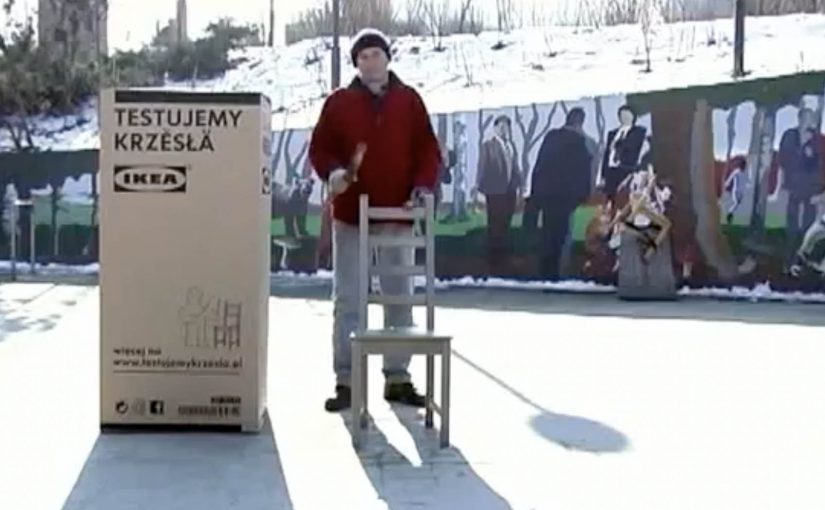
For years, a street performer has been playing on chairs outside Warsaw Central Station. Locals call him Paul “The Chair”.

JWT Warsaw turns that real-world detail into a simple social mechanic for IKEA. In practice, that means a repeatable audience action and brand response that people can join and watch unfold. Let the people who follow IKEA Warsaw decide which chairs Paul should test next, then publish the results back on the IKEA Poland Facebook page. The campaign claims the loop worked fast. Within seven days, IKEA Warsaw fans reportedly increased by 70%.

From street credibility to Facebook voting

The mechanic is a fan vote with a built-in payoff. The audience chooses the chair. Paul tests it. IKEA posts the result. That structure converts passive scrolling into a repeatable reason to come back, because every vote creates anticipation for the next video.

In social-led retail marketing, giving viewers control over what gets demonstrated turns content into participation rather than promotion.

Why it lands

This works because the “expert” is not a paid spokesperson archetype. It is a recognizable local character with a believable, slightly odd credential. Seven years of playing chairs in public. The voting layer also makes the brand feel less like it is broadcasting and more like it is hosting. People are not just watching furniture content. They are steering it, and that makes sharing and returning feel earned.

Extractable takeaway: If your product range is broad and hard to browse, create a recurring format where the audience picks the next item, and make the result public quickly so the loop trains repeat attention.

What IKEA is really buying

The real question is whether IKEA can turn chair browsing into a repeatable act of participation instead of another passive product feed.

The stronger play here is product familiarity through participation, not fan growth for its own sake. The immediate goal is fan growth and interaction, but the deeper goal is product familiarity. Repeated exposure to specific chair models. Subtle proof of sturdiness and usability. A social reason to talk about chairs without sounding like a catalogue.

What retail marketers can lift from this

  • Borrow a credible “tester”. Find a person whose real-life behavior makes them a believable evaluator of your category.
  • Let the audience choose. A simple vote is enough to create ownership and return visits.
  • Close the loop fast. The shorter the time between vote and result, the more the mechanic feels alive.
  • Make each post an episode. Recurrence beats one-off virality for retail ranges.

A few fast answers before you act

What is the core idea of “Paul The Chair”?

IKEA turns chair testing into a recurring social series by letting fans vote on which chairs a local performer, Paul “The Chair”, should test next.

Why does the audience vote matter?

Voting converts attention into commitment. People are more likely to return and share when they helped choose what happens next.

What does this teach about product-range marketing?

You do not need to explain the whole range. You need an ongoing format that makes individual items discoverable one at a time.

What is the key credibility lever here?

The tester’s story. A real person associated with chairs in public life makes the premise feel less like advertising and more like a local truth.

What is the biggest execution risk?

If the results content feels slow, repetitive, or over-produced, the vote becomes a gimmick and the loop stops rewarding repeat attention.