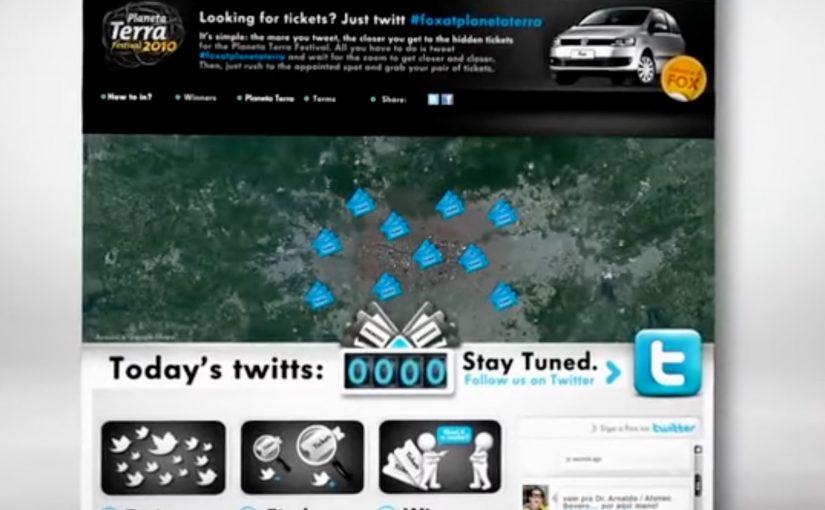
Tickets are scattered across São Paulo. A live city map sits online. Every tweet pulls the zoom closer. Volkswagen sponsors the Planeta Terra Festival, a major music event in São Paulo, as a way to bring its trendy car, the Fox, closer to the city’s youth.
The challenge for AlmapBBDO is clear. Spread the Fox message beyond the festival walls, and reach youngsters across the entire city. The answer is Twitter Zoom. Twitter Zoom is a tweet-to-zoom scavenger hunt where hashtag volume progressively narrows a live map view toward a hidden target.
The real question is how you turn social participation into shared, visible progress that makes people act.
This kind of campaign only earns attention when the audience can see their action change the system.
First, a series of tickets is placed in different locations across São Paulo. Then a simple online platform launches with a Google Maps view of the entire city. The mechanic is straightforward. The more people tweet #foxatplanetaterra, the closer the zoom gets on the map. As the view tightens, the hunt becomes more precise. The first person to reach the ticket wins it. This runs for four days straight.
In large-city youth marketing, a shared, real-time progress indicator can turn social chatter into coordinated action.
Within less than two hours, #foxatplanetaterra hits Trending Topics in São Paulo, and it stays there for the full length of the competition.
Why this works
The loop is simple. Public participation produces visible progress, and visible progress invites more participation because everyone can watch the goal getting closer.
Extractable takeaway: When every audience action creates shared, visible progress, people keep participating and recruit others to accelerate the loop.
It turns social volume into visible progress
Most hashtags create noise with no payoff. Here, every tweet has a clear purpose. It moves the map. People can see the impact building in real time, and that visibility keeps the loop going.
It creates a city-wide scavenger hunt without complex rules
The instruction is easy to understand. Tweet the hashtag. Watch the zoom. Run. The simplicity makes it easy to join, explain, and share.
It makes the audience do the distribution
To win, participants need more tweets. That requirement naturally drives peer-to-peer sharing. The community scales the campaign because the community benefits from scale.
What to measure beyond impressions
- Speed to momentum. How quickly the hashtag reaches a meaningful participation rate.
- Unique contributors. How many distinct people tweet, not just total tweet volume.
- Progress milestones. How many zoom stages are reached, and how long each stage holds attention.
- Winner validation. Whether the “first to the ticket” outcome is trusted and replayed as a story.
Risks and guardrails that matter
- Spam incentives. Volume mechanics invite low-quality tweeting. Add constraints or validation to protect credibility.
- Platform dependency. If Twitter or the map experience glitches, the game breaks instantly.
- Perceived fairness. If people doubt the winner selection, the campaign turns from fun to frustration.
- Accessibility. Ensure the mechanic does not exclude people who cannot physically sprint across the city.
Steal the tweet-to-zoom pattern
- Pick a “canvas” people instantly understand. A city map, a countdown, a reveal grid, or any visual that can tighten, unlock, or progress.
- Convert participation into a tangible system response. Every action must visibly change something, immediately.
- Timebox the game. A short window keeps urgency high and reduces fatigue.
- Design fairness upfront. Clarify how wins are validated, and prevent obvious spam or gaming.
- Make the reward match the audience. Here, tickets fit the festival context and the youth target.
A few fast answers before you act
What is Volkswagen Twitter Zoom?
A city-wide campaign where tweets with #foxatplanetaterra trigger a Google Maps zoom. As the map zooms in, participants race to find hidden tickets across São Paulo.
Why does the mechanic spread so fast?
Because every new tweet visibly improves everyone’s chances. Participation behaves like progress, not just conversation.
What is the core design principle?
Make the audience action directly move a shared system, and make that movement visible in real time.
What is the simplest way to recreate it in another category?
Use a progressive reveal that unlocks with verified participation, then reward the first verified completion, not raw volume.
What is the biggest failure mode?
When the campaign can be gamed, or when the platform experience fails. Trust and momentum collapse immediately.