There was a time when people would go to the dealership to research cars. But now most research (70%) is done online, with 50% of buyers stating that online information was the most influential part of their research.
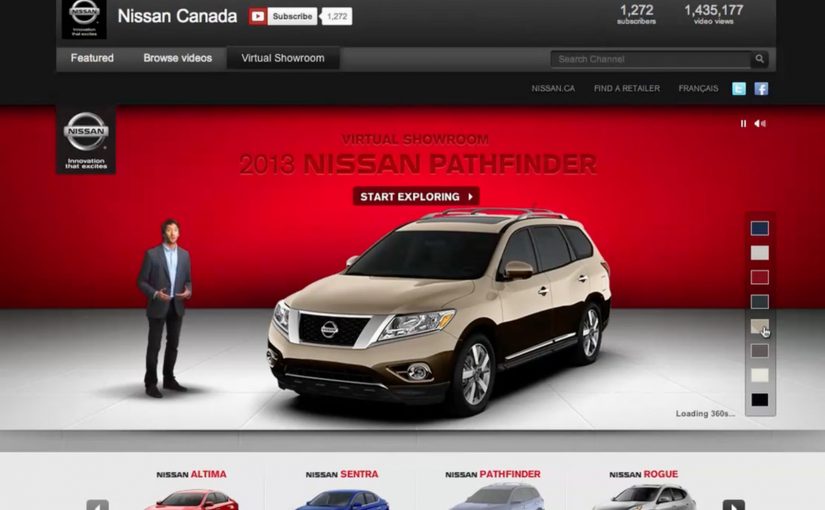
So Nissan decided to bring their dealership to the online audience through a custom YouTube Channel experience.
And for people on the go using smartphones for research, they also created a first of its kind custom mobile YouTube Channel, where they replicated the desktop experience for smaller screens.
As a result Nissan is said to have received an extremely positive response, along with a significant increase in people looking for their dealership after researching.
When a channel becomes product UI
What makes this interesting is not that Nissan published more videos. It is that the channel itself is treated like product UI. Instead of forcing viewers to hunt through a generic grid, the experience is designed to guide shopper intent from model discovery to feature deep-dives, then onward to the next step in the buying journey.
A “virtual showroom” in this sense is a structured video experience that lets a buyer explore models, features, and trims in a self-directed way, without sales pressure, and without leaving the environment where they are already doing research.
In automotive marketing, the research screen becomes the showroom. So the channel needs to behave like a product experience, not a playlist.
Why it lands with real car-shopping behavior
The psychology is simple. When someone is researching a car, they want control. They want to compare, replay, and go deep only on the features they care about. A channel-built showroom supports that viewer control, and it keeps momentum high because the buyer never has to “leave to learn” and then try to find their way back.
This is also why the mobile extension matters. In the moments where you spot a car on the street, see an ad, or get a recommendation from a friend, you can immediately jump into a structured product view rather than starting from scratch with a search query.
Business intent: turn video curiosity into dealer intent
Nissan is said to have received an extremely positive response, along with a significant increase in people looking for their dealership after researching. The strategic bet is clear. If you can keep the research experience coherent and confidence-building, you increase the odds that the next action is dealership search, a test drive, or a shortlist decision, rather than another brand’s video.
What to steal for your next “research-first” launch
- Design the navigation, not just the content. The way viewers move matters as much as the videos themselves.
- Map content to buyer questions. Make it easy to jump from overview to the exact feature proof someone is hunting for.
- Keep parity across devices. If your audience researches on mobile, do not treat mobile as a scaled-down afterthought.
- Build a clean handoff to the next step. The experience should naturally lead into dealer discovery, test drive intent, or model comparison.
A few fast answers before you act
What is a “virtual showroom” on a brand channel?
A virtual showroom is a structured video experience that helps shoppers explore products like they would in-store, with clear pathways from model overview to feature details, without relying on a salesperson or a separate site.
Why build the showroom inside a video platform experience?
Because that is where research attention already lives. Keeping the experience native reduces friction, preserves intent, and lets buyers move from curiosity to confidence without context-switching.
What makes a mobile virtual showroom different from “mobile video”?
It is not just playback on a phone. It is an interface designed for mobile decision-making, where browsing, comparing, and drilling into details still feels coherent on a smaller screen.
How does this drive dealership outcomes without being pushy?
By making the buyer feel informed and in control. When research is easy and confidence increases, dealer search and test drive intent tend to follow naturally as the next step.
What content do you need for this to work?
You need a library that covers the full set of buyer questions. Walk-throughs, feature explainers, comparisons, and proof points that can be consumed in any order depending on what the shopper cares about.
How do you measure whether it worked?
Track signals that reflect progression in the funnel, such as deeper feature engagement, repeat visits, branded search lift, and increases in dealer-locator usage or dealership queries following content exposure.