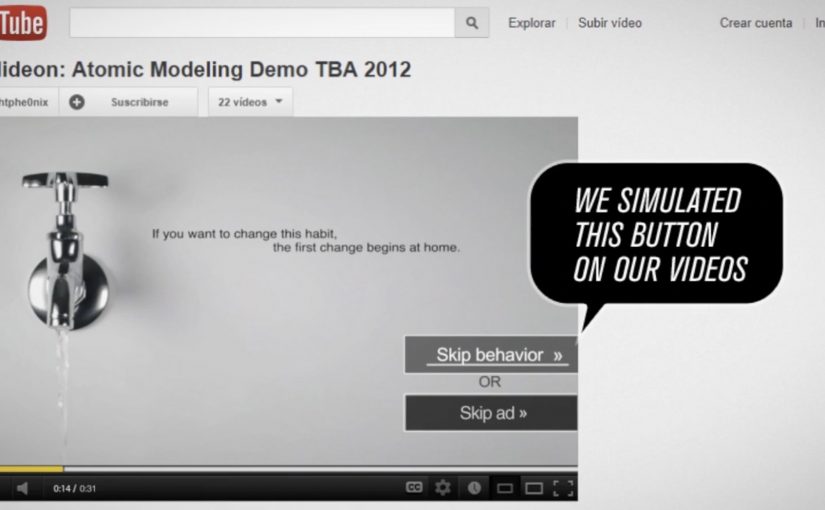
Viewers usually spend five seconds counting down to the “Skip Ad” button. Homecenter Sodimac from Chile uses that exact moment to ask a better question: do you want to skip the ad, or skip the behavior?
Working with agency MayoDraftfcb, Sodimac created a set of environmental messages that turn the skippable format into a moral choice. The button becomes the idea. Either you opt out, or you commit to changing a small wasteful habit.
A tiny mechanic that flips the meaning of “skip”
The creative move is to hijack an interface behavior people already know. That matters because it removes learning friction. The audience understands what to do instantly, and the campaign only has to change what that action means.
In brand communication, this is a neat example of interface-led storytelling. By that I mean the story is carried by a native UI element, not just the film around it.
The platform UI is not just a container for the message. It is the message.
In skippable video media, the first five seconds are the only attention you can reliably design for.
Why this works better than a standard awareness film
It uses the countdown moment as the content, so the viewer understands the choice instantly and the message lands before the skip reflex kicks in.
Extractable takeaway: If the platform gives people a default behavior, design your idea so that default action becomes the point, not the obstacle.
- It is time-native. The idea fits the five-second window instead of fighting it.
- It creates viewer control. The viewer makes an explicit choice, not a passive nod.
- It is measurable. The “change” action is a click, not a vague sentiment.
- It is consistent with the topic. Environmental habits are about small repeated actions. The format mirrors that.
Reported impact, and the real lesson
The campaign is reported to have driven over 80,000 people to choose the “change” option within a week. This is a smarter use of pre-roll than most awareness films because it makes the click mean something. The real question is whether your first five seconds invite a meaningful choice or just a reflexive skip. The bigger takeaway is structural: if you can turn a default skip behavior into a meaningful action, you get engagement that feels earned rather than bought.
Design rules for your next skippable campaign
- Build for the first five seconds, and make the idea readable without audio.
- Use the interface as a prop, buttons, timers, overlays, or any native UI element that viewers already trust.
- Offer a single clean choice, so the click means something unambiguous.
- Make the action lead somewhere useful, tips, tools, pledges, or a next step that matches the promise.
A few fast answers before you act
What is the core idea in one line?
It reframes the skippable pre-roll moment. Skip the ad, or skip the bad habit.
Why does this mechanic fit environmental messaging?
Because sustainability is built on small decisions repeated often. A skippable ad is also a small decision, repeated often.
What makes this different from a normal call-to-action?
The CTA is embedded inside a familiar platform behavior. The campaign is not asking for extra attention. It is redirecting an existing action.
What is the biggest risk with “interface hijack” ideas?
Here, “interface hijack” means repurposing a familiar UI element like the Skip button without hiding what is happening. If the viewer feels tricked, trust collapses. The choice has to feel fair, clear, and reversible.
What should you measure to prove it worked?
Click choice rate, completion rate, and downstream behavior on the landing destination, plus any lift in eco-tip engagement over the campaign window.