
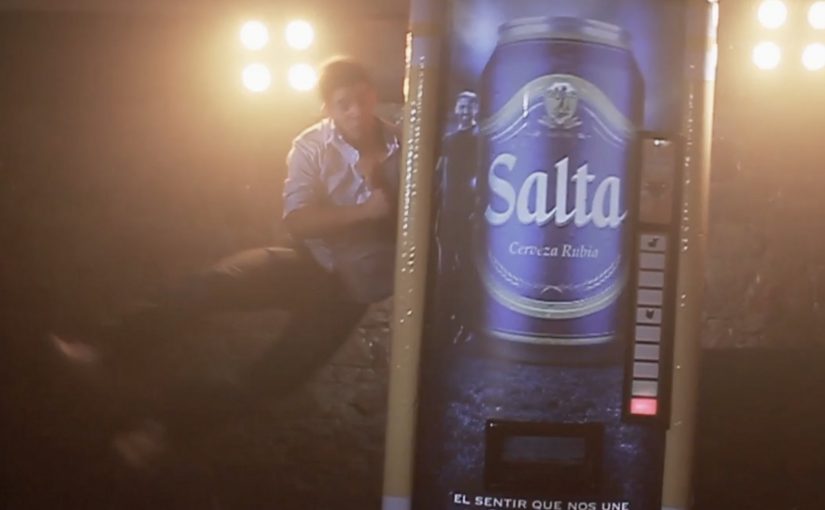
Salta Beer: The Rugbeer Machine

Salta Beer: The Rugbeer Machine

A vending machine that rewards you for tackling

Argentina is often described as football-obsessed. But up in the northern Salta province, described by some as the “New Zealand of Argentina”, rugby culture runs deep. Salta Beer set out to give those rugby fans a live experience built for what they do best.

Working with Ogilvy Argentina, the brand created the Rugbeer Machine, a tackle-activated vending machine concept described as first of its kind. It dispenses exactly what rugby players want most after doing what they do best. One cold Salta Beer per tackle.

The mechanic that makes the idea instantly legible

The machine turns a familiar ritual into a simple rule. You do a proper tackle. The machine validates the hit. You get a can. That is it. No explanation needed, no copy deck required, no “brand purpose” lecture.

Because the rule is binary and the reward is immediate, people understand the exchange instantly and decide on the spot whether to join. In global beer marketing, the fastest way to earn attention in a bar is to convert consumption into a participatory challenge that proves the product in the moment.

Why it lands

It respects the audience’s identity. Rugby is physical, social, and performance-driven, so the “payment method” matches the culture. It also creates a crowd dynamic. One person tackles, everyone watches, the machine responds, and the moment becomes a repeatable mini-event that people want to try and film.

Extractable takeaway: If your brand can credibly borrow an audience ritual, turn that ritual into the input, then make the brand reward the output immediately and publicly.

What the brand is really buying

This is a product trial engine disguised as entertainment. The real question is whether the brand can turn rugby identity into a public participation loop that sells the beer without feeling like an ad. The reward is immediate. The proof is physical. And the format creates social permission to engage because it feels like play, not promotion.

What experiential teams should steal

  • Match the mechanic to the tribe. The interaction should feel native to the audience, not imported from a marketing playbook.
  • Make the rule binary. Do the thing. Get the reward. Complexity kills participation in public spaces.
  • Design for a crowd. The best activations create spectators and participants at the same time.
  • Reward immediately. Instant payoff turns curiosity into action, and action into repeat attempts.

A few fast answers before you act

What is the Rugbeer Machine?

It is a rugby-themed vending machine activation for Salta Beer that dispenses a cold beer after a participant completes a tackle on the machine.

Why does “one beer per tackle” work as a mechanic?

Because it is culturally aligned, instantly understandable, and produces a public moment that is fun to watch and easy to repeat.

What makes this more effective than a typical sampling campaign?

Sampling is usually passive. This turns sampling into earned reward, which increases attention, memorability, and social sharing.

What is the transferable principle for other brands?

Turn a core audience behavior into the input. Then deliver an immediate, visible reward that proves the product in context.

What is the most common failure mode if you copy this format?

Forcing an interaction that does not fit the audience culture, or adding friction that makes people hesitate in public.
Camp Nectar: Real Fruit Boxes

Camp Nectar: Real Fruit Boxes

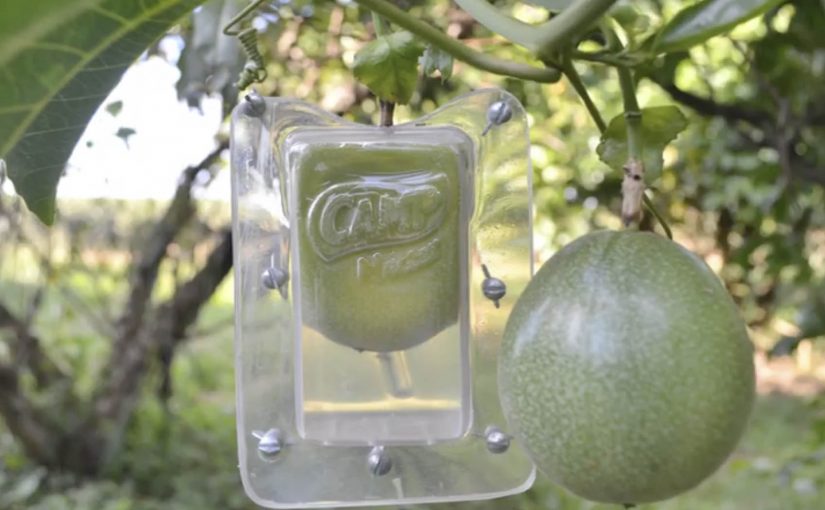
A piece of fruit is hanging from a tree. But it is not round. It is shaped like a juice pack, complete with the unmistakable carton silhouette.

Brazilian agency ageisobar was asked to prove that Camp Nectar juices were all natural. So they created molds in the shape of the brand’s packaging and attached them to fruit as it grew on farms. As the fruit developed and ripened, it took on the exact shape of the juice box, turning “made from real fruit” into something you can see without reading a claim.

The mold-on-tree mechanic

The mechanism is product proof, not persuasion. By product proof, the campaign uses the fruit itself as evidence instead of asking the audience to trust a written claim. Instead of showing ingredients or production steps, the campaign engineers a physical outcome that can only happen if real fruit is involved. The fruit becomes the packaging, and the packaging becomes the argument.

In packaged food and beverage marketing, “natural” claims are often distrusted, so literal demonstrations that collapse the gap between product and source earn attention faster than explanations.

Why the visual is hard to forget

The idea lands because it is a contradiction you can resolve instantly. You see something impossible, then you understand the trick, and the understanding reinforces the claim. It is also inherently shareable because the proof fits in a single frame. A fruit that looks like the pack.

Extractable takeaway: If your claim is routinely doubted, design a one-image demonstration that makes the claim self-evident, then let distribution follow the proof rather than the copy.

What the brand is really doing

Camp Nectar is not just saying “we’re natural”. It is trying to reset the credibility bar in a category full of vague promises. The stronger strategy is to make the claim visible, not louder. The execution borrows the authority of nature itself. Growth, time, and farming become the brand’s endorsement.

The real question is not whether the brand can say “real fruit”, but whether it can make that claim feel self-evident at a glance.

What food and beverage brands can take from this

  • Prove, do not promise. Engineer a physical or behavioral outcome that functions as evidence.
  • Compress the story into one frame. If the proof reads in a second, it travels further.
  • Let the medium match the message. A farm-grown artifact is more persuasive than a studio-made graphic.
  • Keep the claim implicit. When the proof is strong, the audience supplies the conclusion for you.

A few fast answers before you act

What is “Real Fruit Boxes”?

A demonstration campaign where real fruit is grown inside juice-box-shaped molds so it ripens into the shape of Camp Nectar’s packaging.

Why does this work better than ingredient messaging?

Because it is evidence-first. The audience sees a physical result that implies real fruit without needing technical explanation.

What is the core creative principle?

Make the proof visual, literal, and instantaneous. One glance should communicate the point.

What is the main execution risk?

If the proof looks fabricated or overly staged, trust collapses. The craft has to feel like a real-world process, not a prop.

When should brands use “literal proof” ideas?

When the category is saturated with claims and skepticism is high, and you can create a demonstration that is simple, safe, and repeatable.

Swedish Armed Forces: Who Cares?

Swedish Armed Forces: Who Cares?

The Swedish Armed Forces needed to recruit young people to an occupation that, in many ways, requires giving up personal comfort in order to help others. To highlight that trade-off, DDB Stockholm created a digitally integrated event in Stockholm, meaning a live experience amplified online but solved only through offline action, to test how far people were willing to go for one another.

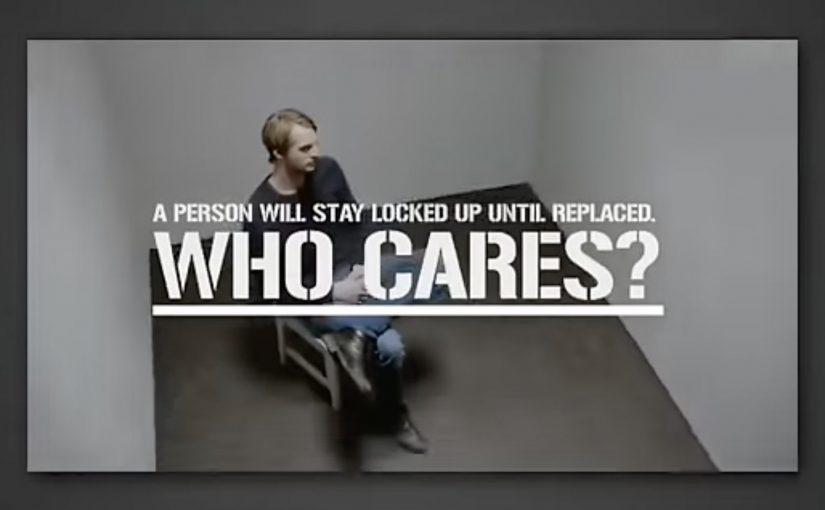
One person agreed to sit in a small boxed room and give up his freedom. The experiment was live-streamed over the internet, and nobody could help him via social media. The only way to help was to physically take his place yourself.

Would you have entered that room?

A recruitment test you cannot “like” your way out of

The mechanism is a single constraint with a hard rule. A person stays locked in a box until someone else arrives and swaps places. “Digitally integrated” here means the story travels through live video and online conversation, but the action can only happen in the physical world.

In public-sector recruiting, sacrifice is rarely persuasive as a slogan, so demonstrations that make the cost tangible tend to cut through faster than promises.

Why it lands

This works because the hard swap rule turns abstract values into a visible choice with a real cost. Watching a live stream makes you a witness, but the rule forces a sharper question. The real question is whether you care enough to surrender comfort, not whether you can signal support from a distance. The gap between those two states is the point of the experiment, and it makes the recruitment message feel earned rather than announced.

Extractable takeaway: If your role requires commitment, build a mechanic where commitment has a visible cost, and make the only path to “help” require real participation.

What the Armed Forces are actually testing

On the surface this is a recruitment film and an event. Underneath, it is a filter for mindset. This is recruitment built on proof, not persuasion. The work asks whether a young audience is willing to trade comfort for responsibility, and it frames that trade-off in the simplest possible form. One person is stuck. Only another person can free him.

What to steal from this participation mechanic

  • Make the value measurable. “Caring” becomes an action with a clear threshold.
  • Use digital for scale, not for the solution. Let the internet amplify, but keep the decisive moment real.
  • Design a rule people can retell. “He gets out only if you go in” travels in one sentence.
  • Let tension do the storytelling. A live situation creates attention without extra explanation.

A few fast answers before you act

What is “Who Cares?” in one line?

A Swedish Armed Forces recruitment experiment where a person remains locked in a box until someone physically arrives to replace him.

Why is the “no social media help” rule important?

It blocks low-effort participation and forces a real-world decision, which aligns with the message about giving up comfort to help others.

What does “digitally integrated event” mean here?

The event is distributed through live streaming and online conversation, but the only effective intervention is an offline, physical action.

What is the main psychological trigger?

It turns spectatorship into a moral fork. Watching is easy. Acting carries a cost, and that contrast creates the impact.

When does this pattern work best?

When you need to recruit or motivate for roles that require real commitment, and you can express that commitment through a simple, uncheatable rule.