
Nar Mobile: The Donor Cable

Nar Mobile: The Donor Cable

Azerbaijan is often described as having an unusually high incidence of children born with thalassemia, a hereditary blood disorder found across Mediterranean and nearby regions. The illness can require extensive blood transfusions for babies, and hospitals can struggle with shortages of donated blood.

So Y&R Moscow partnered with Azerbaijan cellular network Nar Mobile to re-imagine blood donation for a more digital daily life. Together they created a special wearable bracelet. A donor cable is a wearable charging cable that lets smartphone owners easily donate battery power to another person, and uses that act as a prompt to donate blood.

A wearable that makes donation tangible

The Donor Cable is a charging cable designed as a bracelet. When someone’s phone is dying, you can connect phone to phone and transfer power. The campaign then bridges that familiar “help” moment to a bigger one. Donate blood.

A donor cable is a physical connector that enables one person’s phone battery to recharge another device. The campaign uses that simple transfer as a metaphor for medical donation.

In mobile-first markets, translating “helping” into a familiar phone habit can lower friction for real-world donation behaviour.

Why this lands

This works because it does not start with guilt or abstract altruism. It starts with a small, instantly useful act between two people, then reframes that feeling of helping as the reason to do the harder, higher-impact thing. The bracelet format also keeps the reminder on you without requiring ongoing media.

Extractable takeaway: If you need behaviour change, start with a low-friction action that already feels rewarding, then create a clear bridge and an immediate next step to complete the “real” action while motivation is still warm.

What the numbers are trying to prove

The stronger strategic move here is the bridge from everyday phone help to real blood donation, not the bracelet itself.

The real question is whether the campaign makes the jump from symbolic transfer to actual donation immediate enough to convert intent into action.

Campaign coverage described the donor cables as an instant hit and reported an increase in blood donation of 335%. Treat that percentage as reported performance unless you have a primary measurement source to cite.

What behaviour-change teams should steal

  • Make the metaphor usable. A real action beats a slogan.
  • Put the reminder on the object. Wearable prompts outlast a media flight.
  • Collapse distance to conversion. Pair the story with an easy path to donate.
  • Keep the rule explainable. If it takes a paragraph to understand, it won’t spread.

A few fast answers before you act

What is the Donor Cable?

A wearable charging cable that lets one person transfer battery power to another phone. It is used as a behavioural prompt to encourage blood donation.

Why connect phone charging to blood donation?

The idea uses a clear analogy. A small, immediate “donation” of power makes the bigger act of donating blood feel more approachable, and more top-of-mind.

How does the bracelet change behaviour beyond awareness?

It creates a repeatable micro-action people can perform in public, then links that positive social moment to a concrete next step. Donate blood.

Is the 335% figure a verified metric?

It is presented in campaign coverage as a reported result. If you want it stated as verified, you would need a primary measurement source.

What’s the main risk if you copy this pattern?

If the bridge from the small action to the real action is not immediate, the analogy stays clever but does not convert. The donation step must be easy to find and easy to complete.
McDonald’s: Save the Sundae Cone

McDonald’s: Save the Sundae Cone

A melting cone that asks the street to help

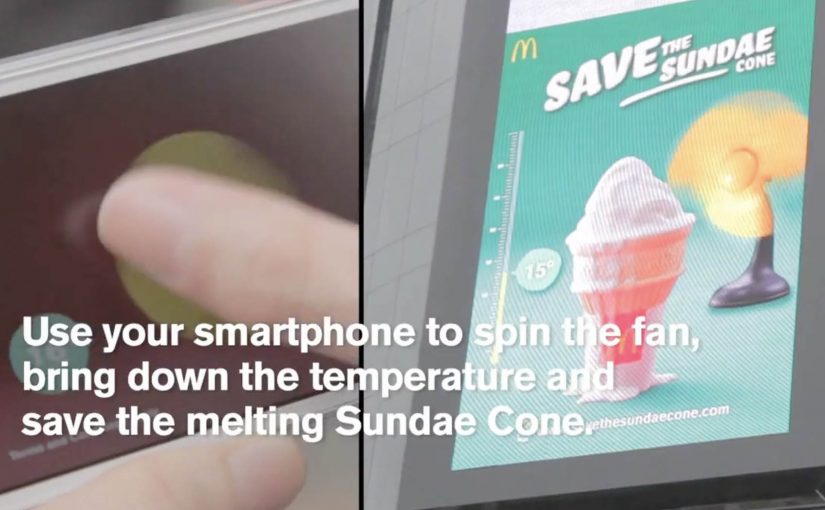
Summer is here and McDonald’s is back with an interactive outdoor campaign built around one simple problem. A giant LED billboard in Bukit Bintang, one of Kuala Lumpur’s best-known shopping districts, showcases the iconic Sundae Cone. But it is melting.

To save it, people use their smartphones to spin a fan on the billboard, bring the temperature down, and stop the cone from disappearing.

The mechanic: one shared control, one visible outcome

The execution translates an abstract idea, “cool it down,” into a single piece of viewer control. You open the experience on your phone and spin a fan. The billboard responds in real time. When more people join in, the cooling effect accelerates, so the experience naturally becomes collaborative rather than solo.

In some write-ups, participation is also rewarded with a Sundae Cone e-voucher that arrives on the phone, adding a clean payoff to the play.

In high-footfall retail districts, interactive DOOH, meaning public digital screens that react to what people do, works best when the action is obvious, social, and instantly rewarded.

In high-density urban retail districts, the win is not interactivity by itself but a public action that converts attention into nearby store traffic.

Why it lands

It is instantly legible from a distance. Something is melting. A crowd can fix it. Because the phone gesture maps directly to the visual problem on the screen, people understand the task instantly and the crowd can follow the result without explanation. That clarity creates a low-friction loop: notice. join. watch the shared progress. earn the reward. The “melting” constraint also adds urgency without needing any heavy messaging, and the big screen makes every participant feel like they are influencing something larger than a banner.

Extractable takeaway: If you want people to interact in public, reduce the mechanic to one familiar gesture, make the result visible to everyone, and design the reward so participation feels worth it even for a 30-second engagement.

What McDonald’s is really buying

The real question is whether the screen can turn public play into store-proximate action before attention drifts. This is a strong retail DOOH execution because the interaction, the product promise, and the path to redemption all reinforce each other. This is not only awareness. It is behavior. Get people to take out their phone, do a playful action tied to heat and refreshment, and then convert that attention into a reason to walk into a nearby store. The billboard becomes a live demo of “cool relief,” not a static claim.

What retail teams should borrow

  • Design for crowds first. If spectators cannot immediately understand what participants are doing, participation stalls.
  • Make progress collective. Shared outcomes create social proof and naturally recruit more people.
  • Keep the gesture native. One simple interaction beats a clever multi-step flow in outdoor environments.
  • Tie reward to proximity. If you can convert engagement into a nearby redemption moment, the media becomes a traffic engine.

A few fast answers before you act

What is “Save the Sundae Cone”?

It is an interactive digital out-of-home campaign in Kuala Lumpur where a billboard shows a melting Sundae Cone and invites the public to cool it down using their smartphones.

How do people control the billboard?

They use their phone to spin a fan mechanic that cools the on-screen temperature. More participants increase the effect, making it collaborative.

Why is the melting mechanic effective?

Melting creates urgency that anyone understands, and it turns participation into a visible “save” moment the crowd can watch.

What makes this a strong example of interactive DOOH?

The action is obvious, the feedback is immediate, and the experience becomes social because progress is shared on a large public screen.

What is the key takeaway for other brands?

Use one native gesture, show real-time feedback in public, and reward participation quickly so interaction feels like a fair trade.

Playable Music Posters: Tap to Hear

Playable Music Posters: Tap to Hear

Borders between media are blurring. Books are being swiped, magazines digitally scrolled and even in print one can today occasionally navigate. So it is no surprise when regular paper posters come to life on being combined with bluetooth, conductive ink, sensors and speakers.

Paper as an interface, not a surface

The mechanism is straightforward. Conductive ink turns parts of a poster into touch-sensitive zones. Sensors detect taps, knocks, or touch patterns. Bluetooth and small speakers, or a paired phone, provide the audio output. The poster stops being an image and starts behaving like a controller.

In public retail and event environments, touch-based posters only work when people feel safe and permitted to interact.

In consumer marketing and live environments, interactive print means print that senses touch and triggers a digital response. It is a way to turn passive out-of-home into a touchpoint that behaves like a device.

Beck’s Playable Poster

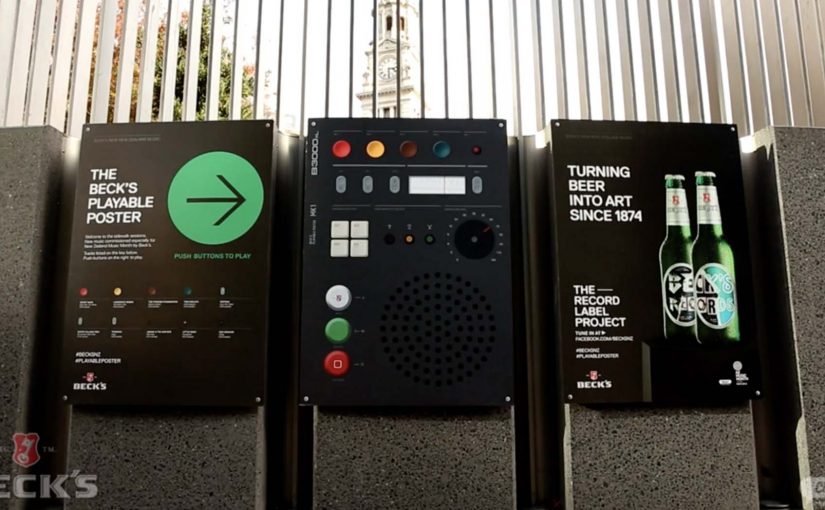
Looking for an innovative way to mark New Zealand’s Music Month, Beck’s partnered with Shine to design a playable poster. Using conductive ink and speakers the posters were made playable with a simple tap of the finger.

The Sound of Taste

Herb and spice brand Schwartz is all about flavour. So to dramatise flavour which was invisible and silent, they got print tech collective Novalia and ad agency Grey London to collaborate on an interactive poster. The poster used conductive ink to turn the surface area of the paper into an interactive interface that also connected to the viewers smartphone to deliver a richer experience.

Change the tune

Agency Republic from UK created a poster with an embedded sensor which when knocked changed the song being played on the agencies shared sound system.

Why these work: the demo happens in your hands

Each example keeps the interaction legible. Tap to trigger sound. Touch to explore flavour as audio. Knock to skip a track. The poster does not ask people to learn a new behavior. It hijacks an existing one, touching a surface, and rewards it instantly.

Extractable takeaway: When you want print to feel alive, make one obvious gesture trigger one immediate reward, and let the brand message ride on that moment of viewer control.

The real question is whether the interaction earns enough memorability to justify the added production. If the payoff is not instant and on-message, do not build it. Because the audience causes the outcome with a simple touch, the message sticks.

Practical patterns for interactive print

  • One interaction, one reward. Do not overload the surface with too many modes.
  • Make the “how” obvious. A tap zone, a knock cue, a simple instruction. Then deliver instantly.
  • Use phones as infrastructure. If pairing adds depth, let the phone do what paper cannot, audio, saving, sharing.
  • Design for public confidence. People will only touch a poster if it feels safe, clean, and socially acceptable.

A few fast answers before you act

What is “conductive ink” doing in these posters?

It creates touch-sensitive paths on paper, so taps or touches can be detected and mapped to actions like playing audio.

Do these posters need special printing like QR codes?

They still require specialist production, but the interaction can be integrated invisibly into the design. The poster itself becomes the control surface rather than carrying visible codes.

Why add Bluetooth to print?

Bluetooth allows paper to trigger sound through a phone or external speaker, which is essential when the content is audio or when you want richer layers than print can carry.

What makes an interactive poster feel “worth it” to a passer-by?

Immediate payoff and low friction. If the result is instant and satisfying, people will try it. If setup or pairing is slow, they walk past.

Where does this format fit best?

In environments where people have dwell time and curiosity, festivals, transit hubs, retail windows, office interiors, and brand experiences where interaction is socially normal.