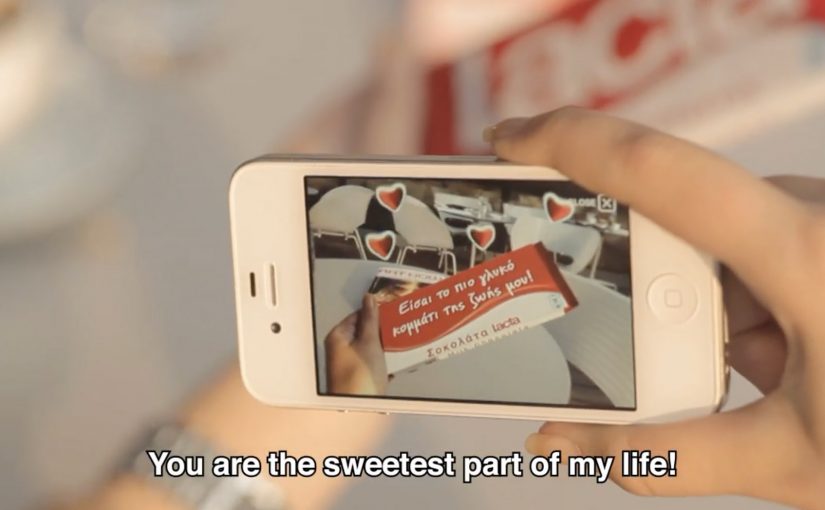
OgilvyOne Athens created another innovative campaign for Lacta Chocolate. This time, people write their own love messages and see them appear on real Lacta bars through an augmented reality mobile app.
The twist is that the message is not “published” online first. It is revealed on the physical product when the receiver scans the wrapper with the app, which turns a simple bar of chocolate into a personalized moment.
Click here to view some of the past Lacta Chocolate campaigns that are equally innovative.
How the AR message reveal works
The mechanism is a clean three-step loop. The sender composes a message in the app and chooses who it is for. The receiver is prompted to use the app too, then scans a Lacta bar to reveal the hidden message in augmented reality. Because the reveal depends on scanning the product, the experience is designed to connect emotion and purchase in the same gesture.
In FMCG gifting categories where love and ritual drive preference, adding a personal reveal layer can create differentiation without changing the core product.
Why it lands
It modernizes a familiar behavior, writing something personal on a gift, without losing the physicality of giving chocolate. The message feels private and earned because it only appears when the recipient holds a real bar in their hands and chooses to reveal it. That makes the brand’s role feel like an enabler of intimacy, not an interruption. That works because the product scan turns anticipation into part of the gift, which makes the interaction feel more meaningful than a standard message.
Extractable takeaway: If you want personalization to drive both attention and sales, tie the reveal to a physical trigger. Make the digital layer unlockable only through the product, so the magic moment and the transaction reinforce each other.
What Lacta is really optimizing for
The real question is how to make personalization pull product demand instead of floating as a nice digital extra.
This is built to turn gifting into repeatable behavior. One person sends a message, another person downloads the app, then the product becomes the key that unlocks the experience. That creates a loop that can scale through relationships rather than through media weight alone.
The strongest strategic choice here is keeping the chocolate bar as the gate to the experience, not just the branded wrapper around it.
What to steal for your own packaging-led digital work
- Use the pack as the trigger. If the wrapper is the marker, the product stays central.
- Make the reveal the reward. The moment of discovery is what people remember and retell.
- Keep the steps simple. Create, send, scan. Anything more complex reduces participation.
- Design for reciprocity. The best gifting mechanics invite the receiver to respond, not just consume.
A few fast answers before you act
What is the core idea of this Lacta campaign?
An AR mobile app that lets people write a love message that only appears when the recipient scans a real Lacta chocolate bar.
Why does tying the reveal to the physical bar matter?
It keeps the product as the gateway to the experience, so personalization supports purchase rather than replacing it.
What is the main emotional benefit versus a normal digital message?
The message feels more intimate because it is hidden and revealed in a physical moment, not broadcast in a feed.
Why not publish the message online first and then link to the product?
Because that would make the product secondary. Here, the chocolate bar is the access point, so the physical gift remains central to the experience.
What is the biggest execution risk with AR-on-pack ideas?
Friction. If install, scanning, or recognition is unreliable, the magic becomes disappointment. The reveal has to work fast and consistently.