
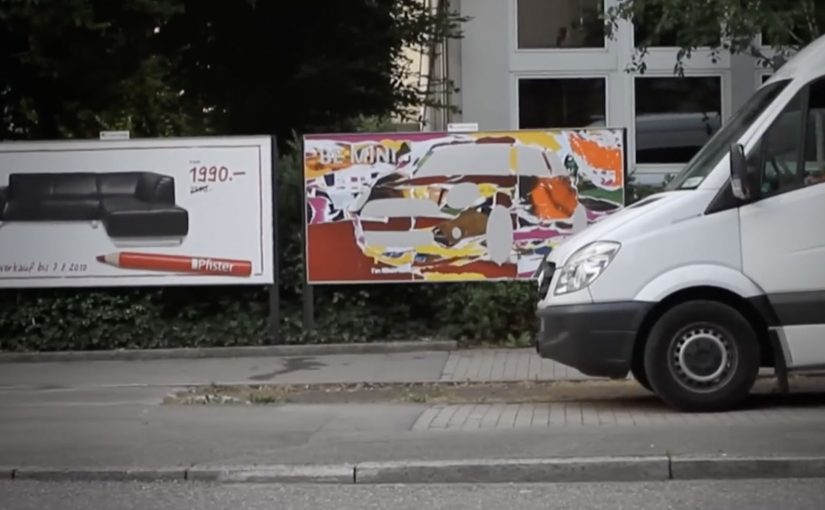
MINI: The Art of Omission Posters

MINI: The Art of Omission Posters

A “MINI” has only the things it really needs. That means getting rid of the superfluous and keeping an eye on the essentials. MINI calls this “Minimalism”.

So Draftfcb/Lowe Group in Zürich creates a poster series across Switzerland that demonstrates the MINI art of omission in an intentionally simple way. Here, “art of omission” means the idea is carried by what you remove, not what you add. Reportedly, more than 20 executions appear in the wild, framed as genuine, unique works of art rather than disposable tactical print.

Minimalism as a communication system, not a slogan

The mechanism is straightforward: take the brand’s “minimum necessary” philosophy and express it through omission, letting what is missing do as much work as what is shown.

In European automotive advertising, stripping a message down to a single visual point is often the fastest way to win attention in cluttered public spaces.

Why omission cuts through

Most posters fight for attention by adding. More copy. More product shots. More badges. Omission flips that logic. The real question is whether your idea is strong enough to survive subtraction. If simplicity is part of the product truth, omission beats piling on claims. The viewer has to resolve the idea themselves, and that small moment of mental completion makes the message stick.

Extractable takeaway: If the audience can reconstruct the meaning from what you remove, the idea is strong. If they need you to explain it, you are not done simplifying.

What the street placement adds

Putting the work across Switzerland turns “Minimalism” into a repeated encounter, not a one-off reveal. Repetition is the multiplier here, because every new variation reinforces the same discipline: remove anything that does not earn its place.

How to apply omission in your next poster

  • Use subtraction as the creative device. If you cannot remove an element without losing the point, it is probably essential.
  • Let the format carry the proof. A minimalist brand idea is more believable when the execution is minimalist too.
  • Design for one-second comprehension. The fastest posters are the ones that do not ask for reading.
  • Build a series, not a single hero. Variations teach the audience the “rule” of the campaign.

A few fast answers before you act

What is this MINI “Minimalism” poster idea in one line?

A Swiss poster series that communicates MINI’s “keep only what you need” philosophy by using omission as the main creative device.

Why does omission work better than adding more message?

Because it interrupts expectations in public space and forces a quick mental “solve”, which increases recall.

What makes this feel clutter-breaking?

The work reduces visual noise instead of competing with it, so the absence becomes the attention trigger.

When should a brand use this pattern?

When the brand truth can be expressed as one visual point, and when simplicity is a credible part of the product story.

How do you decide what to remove without losing meaning?

Strip the execution until the message breaks, then add back only the one element that restores the point. If you need multiple add-backs, the idea is not single-point yet.


Vodafone: 5 Million Pixel Hunt

Vodafone: 5 Million Pixel Hunt

To promote the Vodafone LG Optimus Windows 7 phone with a 5-megapixel camera, Jung von Matt/Alster built a deceptively simple challenge: find the “winning” pixels inside a picture made of five million clickable pixels.

The premise is literal. One giant image is broken into a massive pixel field. A small set of those pixels are winners, and each winning pixel unlocks a prize, a new LG Optimus Windows 7 phone.

In handset launches, interactive “single mechanic” experiences can outperform heavier builds because the payoff is immediate and the learning curve is close to zero. By “single mechanic,” I mean one repeatable action loop that anyone can understand instantly.

A camera spec turned into a game mechanic

Most 5MP messaging ends up as lifestyle photography claims. This flips it into a rule: five million pixels. Go hunt them. That move makes the spec tangible, even if you never take a photo. Because the spec becomes a rule you can act on, the message lands without explanation and invites immediate participation.

It also reframes the product story from “better camera” to “better challenge.” The camera claim becomes the architecture of the experience.

In mass-market handset launches, the simplest interactive loops win because they reward attention in seconds, not minutes.

Why the pixel hunt pulls people in

A “pixel hunt” is a giant clickable image where only a small set of pixels are winners, and three forces do the work:

Extractable takeaway: When a spec can be turned into a single, repeatable micro-action with an obvious reward, participation scales faster than feature-heavy experiences.

  • Micro-actions: every click feels like progress, even when nothing happens.
  • Lottery logic: anyone can win, which keeps effort rational in small bursts.
  • Social proof: the more people play, the more the hunt feels “worth trying.”

The real question is whether your mechanic is so obvious that people can start without instructions and still feel progress within the first few clicks.

This is the kind of engagement design that scales without extra features. It is not a platform. It is a loop you can explain in one sentence.

Reported outcomes, and the real takeaway

The campaign is reported to have driven hundreds of thousands of visitors and to have had the full pixel field “clicked out” within weeks. Whether or not you track the exact numbers, the lesson holds: a single, repeatable micro-action can create massive aggregate participation when the reward is clear and the friction is low.

For spec-led launches, I would rather ship one obvious loop like this than a sprawling feature set that needs onboarding.

What to borrow from the pixel-hunt mechanic

  • Translate a spec into an experience rule, not a headline.
  • Use one action that is impossible to misunderstand, here it is “click to search.”
  • Make progress feel constant, even when outcomes are rare.
  • Keep the story retellable, “there were prizes hidden in five million pixels.”

A few fast answers before you act

What is a “pixel hunt” campaign?

An interactive image where users click through a dense pixel field to uncover hidden winning spots that unlock prizes.

Why does tying the hunt to “five million pixels” matter?

It turns a product attribute into the core mechanic. The spec becomes something you do, not something you are told.

What makes this kind of engagement scale?

Low friction plus high repeatability. People can participate in seconds, stop, and return without needing to relearn anything.

What is the biggest risk with this mechanic?

Fatigue. If the reward feels too remote, people churn. The prize framing and perceived odds must stay motivating.

How do you measure success beyond page views?

Unique participants, average clicks per session, return rate, and the conversion from participation into newsletter opt-ins, store visits, or qualified leads, depending on your objective.