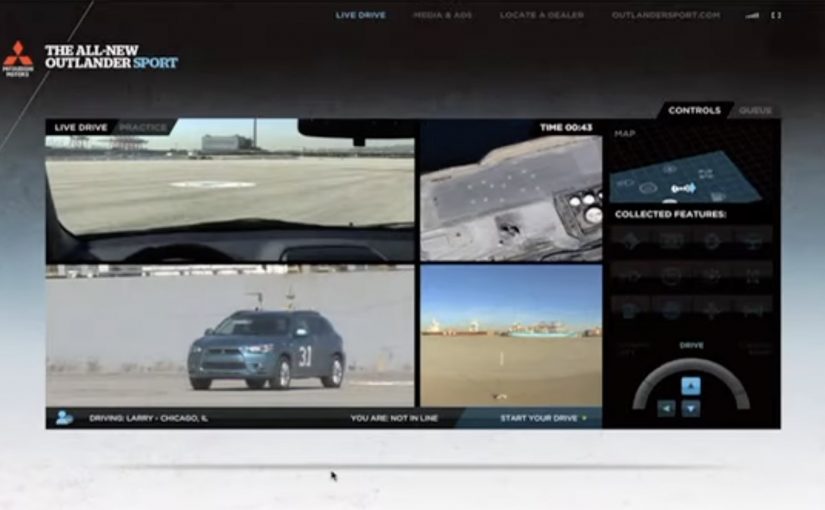
The future of test driving a car is here. 180/Los Angeles has hooked up the Mitsubishi Outlander Sport to a unique system allowing people to test drive it through their browser.
The interactive element, with the claim from the agency that it is the world’s first online test drive, is the first in a series of launch components in an integrated campaign that is running through January.
Working with production company B-Reel, 180 and Mitsubishi have developed a remote control system that will allow prospective buyers to take the Outlander Sport for a drive on a closed course, over the web.
Multiple cameras, in-car servos and GPS mapping, with the help of a robotics engineer, will keep the Outlander Sport on-course and responsive to online drivers’ commands.
Starting October 15th you can sign up (US residents only) for the test drive at www.outlandersport.com.
How the remote test drive is staged
The mechanism is a tight loop between live video and machine control. You watch the car from multiple camera angles. Your browser inputs translate into steering and pedal actions via servos. GPS mapping and safety logic keep the vehicle constrained to a closed course while still feeling responsive.
In automotive launches, reducing “dealership friction”, the time, travel, and commitment people associate with a showroom visit, is a reliable way to move people from curiosity to consideration.
Why it lands
This works because it reframes a test drive as an event. It is not only “learn about the car”. It is “drive it now” from wherever you are. That live control loop matters because the moment people see the car respond to their own inputs, the demo stops feeling like content and starts feeling like proof. The closed-course constraint does not weaken the idea. It actually signals seriousness, safety, and engineering intent.
Extractable takeaway: If you can let people control a real-world object remotely, even within strict guardrails, you turn a product demo into a personal story. That story is easier to share and harder to forget than a standard video.
What the campaign is really selling
Beyond features, this sells confidence in the brand’s relationship with technology. The real question is whether the launch gives people a reason to move from passive viewing to active participation. It also creates a strong reason to register and show up at a specific time. That turns passive awareness into an active lead moment without forcing an immediate dealership visit.
Steal this pattern
- Make the product controllable: remote control, configurators, live demos. Anything that turns viewers into participants.
- Use guardrails, not free-for-all: closed courses and constraints can increase trust and reduce risk while keeping the thrill.
- Design for “I have to try this”: the premise should be understandable in one sentence and irresistible in the next.
- Pair novelty with capture: registration and scheduling turn a stunt into measurable demand.
- Ship proof, not promises: let the mechanism do the persuasion instead of piling on claims.
A few fast answers before you act
What is the “test drive from your browser” concept?
It is a remote driving experience where a real Mitsubishi Outlander Sport is driven on a closed course while participants control it over the web and watch via multiple cameras.
How does it stay safe and on-course?
The setup combines in-car servos, GPS mapping, and production controls that keep the vehicle constrained to a defined route while still responding to user commands.
Why do this instead of a normal video or configurator?
Because control changes attention. A controllable demo creates involvement, and involvement creates memory and sharing.
Is “world’s first online test drive” the important part?
It is the headline hook. The transferable value is the format: a real product experience delivered remotely with live feedback.
What is the main marketing benefit?
It turns awareness into action. People register, show up, and participate. That makes the launch measurable and builds intent without requiring an immediate dealership visit.