
T-Mobile ‘Tell Me Why’: The Live-Retail Play

A boy-band button in Times Square. And a very deliberate question

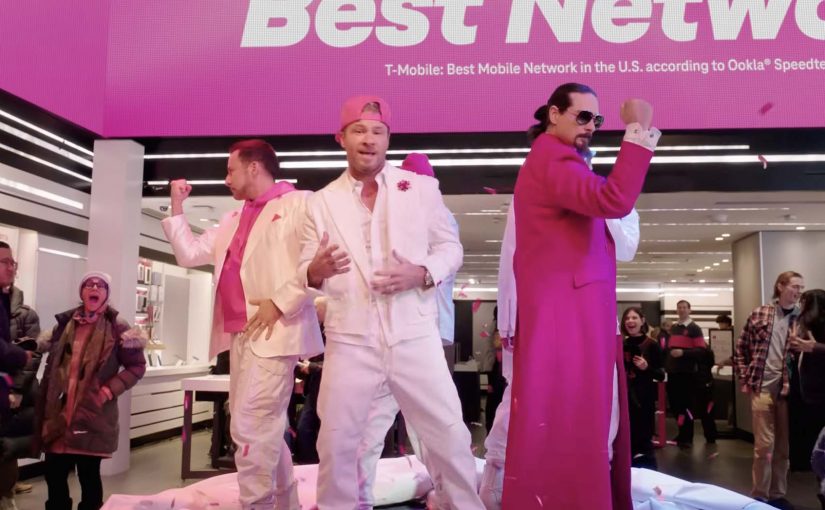
T-Mobile’s Super Bowl LX spot opens inside its Times Square Signature Store, surrounded by real customers, with a plain prompt on-screen: “Why is it better over here?” Then someone hits a big red button, the Backstreet Boys appear, and the “answer” arrives as a reimagined performance of I Want It That Way, with cameos from Druski, mgk (Machine Gun Kelly: Colson Baker) and Pierson Fodé. The commercial is credited to Panay Films and was slated to run as a :60 in the second quarter of the February 8, 2026 Big Game broadcast.

What matters is not the celebrity stack. It is the structural move: a telecom brand turning a comparison claim into a moment people can watch happening to other people.

How “Tell me why” turns a service claim into a stageable event

The core mechanic is simple on purpose. A single question frames the ad like a customer challenge, not a brand monologue. A physical trigger, the button, converts messaging into cause and effect. A live performance inside a real retail space supplies social proof because the audience is already there and reacting in-frame.

You can call this retail-as-stage. By retail-as-stage, I mean a physical store that functions as content set, event venue, and credibility engine at the same time.

When you turn a service comparison into a witnessed moment in a real store, with real reactions, belief shifts from “do I trust this claim?” to “I just saw why it’s true.”

The real question is how you make an invisible network promise feel provable in the moment, not just plausible in a chart.

The fastest path to belief is to turn an invisible network promise into a shared, watchable moment.

In telecom marketing, most value is felt after purchase, so “proof” has to be engineered before the contract is signed.

Why the nostalgia remix works, and why it is not just “a pop-culture hook”

Yes, it is familiar. But the stronger psychological play is fluency. A chorus people can finish in their head reduces processing effort, then that freed-up attention gets spent on the new lyric payload. The button adds perceived transparency. When a brand invites “why,” then stages an immediate “answer,” it signals it can withstand scrutiny.

Extractable takeaway: If your offering is hard to evaluate because it is invisible, abstract, or overloaded with fine print, stop trying to explain it better. Engineer a moment where the audience can watch someone else receive the answer in real time, because observed reactions become the credibility layer your claims cannot earn on their own.

Rewritten lyrics are inherently risky because they can feel like a jingle wearing a costume. This spot reduces that risk by grounding the musical in a real place, with real customers, and a visible trigger that creates a story arc worth retelling.

What T-Mobile is really trying to shift in 60 seconds

Look past the network line and you see a category-level repositioning attempt.

  • From coverage to a value stack. The ad frames the carrier choice as network plus bundled value plus experience, not just bars and price.
  • From switching pain to switching ease. The broader message is “make it easy to reconsider,” while the spot’s job is to create emotional permission to do so.
  • From brand assertion to customer interrogation. Opening with “why” signals the brand is answering scrutiny, which is a more credible posture in a high-skepticism category.

The Europe echo: making a network promise watchable

It should feel familiar. This “make connection visible” move has shown up before, by turning a network promise into a shared public moment you can actually witness.

Back in 2011, Deutsche Telekom executed a multi-city Christmas activation where Mariah Carey appeared as a hologram simultaneously across five European countries, with audiences linked across cities to experience the same performance at once.

The shared mechanic across both campaigns is consistent.

  • Make the promise tangible by creating a collective moment that can only exist because connection exists.
  • Use a universally recognizable song layer to synchronize emotion across audiences.
  • Build a reveal structure so the audience has a story arc worth retelling.

For the full Germany case, see Deutsche Telekom’s hologram Christmas surprise.

Steal the retail-as-stage pattern for “invisible products”

  • Start with a question the customer would actually ask. Not a tagline. A test.
  • Build one physical trigger. Buttons, switches, taps, scans. One action that says “watch this.”
  • Make the audience part of the evidence. Real reactions often land harder than any graphic.
  • Use music as memory infrastructure, not decoration. A familiar melody can carry new meaning fast.
  • Design for retellability. If it is easy to summarize, it is easier to spread.

A few fast answers before you act

What is the big idea behind “Tell Me Why” in one line?

It turns a telecom comparison claim into a witnessed moment in a real retail setting, using a familiar chorus and real-customer reactions to make “why” feel observed rather than asserted.

What is the core mechanic that makes it work?

A single customer-style question plus a physical trigger, the button, that immediately produces the “answer” as a performance, with the crowd reaction acting as the credibility layer.

Why does the Backstreet Boys remix outperform a normal benefits list?

Because audiences already encode the melody automatically. The rewritten chorus becomes a fast memory container for new information, and the live-style staging reduces skepticism.

What is the strategic intent beyond awareness?

To shift evaluation from “coverage and price” toward “network plus value plus experience,” and to lower switching resistance by making reconsideration feel emotionally safe.

What is the transferable lesson from the Deutsche Telekom hologram example?

If your product promise is invisible, create a synchronized public moment that can only exist because your promise exists, then let the shared reaction do the persuasion work.


AI Trends 2026: 9 Shifts Changing Work & Home

AI will impact everything in 2026, from your fridge to your finances. The interesting part is not “more AI features”. It is AI becoming an execution layer that can decide and act across systems, not just advise inside a chat box. That shift matters because once AI can execute, throughput and experience depend less on prompts and more on integration, permissions, and policy.

The nine trends below are a useful provocation. I outline each shift, then add the operator lens: what is realistically visible in the market this year, and what still needs a breakthrough proof point before it goes mainstream.

The 9 trends, plus what you can realistically expect to see this year

Trend 1: AI will buy from AI

We move from “people shopping with AI help” to agents transacting with other agents, purchasing that is initiated, negotiated, confirmed, and tracked with minimal human intervention. This shows up first inside high-integration ecosystems. Enterprise procurement, marketplaces, and platforms with clean APIs, strong identity controls, and policy layers. Mass adoption needs serious integration across catalogs, pricing, budgets, approvals, payments, and compliance, so this needs high-profile integration before it becomes mainstream behavior.

Trend 2: Everything gets smart

Not just more connected devices, but environments that sense context, adapt, and coordinate, from home energy to health to kitchen routines. You will start seeing this more clearly, but it requires consumers to spend money to upgrade. The early phase looks like pockets of “smart” inside one ecosystem because upgrade cycles are slow and households hate complexity. It will be visible this year, but it is gated by consumer investment.

Trend 3: Everyone will have an AI assistant

The tangible version is not a chatbot you consult. It is a persistent layer that can take actions across your tools: triage inbox, draft and send, schedule, summarize, file, create tasks, pull data, and nudge you when a decision is needed. This year, the realistic signals are assistants embedded in software people already live in, email, calendar, docs, messaging, CRM. You will see “do it for me” actions that work reliably inside one suite. You will not yet see one universal assistant that flawlessly operates across every app and identity boundary, because permissions and integration are still the hard limit.

Trend 4: No more waiting on hold

AI takes first contact, resolves routine requests, and escalates when needed. This is one of the clearest near-term value cases because it hits cost, speed, and experience. Expect fast adoption because the workflows are structured and the economics are obvious. The difference between “good” and “painful” will be escalation design and continuous quality loops. Otherwise you just replace “waiting on hold” with “arguing with a bot”.

Trend 5: AI agents running entire departments

Agents coordinate end-to-end processes across functions, with humans supervising outcomes rather than executing every task. Mainstream is still a few years out. First we need a high-profile proof of concept that survives audit, risk, and operational messiness. This year, the credible signal is narrower agent deployments: specific workflows, explicit boundaries, measurable KPIs. By “agentic workflows” I mean systems that can plan a sequence of steps and take tool actions, within explicit boundaries, to complete a task. “Entire departments” comes later, once governance and integration maturity catch up.

Trend 6: Household AI robots

Robots handle basic household tasks. The near-term reality is that cost and reliability keep this premium and limited for now. This year you may see early adopters, pilots, and narrow-function home robots and services. Mainstream needs prices to fall significantly, plus safety, support, and maintenance models to mature. This is expensive investment until it gets cheaper.

Trend 7: AI robots will drive your car

This spans autonomous driving and even robots physically operating existing cars. The bottleneck is public safety, liability, and regulation. Mainstream is still some years away largely due to government frameworks and insurance constraints. The earlier signals show up in controlled environments, private roads, campuses, warehouses, and geofenced routes where risk can be bounded.

Trend 8: AI-powered delivery

Automation expands across delivery chains, from warehouse robotics to last-mile drones and ground robots. Adoption will be uneven. You will see faster rollout where regulation is lighter or clearer, and in constrained zones like campuses and planned communities. More regulated markets will follow slowly, which means this trend will look “real” in some countries earlier than others.

Trend 9: Knowing AI = career advantage

AI literacy becomes a baseline advantage. Prompting is table stakes. The career advantage compounds when you can move from using AI to integrating it into repeatable workflows with governance and measurable impact. The speed of that shift, from “use” to “integrate”, determines how quickly this advantage becomes visible at scale.

The real question is whether you are treating AI as a feature add-on, or as an execution layer with integration, explicit permissions, and measurement.

If you want durable advantage in 2026, build the integration and guardrails first, then scale the “do it for me” moments.

In enterprise and consumer ecosystems, the practical winners are the organizations that treat AI as an execution layer with integration, governance, and measurement built in.

2026 is a signal year, not an endpoint

Do not treat these nine trends as predictions you must “believe”. Treat them as signals that AI is moving from assistance into action.

Extractable takeaway: When AI starts taking action, advantage shifts to teams that can connect systems, grant permissions safely, and prove outcomes with measurement.

Some shifts will show up quickly because the economics are clean and the workflows are structured. Others need a breakthrough proof point, cheaper hardware, or regulatory clarity. The leaders who pull ahead this year will be the ones who build integration, guardrails, and measurement early, so when the wave accelerates, they are scaling from a foundation, not improvising in a panic.

What to operationalize from these 2026 shifts

  • Pick a few workflows, not “AI everywhere”. Start with bounded tasks where inputs, approvals, and outputs are clear.
  • Make permissions and escalation explicit. Define what the assistant can do, when it must ask, and how humans take over cleanly.
  • Invest in integration and data hygiene. Catalogs, identity, policies, and reliable APIs are what make “do it for me” work.
  • Measure the delta. Track cycle time, resolution quality, and error handling so automation improves instead of drifting.

A few fast answers before you act

What are the biggest AI trends to watch in 2026?

The nine shifts to watch are agent-to-agent buying, smarter consumer tech, mainstream AI assistants, AI-first customer service, narrower agent deployments in business functions, household robots, autonomous driving progress, AI-powered delivery, and AI literacy becoming a career differentiator.

Which AI trends will show visible adoption this year?

Customer service automation (no more waiting on hold) will scale fastest because the workflows are structured and the economics are clear. You will also see clearer signals in “smart everything” and AI assistants, mainly inside closed ecosystems and major software suites.

What will slow down “AI buying from AI”?

Integration and policy. Autonomous purchasing needs clean product data, pricing, payments, approvals, identity, and compliance across multiple systems. Expect early signals in high-integration marketplaces and enterprise procurement before mass adoption.

Are “AI agents running entire departments” realistic in 2026?

You will see more narrow, high-impact agentic workflows. Department-level autonomy is likely still a few years out because it needs high-profile proof points that survive audit, risk, and real operational complexity.

When will robots in homes and cars become mainstream?

Not yet. The early phase is expensive and limited. Mainstream adoption depends on price drops, reliability, safety standards, and support models, plus regulation, liability, and insurance frameworks that make autonomy feel dependable at scale.

Why does AI literacy become a career advantage in 2026?

Because advantage compounds when people move from using AI to integrating it into repeatable workflows with governance and measurable impact. Prompting helps. Integration changes throughput and business outcomes.

AI in Hollywood: Threat or Storytelling Upgrade?

AI is now part of everyday filmmaking. Some people see opportunity. Others see threat.

So, will AI destroy Hollywood and the film industry. Or will it change how we tell stories, who gets to tell them, and what “craft” even means.

AI is already in how films get made. Whether we admit it or not

The debate often sounds theoretical. Meanwhile, AI is already doing real work in how films get made. From early ideas to post-production: scripting support, concept design, scoring, editing assistance, voice work, and performance modification.

That matters for one simple reason. The question is no longer “Will AI arrive?”. The question is “What kind of AI use becomes normal, and under what rules?”.

If you look closely, the industry is already making that choice in small, easy-to-miss steps. The tools are frequently packaged as “features” inside software people already trust. Auto-transcription. Auto reframing for different screen formats. Tools that automatically cut out subjects from backgrounds. Tools that track motion in a shot. Noise reduction. Dialogue cleanup. Autotagging clips by faces or scenes. Call it machine learning, call it AI. The practical outcome is the same. Decisions that used to require time, specialists, or budget are getting compressed into buttons.

Because these features ship as defaults inside tools people already use, adoption becomes invisible, and “normal” shifts one button at a time.

The real question is how AI gets used, and what standards come with it.

In Hollywood production and modern brand storytelling teams, AI shifts the cost curve of production while raising the premium on taste, direction, and rights management.

AI is a tool. What matters is how you use it

There’s a repeating pattern in creative industries.

Extractable takeaway: When a tool compresses cost and time, the differentiator moves upstream to taste, direction, and the rules around what you are allowed to use.

A new tool arrives. People fear it will dilute artistry, eliminate jobs, and flood the market with mediocrity. Some jobs do change. Some workflows do get automated. Then the craft adapts, and the best creators use the tool to raise the ceiling, not lower the bar.

Sound did not kill cinema. Digital did not kill cinematography. Non-linear editing did not kill storytelling. CGI did not kill practical effects. What changed was access, speed, and the competitive baseline.

The sober takeaway is this. AI at its core is a tool. Like any tool, it amplifies intent. Without taste, it accelerates slop, meaning output that is fast but unconsidered. With taste, it accelerates iteration.

AI is leveling the playing field for filmmakers and creators

Here’s where the conversation gets practical.

AI lowers the cost of getting from idea to “something you can show.” It helps smaller teams and individual creators move faster. It also lets bigger studios compress timelines.

That’s the real shift. Capability is becoming less tied to budget, and more tied to taste, direction, and how well you use the tool.

Does AI help you be creative, or does it replace you?

Used well, AI helps you unlock options and enhance what you already made. It is not about creating a film from scratch. You still have to create. You still have to shoot. You still have to film. The difference is access. AI puts capabilities that used to require six-figure VFX budgets within reach, so more of your ideas can make it to the screen.

The line that matters is this: enhancement, not replacement.

The dark side. When “faster and cheaper” wins

The risk is not that AI exists. The risk is that business pressure pushes studios to use it as a shortcut.

When “cheap and fast” replaces craft, the damage shows up quickly: fewer human jobs, weaker trust, and more content that feels engineered instead of made. This is where AI stops being a creative tool and becomes a replacement strategy.

The pragmatic answer. It’s not AI or artists. It’s AI and artists

The realistic future is hybrid.

The best work will blend the organic and the digital. It will use AI to strengthen a filmmaker’s vision, not replace it. CGI can strengthen practical effects, and editing software can assemble footage but not invent the story. Similarly, AI can support creation without owning authorship.

So the goal is not “pick a side.” The goal is to learn how to use the machine without losing the magic. Also to make sure the tech does not drown out the heart.

AI is here to stay. Your voice still matters

AI is not going away. Ignoring it will not make it disappear. Using it without understanding it is just as dangerous.

The creators who win are the ones who learn what it can do, what it cannot do, and where it belongs in the craft.

Because the thing that still differentiates film is not gear and not budget. It is being human.

AI can generate a scene. It cannot know why a moment hurts. It can imitate a joke. It cannot understand why you laughed. It can approximate a performance. It cannot live a life.

That’s why your voice still matters. Your perspective matters. Your humanity is the point.

What to change in your next AI-assisted cut

  • Set the “allowed use” rules first. Decide what inputs are permitted, what must be licensed, and what needs explicit consent.
  • Use AI to expand options, not to dodge choices. Faster iteration is only useful if a human still owns direction and taste.
  • Protect trust as a production requirement. If viewers or talent feel tricked, the work loses leverage no matter how efficient it was to make.
  • Design for credit and accountability. Make it clear who is responsible for decisions, even when parts of the pipeline are automated.

A few fast answers before you act

Will AI destroy Hollywood?

It is more likely to change how work is produced and distributed than to “destroy” storytelling. The biggest shifts tend to be in speed, cost, and versioning, meaning producing multiple tailored cuts quickly. The hardest parts still sit in direction, taste, performance, and trust.

Where is AI already being used in film and TV workflows?

Common uses include ideation support, previs, VFX assistance, localization, trailer and promo variations, and increasingly automated tooling around editing and asset management. The impact is less “one big replacement” and more many smaller accelerations across the pipeline.

What is the real risk for creators?

The risk is not only job displacement. It is also the erosion of creative leverage if rights, compensation models, and crediting norms lag behind capability. Governance, contracts, and provenance, meaning where assets came from and what rights attach to them, become part of the creative stack.

What still differentiates great work if everyone has the same tools?

Clear point of view, human insight, strong craft choices, and the ability to direct a team. Tools compress execution time. They do not automatically create meaning.

What should studios, brands, and agencies do now?

Set explicit rules for data, rights, and provenance. Build repeatable workflows that protect brand and talent. Invest in directing capability and taste. Treat AI as production infrastructure, not as a substitute for creative leadership.