

Pepsi Max: Test Drive

Last year in March, Pepsi Max along with professional stock car racing driver Jeff Gordon performed a prank on an unsuspecting car salesman by taking him on a test drive of his life. Here, a “prank” is a designed real-world setup filmed to capture reactions, not a fully scripted spot.

The video since then got over 41 Million views on YouTube. Despite its viral success, automotive journalist Travis Okulski was not impressed and was pretty vocal in pointing out inconsistencies in the viral ad and calling it a fake.

So Jeff Gordon teamed up again with Pepsi Max to pull a similar prank on unsuspecting Travis Okulski, just to prove the authenticity of the original test drive video…

But even after all of that Travis Okulski is still not convinced and the video since its release last week has already gotten over 13 Million views on YouTube.

The real question is what you do when a viral stunt becomes a public authenticity debate.

Why this became a two-part story

The first video worked because the premise is simple, the escalation feels real, and the payoff is pure reaction. But the moment it went viral, it also invited scrutiny. Because the setup looks “too good to be true”, it triggers a verification instinct, which is why people rewatch, share, and interrogate the details. That is what makes the follow-up so interesting. The brand turned criticism into content by making the skeptic part of the narrative.

Extractable takeaway: When your entertainment idea can be framed as “real or staged”, plan a proof-driven sequel path up front, so the debate extends the platform instead of draining trust.

  • Viral hook. A familiar setting, then a sudden reveal of unexpected capability.
  • Credibility challenge. A public critique that reframed the conversation as “real or staged”.
  • Response as sequel. A second execution aimed at the critic to re-earn belief.

In mass-reach consumer campaigns, “real or staged” scrutiny is part of distribution, so the sequel has to protect credibility without changing the core promise.

What to learn from the backlash

If doubt becomes the headline, leaning in with credible proof beats going quiet. When stunts travel, authenticity becomes part of the product. If the audience starts debating “is it real”, the brand can either go silent or lean in. Pepsi Max leaned in and used the debate as fuel, which extended the lifecycle and kept attention anchored to the same brand platform.

  • Design for verification. Build in moments that can withstand frame-by-frame scrutiny.
  • Turn skeptics into structure. If a credible critic challenges you, make the response the next chapter, not a defensive footnote.
  • Keep the platform constant. Address doubts without drifting into a different promise or tone.

A few fast answers before you act

What is Pepsi Max “Test Drive” with Jeff Gordon?

It is a prank-style stunt video where Jeff Gordon takes an unsuspecting car salesman on an extreme test drive, created as part of Pepsi Max’s viral entertainment approach.

Why was there controversy around the first video?

An automotive journalist publicly pointed out inconsistencies and argued it was staged, which sparked debate about authenticity.

Why did Pepsi Max do a second video?

To address the credibility debate directly by repeating a similar stunt and making the outspoken critic part of the execution.

What is the transferable pattern for viral campaigns?

Expect scrutiny, especially when the content looks “too good”. If doubt becomes the story, design a credible sequel that engages the criticism rather than ignoring it.
Apotek Hjärtat: Blowing in the Wind

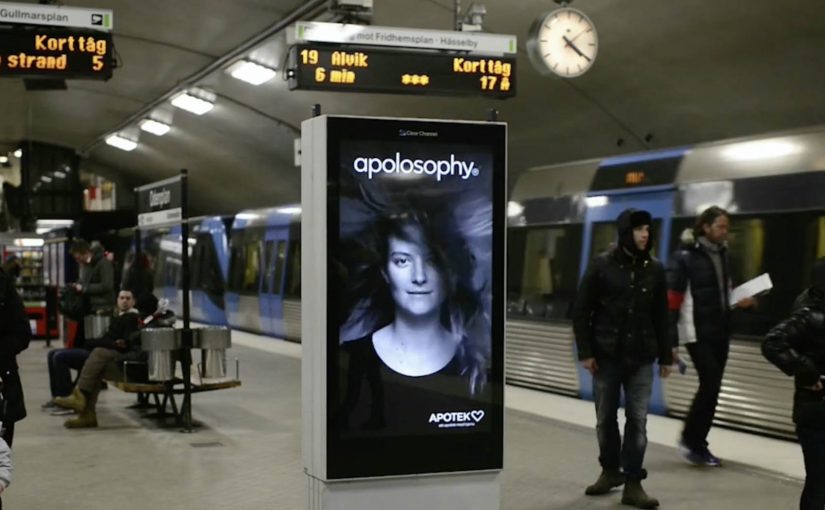
A subway platform in Stockholm. A digital screen. A model with a lush mane. Then the train arrives and her hair starts to whip around, perfectly timed to the rush of air you can feel on the platform.

To introduce a new line of hair products, Swedish pharmacy Apotek Hjärtat worked with Åkestam Holst to fit the platform screens with ultrasonic sensors. When those sensors detect an incoming train, the film switches into a “blowing in the wind” sequence, creating the illusion that the turbulence from the train is affecting the model on the screen.

The trick behind the timing

This is reactive outdoor done with restraint. Here, reactive outdoor means the screen responds to a real environmental trigger instead of running the same sequence on a fixed loop. There is no complex interface and no extra instruction for commuters. The environment provides the trigger, the sensor provides the cue, and the creative provides the payoff. The moment is over in seconds, which is exactly how long you get on a platform before attention snaps back to schedules and crowds.

In high-traffic transit environments where attention is scarce, reactive outdoor works best when it synchronizes with a real-world moment everyone already notices.

Why commuters stop

The effect feels “impossible” because it is contextual and precise. People experience the wind and see the wind at the same time. That sensory alignment is what makes it memorable, and it makes the product claim feel physical instead of cosmetic.

Extractable takeaway: If you want outdoor to earn attention, link the creative to a shared environmental trigger, and make the response immediate enough that viewers can connect cause and effect without being told.

What the brand is signaling

The story is not really about sensors. It is about vitality. The real question is whether the public moment makes the product promise feel physically true before the commuter moves on. The ad implies the product brings hair to life, then proves that idea through a living, timed reaction in a public space. You remember the feeling first, then the brand name attached to it.

What to steal for reactive outdoor

  • Pick a trigger that already exists. Trains arriving, doors opening, crowds gathering.
  • Make the payoff instantly legible. One glance should be enough to get it.
  • Use craft to hide the tech. The illusion matters more than the explanation.
  • Design for repeat viewing. Platforms are perfect for loops, because people wait.

A few fast answers before you act

What is “Blowing in the Wind”?

A reactive DOOH installation for Apotek Hjärtat where ultrasonic sensors detect an approaching subway train and trigger a film effect that makes the model’s hair appear to blow in the train’s turbulence.

What is the core mechanism?

Sensor detects train arrival. Creative switches at the same moment the real airflow hits the platform. The viewer experiences both together, which sells the illusion.

Why does it feel more persuasive than a normal screen ad?

Because it is synchronized with the physical environment. That alignment makes the message feel like something happening, not something being played at you.

What is the most common mistake when copying this pattern?

Overbuilding the interaction. If viewers need instructions, or if the trigger is unreliable, the magic disappears and the screen becomes just another screen.

Why does the product claim feel more real than in a standard beauty ad?

Because the demonstration is tied to a real physical cue on the platform. That makes the benefit feel observed in the moment, not merely claimed in the creative.

Polar Beer: Cell Phone Nullifier

There is a specific kind of modern annoyance. You go out with friends, and ten minutes later the table is lit by phone screens instead of conversation.

Polar, a regional Brazilian beer brand, decides to treat that as a solvable problem. If phones steal the night, then the beer should give it back.

A beer cooler that changes the rules of the table

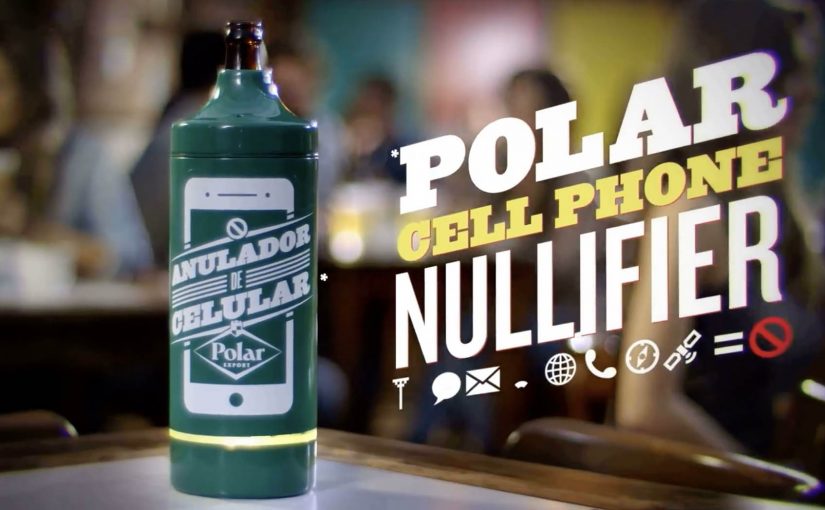
The mechanism is a physical prop with a blunt promise. A special Polar cooler is described as blocking 3G, 4G, Wi Fi, and GSM signals for devices within roughly a five-foot radius. Order Polar. Get served in the cooler. Watch the room look up.

In bar and nightlife settings, the strongest behavior-change ideas work when they attach to an existing ritual and alter it with minimal effort from the audience.

Because the cooler makes the phone temporarily useless at the table, conversation becomes the path of least resistance.

Why it lands, even if people hate it for a minute

This plays with a familiar tension. Everyone complains about “phubbing,” the habit of snubbing people in front of you by focusing on your phone, but nobody wants to be the first person to say “can we put phones away.” The cooler does the awkward social work on behalf of the group.

Extractable takeaway: If a social norm is breaking down, redesign the environment so the better behavior becomes the default. Remove the need for a lecture, and replace it with a small constraint that everyone experiences equally.

The brand benefit is also clean. Polar is not asking for attention. It is buying it back for you, then sitting at the center of the moment it created.

What the stunt is really selling

On the surface it is a gadget. Underneath it is a positioning move. Polar equates itself with real-world connection and the kind of night people say they want, even when their hands keep reaching for the screen.

The real question is whether you can earn attention by subtracting distraction, not by adding more stimulation.

This is a smart positioning move because it delivers the promise through the ritual, not through a slogan.

It is also a reminder that “anti-tech” can be a tech story. The cooler is not anti phone as an identity. It is pro conversation as an outcome.

Steal this for phone-free nights

  • Target the moment, not the attitude. Fix the table behavior, not the entire relationship with smartphones.
  • Use a prop that belongs in the setting. A cooler at a bar feels natural. A lecture does not.
  • Make it equal. The constraint applies to everyone in range, so it feels like a shared game, not a personal attack.
  • Build a story people retell in one sentence. “The beer that makes your phone stop” spreads fast.

A few fast answers before you act

What is Polar’s “Cell Phone Nullifier”?

It is a branded beer cooler concept described as cutting off nearby phone connectivity, so people ordering Polar are nudged into talking to each other instead of scrolling.

Why does blocking the signal work as a behavior-change tactic?

It removes the temptation rather than arguing with it. By changing the environment, it turns “I should put my phone away” into “my phone is not part of the table right now.”

What is the core creative mechanism here?

A familiar bar object is redesigned to enforce a social norm. The product ritual, ordering beer and receiving it in a cooler, becomes the delivery system for the idea.

How can brands adapt this without feeling preachy?

Focus on shared benefits and shared participation. Make the intervention playful and collective, and keep the user action simple and voluntary.

What is the biggest risk if you copy this idea?

If the constraint feels forced or punitive, it becomes the story instead of the conversation it was meant to protect. Keep it lightweight, contextual, and easy to opt into.