
Amazon Go was never about checkout

When Amazon Go surfaced, the headlines went straight to the obvious part. No cashiers. No checkout lines. Walk in, grab what you want, walk out.

It sounds like a stunt until you look at what it quietly challenges.

For decades, retail has been built around a fixed moment. The moment the customer stops. The moment the basket becomes a transaction. The moment the system catches up with reality.

Amazon Go takes that moment and tries to delete it. Not by making checkout faster, but by questioning whether checkout needs to exist as a separate step at all.

Position: Amazon Go is not primarily about convenience. It is about shifting the burden of “truth” from the customer’s confirmation to the system’s continuous sensing.

The real innovation is the part you don’t see

The experience is intentionally boring. That’s the point.

Nothing about the store screams “innovation” in the way tech demos usually do. There’s no “wow” screen at the end. No special ritual. No new behavior to learn. You behave like you always do. The store adapts around you.

That is the shift.

Amazon Go is less a store format and more a live system that tries to observe reality continuously. Who entered. What they picked up. What they put back. What they left with. Then reconciling all of that with identity and payment, without forcing you to participate in a checkout confirmation moment.

Retail has always relied on explicit confirmation. A barcode scan. A till. A receipt. A moment where the system can say, “Now we know.” Amazon Go is testing something different. A world where the system is confident enough, early enough, that it doesn’t need to ask.

In large omnichannel retailers, the hardest part is building operational truth without making customers do the bookkeeping.

Why this matters beyond convenience

If this works, it changes the definition of “frictionless”. Here, “frictionless” means uninterrupted flow. No queue and no explicit stop where the customer must confirm the basket.

Extractable takeaway: Removing a checkpoint beats optimizing it. But removing a checkpoint only works when you move its control logic into the system and design the exception path as carefully as the happy path.

Most retail innovation tries to shave seconds off steps. This tries to remove steps entirely. The customer doesn’t feel faster checkout. The customer feels absence. No interruption. No break in flow.

That absence is not just UX. It is a statement about operations.

When you delete a checkpoint, you do not remove work. You relocate it into sensing, reconciliation, inventory accuracy, and exception handling.

Because once you remove checkout as a formal checkpoint, the store must become more precise everywhere else. The “truth” can’t be created at the end of the journey. It has to be maintained throughout it.

And that’s why Amazon Go is interesting. Not because it eliminates a job role, but because it attempts to turn physical retail into something closer to software. A continuous system. Not a set of steps. A continuous system means a loop of sensing, reconciliation, and exception resolution, not a sequence of isolated handoffs.

What Amazon is really buying with this

Checkout-free is a design bet. You trade a visible control point for invisible control. That can reduce interruption for customers, but it also raises the bar for operational discipline behind the scenes.

The business intent is not “no lines” as a feature. The business intent is end-to-end reliability. Identity, item state, and payment have to reconcile cleanly without asking the customer to do the reconciliation work for you.

That is where the real cost sits. Sensors and models are only the beginning. The hard part is governance. How you handle misreads, disputes, refunds, edge cases, and the human operating model that keeps the system trustworthy.

Steal the pattern. Delete the checkpoint

The deeper takeaway is not “checkout-free store”. The real question is which checkpoints in your customer journey still earn their existence, and which ones only exist because your systems cannot carry the truth continuously.

  • Name your checkpoints. List the moments where the customer must stop to confirm something. Identity. Eligibility. Basket. Address. Consent. Payment.
  • Ask what the checkpoint protects. Fraud. Compliance. Inventory truth. Revenue assurance. If you cannot name it, you cannot redesign it.
  • Decide what “enough confidence” means. Define what the system must know before it stops asking the customer for confirmation.
  • Design the exception path first. The happy path is cheap. The edge cases are where trust is won or lost.
  • Measure absence, not speed. The KPI is not seconds saved. The KPI is interruptions removed without increasing disputes or operational cost.

Amazon Go is a reminder that sometimes innovation is not adding something new. It is removing something that no longer earns its existence.


A few fast answers before you act

What is Amazon Go?

Amazon Go is a retail concept that removes the traditional checkout step. Customers enter, pick up items, and leave without stopping at a register.

What is the real innovation behind Amazon Go?

The real innovation is not “no cashiers”. It is a live system that tries to observe shopping behavior continuously and reconcile what happens in the store with identity and payment without requiring a checkout confirmation moment.

Why does removing checkout matter?

Checkout is one of retail’s most fixed moments. Removing it reframes convenience from speed to absence. No queue and no interruption of flow.

What does Amazon Go suggest about customer experience design?

It suggests the biggest experience gains may come from removing steps that no longer earn their existence, rather than optimizing them. Removing a step only works when the system absorbs its control logic and handles exceptions cleanly.

What is the key takeaway from Amazon Go in 2016?

Amazon Go challenges the assumption that checkout must exist as a separate step. It tests whether retail can move from a sequence of discrete moments to a more continuous system of sensing, reconciliation, and exception handling.
Coca-Cola: First Drinkable Advertising

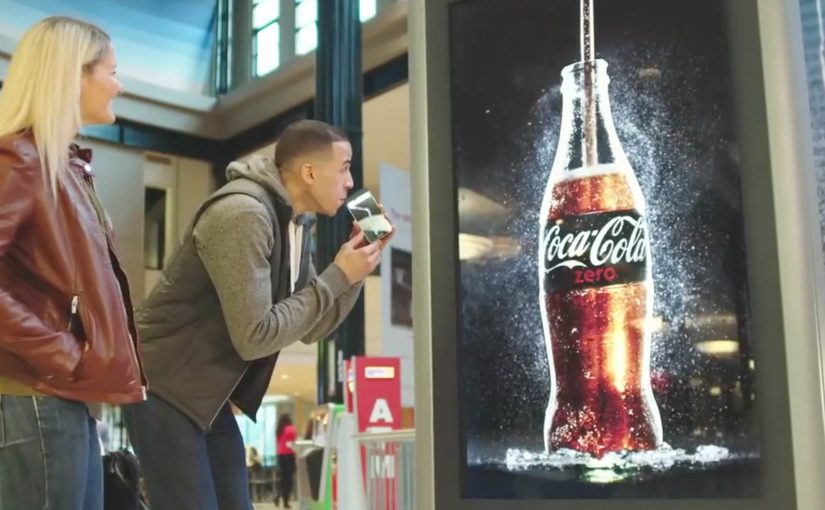
You are looking at a Coke Zero ad on a billboard, on TV, in print, or even on radio. Instead of just watching it, you Shazam it. On your phone, Coke Zero appears to pour into a glass on-screen, and that moment converts into a free Coke Zero coupon you can redeem at select retail stores across the US.

The premise is blunt and smart. Many people think they know the taste of Coke Zero, but they actually do not. So Ogilvy & Mather creates a campaign where the quickest route from awareness to belief is not another claim. It is immediate trial.

How “drinkable” advertising is engineered

This execution turns Shazam into a universal call-to-action layer across media. Here, “drinkable” means the ad triggers a mobile pour moment that turns into a redeemable coupon for immediate trial.

  • Any channel can trigger the experience. Billboard. TV. Print. Radio.
  • The smartphone becomes the conversion surface. Visual payoff first, then the coupon.
  • The coupon bridges straight into retail. “Try it now” becomes a physical action, not a brand sentiment.

The important part is not the novelty of animation. It is the end-to-end path from message to product-in-hand, because the Shazam trigger and coupon make the next step unambiguous.

Why this works as shopper marketing, not just a stunt

The campaign is designed to reduce the classic friction points that kill trial. In performance-led shopper marketing, the fastest path from awareness to belief is reducing trial friction and making redemption immediate.

Extractable takeaway: If you want trial, design the interaction so it ends in redemption, not in more content.

  • No guessing what to do next. Shazam is the behaviour.
  • No abstract promise. The ad demonstrates “taste” by pushing you to the real thing.
  • No delayed gratification. The reward is immediate and concrete. A redeemable coupon.

It is experiential marketing that does not require a pop-up installation or a live event. The experience travels with the media buy.

This is shopper marketing done right. It treats media as the first step of redemption, not as a detour into “engagement.”

The real question is whether your media can trigger immediate trial without adding steps or new infrastructure.

Steal this: Shazam-to-trial loop

If you are trying to drive trial at scale, this is a reusable model.

  1. One trigger across channels. Create a single interaction that works across channels.
  2. Mobile as the conversion surface. Use mobile to make the experience feel personal and immediate.
  3. Redemption, not delay. Close the loop with a retail mechanic that is simple to redeem.

Do that well, and “engagement” stops being a vanity metric. It becomes a measurable bridge to purchase.


A few fast answers before you act

What makes this advertising “drinkable”?

Shazaming the ad triggers a mobile experience that ends in a free Coke Zero coupon. It is designed to turn exposure into real-world trial.

Why use Shazam in the first place?

It provides a consistent interaction across media formats, including channels where clickable links do not exist.

What business problem is this solving?

Driving immediate trial for a product where many people assume they already know the taste, but have not actually experienced it.

What is the key CX detail that makes it work?

A simple, familiar action. One step to trigger, then a clear reward that can be redeemed in-store.

How do you prove this is more than a stunt?

Measure Shazam activations and coupon redemptions, then compare trial impact against a similar media buy without the redemption mechanic.

Coca-Cola Second Screen Reinvented

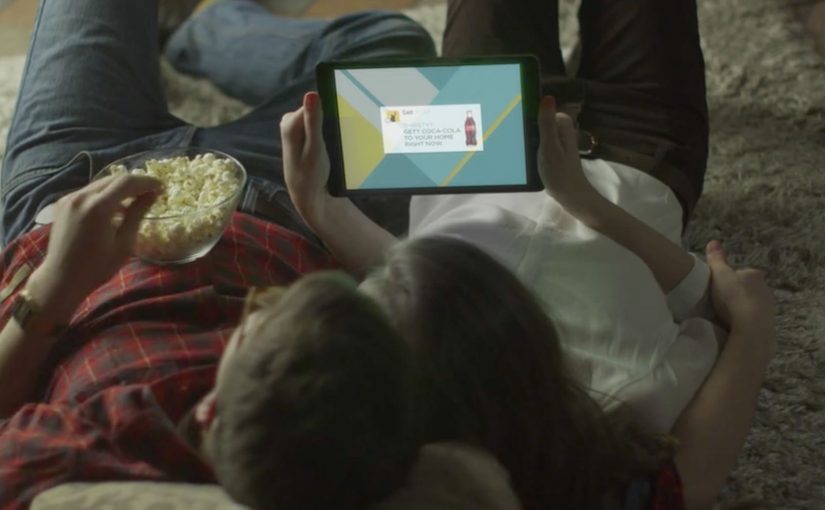
You are watching a Coca-Cola TV spot in Israel. Your phone lights up. A “Gett Coca-Cola” prompt appears. You tap once. Five minutes later, a special Coca-Cola package shows up at your door: a branded cooler, two Coke bottles, and a bottle opener.

From TV spot to one-tap delivery

Turn a TV ad into a one-tap order, and make “second screen” mean immediate delivery, not just engagement. Here, “second screen” means the phone acting as the immediate action surface while the TV spot supplies the trigger.

What is actually happening on the second screen

The TV spot carries an audio trigger that a smartphone can recognize. The moment the ad plays, phones with the Gett app installed receive a push notification. The viewer swipes or taps, and the order is placed in one click.

In practice, this behaves like Shazam for commerce. Except the payoff is not identification. It is fulfillment.

Why the Gett partnership is the real unlock

The ad is only half the experience. The other half is logistics.

To make the “five minutes later” promise credible, Coca-Cola partners with Gett, a local taxi app, and during the promotion Gett dispatches thousands of vehicles packed with branded coolers across Israel, ready to deliver on demand.

In FMCG and retail campaigns, the strategic value is not the novelty of a second screen, but the ability to compress media, commerce, and fulfillment into one immediate behavior.

The real question is whether the brand can remove enough friction that attention turns into action before intent cools.

Why this feels like a reinvention of TV, not a gimmick

This is not a gimmick. It is a tighter piece of commercial design because the creative, transaction, and fulfillment layers are built to work as one system.

Extractable takeaway: When a campaign links attention, transaction, and delivery inside one continuous action, the medium stops acting like awareness-only media and starts behaving like a service.

It collapses the funnel

There is no gap between awareness and action. The moment of attention is the moment of purchase.

It turns “sampling” into a media format

The campaign is a TV impression plus product trial, delivered instantly.

It makes the second screen earn its place

Second screen ideas often stop at polls and hashtags. Here, the phone is not a companion. It is the checkout button.

The deeper point

This is what “buyable advertising” looks like when it is engineered end to end. By “buyable advertising,” this means media that lets a viewer move from exposure to transaction without leaving the moment.

The business intent is simple: remove the lag between media spend and product trial by turning broadcast attention into immediate, measurable fulfillment.

Media triggers action. Action triggers logistics. Logistics completes the brand promise while attention is still warm.

What to steal from this buyable-media model

  • Collapse the funnel deliberately: If you can connect attention to action in one gesture, the “ad” becomes the first step of the purchase flow.
  • Make the trigger earn its existence: Second screen only matters when it changes the outcome, not when it adds commentary.
  • Engineer fulfillment as part of the creative: The logistics promise is the product. Treat it like core campaign craft, not an ops afterthought.
  • Turn sampling into a format: Delivering the kit is the media unit. That is why this reads as more than a shoppable banner.
  • Protect trust explicitly: Any “listening” mechanic needs clear permissioning and transparency, or the whole experience flips from magic to creepy.

A few fast answers before you act

What does the TV ad do that is different?

It uses an audio trigger so phones can recognize the ad and prompt a “Gett Coca-Cola” order on the second screen.

Do viewers need anything installed for this to work?

Yes. The flow depends on the Gett app, since the notification and one-tap order happens inside Gett.

How does it deliver so fast?

Gett uses its taxi network as a delivery fleet, with cars preloaded with the cooler kits during the promotion.

Why is this more powerful than a “second screen” hashtag?

Because the second screen is not commentary. It is conversion plus fulfillment.

What is the main risk brands must manage?

User trust. Any experience that “listens” for triggers must be transparent and permissioned, or it will feel creepy, even if the mechanics work.