
Meat Pack: Hijack

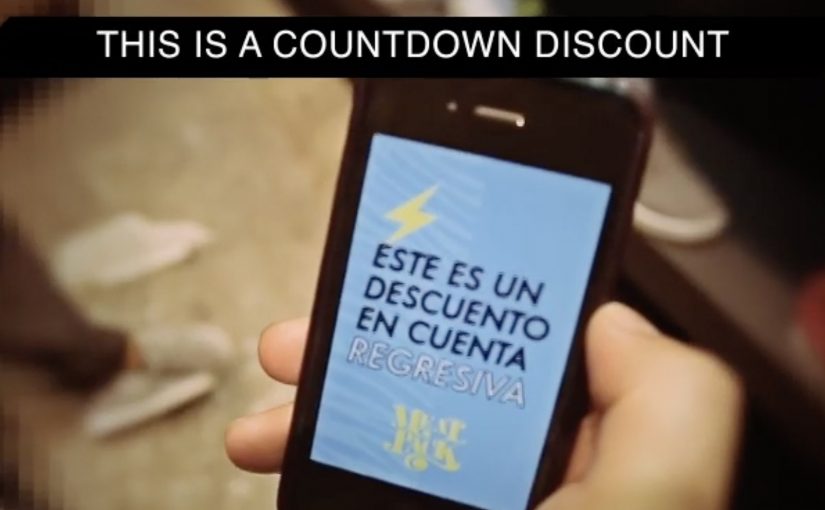
You walk into a competitor’s store to browse shoes. Your phone buzzes. Meat Pack offers you a discount that starts at 99%, then drops by 1% every second. If you want the deal, you have to move.

For a new discount promotion, Meat Pack, a shoe store in Guatemala known for an edgy, irreverent style, created Hijack, described as a GPS-based enhancement to their official smartphone app. Each time a customer entered the official store of one of the brands sold at Meat Pack, the app triggered a promotional message with a countdown offer. The discount started high and decreased every second, then the countdown stopped when the customer reached Meat Pack’s store.

Definition tightening: This is geofencing. A mobile app uses location signals to detect when you enter a defined physical area, then triggers a message based on that location event.

Turning a discount into a race

The mechanism is deliberately ruthless. The offer is so large it interrupts whatever you were doing, and the time pressure converts curiosity into action. The “best possible price” is available only at the exact moment your intent is hottest, while you are literally standing inside a competitor’s store.

In dense urban retail environments where shoppers compare options across nearby stores, location-triggered pricing can create an immediate switching incentive precisely at the point of decision.

Why it lands

It lands because it is a clean behavioural hack. The discount is not just a number. It is a ticking loss. Every second you hesitate, you feel the deal slipping away, which makes running across the street feel rational. The campaign also bakes in bragging rights by reportedly posting successful redemptions to Facebook, turning individual wins into social proof.

Extractable takeaway: If you want people to switch behaviours fast, combine a dramatic incentive with a visible countdown that makes hesitation feel expensive, then make the “next step” unmissable and immediate.

The business intent behind the provocation

This is conquesting with teeth. It aims to convert high-intent foot traffic that is already shopping the category, and to do it at the moment a competitor is paying the cost of acquisition. Reported results from the period describe hundreds of customers being “hijacked” and discounted inventory selling through quickly.

This is smart conquesting, but it only works when the store is close enough for the sprint to feel real. The real question is whether the route from trigger to redemption is short enough to make switching feel instant.

What this retail ambush gets right

  • Trigger at the true decision point. Not at home. Not later. At the shelf moment.
  • Make the offer legible in one second. “99% now, dropping” beats a paragraph of terms.
  • Use urgency with a real rule. A countdown works when it actually changes the outcome.
  • Design the route. If people cannot act quickly in real geography, the mechanic collapses.
  • Handle social sharing carefully. If you auto-post, consent and control decide whether it feels fun or creepy.

A few fast answers before you act

What is Meat Pack “Hijack”?

A location-triggered promotion inside Meat Pack’s app that detects when customers enter competitor brand stores, then offers a discount that decreases by 1% every second until the customer reaches Meat Pack.

What is the core mechanism?

Geofencing triggers an offer at the competitor location. A countdown reduces the discount each second. The timer stops when the shopper reaches Meat Pack, turning the offer into a physical sprint.

Why is the countdown so important?

It converts interest into movement. The value loss is visible and immediate, so delaying feels like paying extra.

What are the biggest risks in copying this?

Customer trust and permission. Location tracking and social posting require clear opt-in. Poor transparency turns a clever mechanic into backlash.

What kind of business does this fit best?

Retailers with nearby competitors, fast redemption, and inventory they can afford to discount aggressively for short bursts.
Misereor: The Power of a Coin

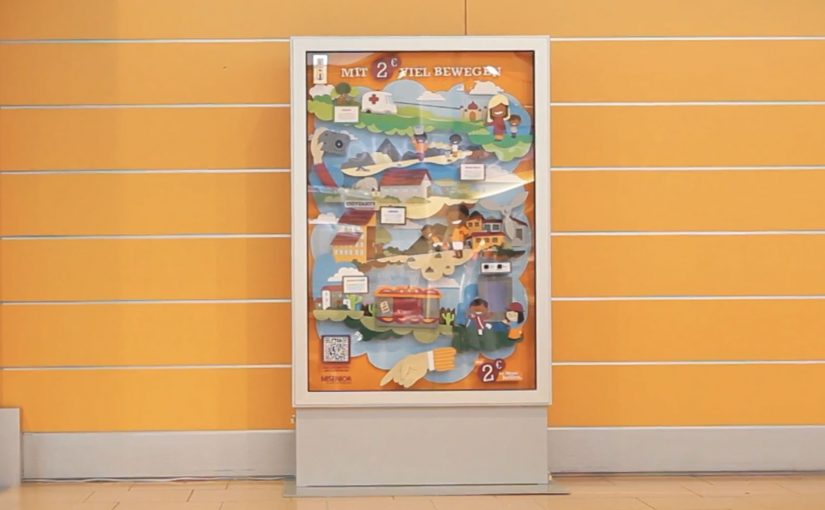
A billboard at Hamburg Airport does not just ask for money. It takes a 2-euro donation and immediately shows what that coin can do.

Misereor has been committed to fighting poverty in Africa, Asia and Latin America for over 50 years. To drive more donations, they install a billboard with a donation box built into it. When people put in 2 euros, the billboard brings to life how that coin can help across Misereor’s aid projects.

The billboard also links the offline act to an online conversation. It takes a photo of the donor and posts it to the campaign’s Facebook app. A QR code on the billboard lets donors share the promotion on their own Facebook page.

How the interaction is designed to convert

The mechanism is a tight, three-step loop. Physical donation triggers an immediate visual payoff. The payoff translates “impact” from an abstract promise into a concrete scene. The scene then becomes shareable proof through an automatic photo post and a QR-driven sharing prompt.

In high-traffic public spaces where attention is fragmented and dwell time is unpredictable, donation design wins when it minimizes steps and makes impact visible immediately.

Why it lands

This works because it replaces guilt with clarity. You do not just hear that your money helps. You see a specific outcome the moment you give, which makes the decision feel both meaningful and finished.

Extractable takeaway: If you want more donations, build a “give. see. share.” loop where the act of giving triggers instant, legible impact, and the sharing step is optional but effortless.

The real goal behind the 2-euro choice

The real question is whether a donation ask can feel immediate, visible, and worth doing before the traveler walks away. A 2-euro ask is small enough to feel impulse-safe, especially in an airport moment where people already make small purchases without overthinking. The campaign then uses the experience to recruit advocates, not just donors, by turning each donor into a visible participant online.

What this donation design gets right

  • Make the donation amount frictionless. Small, fixed amounts reduce decision paralysis.
  • Show impact instantly. The payoff must happen before the donor walks away.
  • Bridge offline to online. Capture a shareable artifact, but keep it consent-friendly.
  • Keep the interface obvious. A slot, a prompt, a clear result. No instructions required.

A few fast answers before you act

What is “The Power of a Coin”?

An interactive airport billboard for Misereor where a 2-euro donation triggers an animation that shows how the money helps, and then offers easy sharing via photo and Facebook.

What is the core mechanism?

Donate a fixed amount, get an immediate visual “impact reveal”, then optionally share via an automatically posted donor photo and a QR-enabled share prompt.

Why is the instant animation important?

It turns “trust us” into “watch this”. Immediate feedback reduces skepticism and increases the chance of giving in-the-moment.

What is the biggest risk with the social layer?

Consent and platform drift. If posting feels automatic in a way donors did not expect, or if platform permissions change, the sharing layer can backfire or break.

What is the transferable lesson for other causes?

Design the donation moment like a product demo. One action triggers a clear result, then the donor can share proof without extra effort.

MCSC: World’s Most Valuable Social Network

When a child goes missing, the first hours matter. The problem is that the people who could help are often nearby, busy, and scrolling.

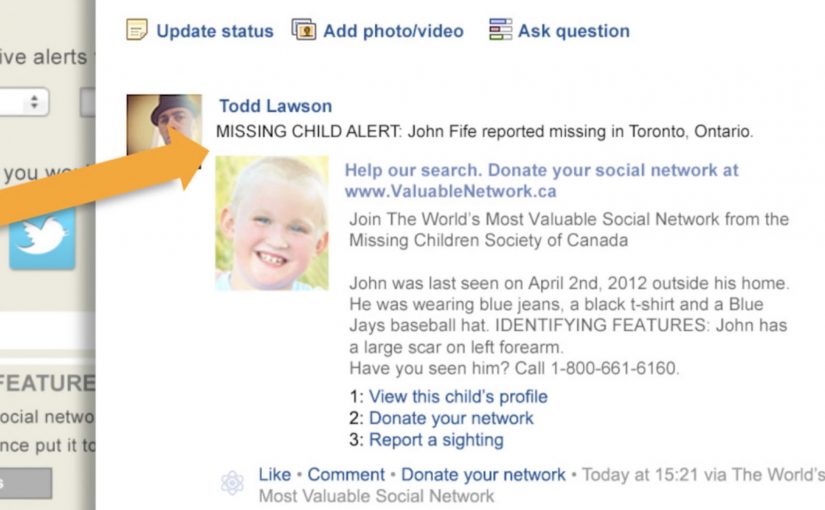
The Missing Children Society of Canada, with Grey Canada, asks people to “donate” their Facebook and Twitter news feeds. By opting in, a person allows missing-child alerts to be posted directly into their feed, turning everyday social reach into a public-safety broadcast layer.

The distribution logic is local. Alerts are geographically coded, so someone in Toronto sees posts about missing children in their area, not a national firehose.

Turning social feeds into an emergency surface

The mechanism is permissioned publishing. Here, “permissioned” means people explicitly opt in to let the program post on their behalf. Instead of asking people to remember to share posters or retweet at the right moment, the campaign uses opt-in account access to place alerts where attention already lives. Because the alert is published automatically into feeds people already check, it moves faster than a request that depends on manual sharing.

In Canadian public-safety communications, speed and local relevance determine whether a message gets acted on or ignored.

Why this lands better than a generic awareness push

Most “support the cause” messaging competes with everything else in the feed. This flips the frame. The feed itself becomes the tool, and the content is time-sensitive and action-oriented. This is a stronger model than a generic awareness push because it routes attention into action without extra steps.

Extractable takeaway: If the mission depends on time, do not optimize for “awareness.” Optimize for distribution mechanics that reduce steps at the moment of need, and constrain the message to the people who can realistically act.

Geo-coding is the quiet hero here. Locality reduces fatigue, increases perceived responsibility, and makes the alert feel like a neighborhood problem, not distant tragedy content.

What the campaign is really building

Beyond any single case, this creates a repeatable digital volunteer layer. Every donated feed is a standing commitment, and every local alert becomes a test of whether the network can mobilize attention fast enough to matter.

The real question is whether you can convert passive sympathy into permissioned, local distribution during the first hours.

Design moves worth borrowing

  • Make opt-in feel like “donation.” People understand giving reach the way they understand giving money.
  • Automate the share. Remove the “I should post this” friction.
  • Localize by default. Relevance is the difference between help and noise.
  • Keep the message actionable. Clear identifiers and a next step beat emotional copy in urgent scenarios.

A few fast answers before you act

What does it mean to “donate” your social media feed in this campaign?

You opt in so missing-child alerts can be posted directly to your Facebook or Twitter feed, using your reach to distribute time-sensitive information.

Why use geo-coded alerts?

It keeps the feed relevant and increases the chance someone nearby recognizes the child or has useful information, while avoiding national alert fatigue.

What problem is this solving compared to posters or standard PSAs?

Speed and placement. It puts alerts into a high-attention channel immediately, without relying on people to take an extra step to share.

What should a program like this measure?

Opt-in volume, local reach per alert, time-to-first-distribution, engagement actions that indicate reading, and downstream reporting behavior where available.

What’s the smallest version you can pilot?

Start with a single opt-in flow, a clear local targeting rule, an approval workflow for posting, and one simple call to action that tells people exactly what to do if they have information.