
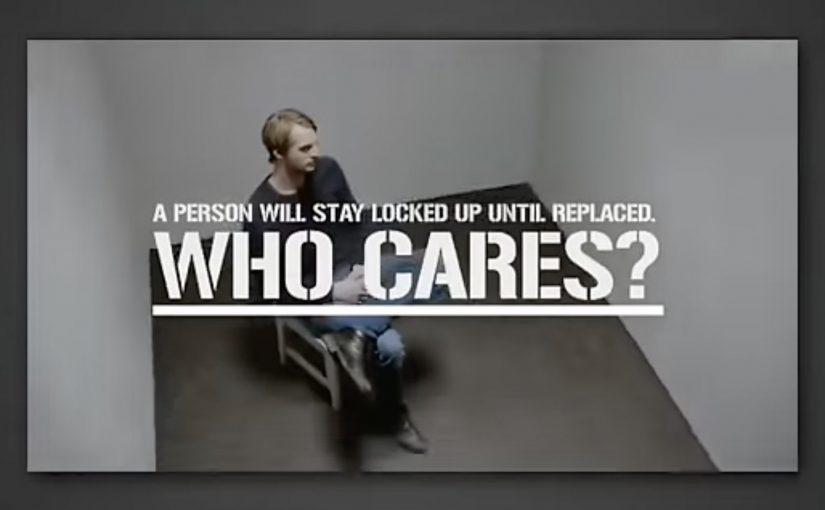
Swedish Armed Forces: Who Cares?

Swedish Armed Forces: Who Cares?

The Swedish Armed Forces needed to recruit young people to an occupation that, in many ways, requires giving up personal comfort in order to help others. To highlight that trade-off, DDB Stockholm created a digitally integrated event in Stockholm, meaning a live experience amplified online but solved only through offline action, to test how far people were willing to go for one another.

One person agreed to sit in a small boxed room and give up his freedom. The experiment was live-streamed over the internet, and nobody could help him via social media. The only way to help was to physically take his place yourself.

Would you have entered that room?

A recruitment test you cannot “like” your way out of

The mechanism is a single constraint with a hard rule. A person stays locked in a box until someone else arrives and swaps places. “Digitally integrated” here means the story travels through live video and online conversation, but the action can only happen in the physical world.

In public-sector recruiting, sacrifice is rarely persuasive as a slogan, so demonstrations that make the cost tangible tend to cut through faster than promises.

Why it lands

This works because the hard swap rule turns abstract values into a visible choice with a real cost. Watching a live stream makes you a witness, but the rule forces a sharper question. The real question is whether you care enough to surrender comfort, not whether you can signal support from a distance. The gap between those two states is the point of the experiment, and it makes the recruitment message feel earned rather than announced.

Extractable takeaway: If your role requires commitment, build a mechanic where commitment has a visible cost, and make the only path to “help” require real participation.

What the Armed Forces are actually testing

On the surface this is a recruitment film and an event. Underneath, it is a filter for mindset. This is recruitment built on proof, not persuasion. The work asks whether a young audience is willing to trade comfort for responsibility, and it frames that trade-off in the simplest possible form. One person is stuck. Only another person can free him.

What to steal from this participation mechanic

  • Make the value measurable. “Caring” becomes an action with a clear threshold.
  • Use digital for scale, not for the solution. Let the internet amplify, but keep the decisive moment real.
  • Design a rule people can retell. “He gets out only if you go in” travels in one sentence.
  • Let tension do the storytelling. A live situation creates attention without extra explanation.

A few fast answers before you act

What is “Who Cares?” in one line?

A Swedish Armed Forces recruitment experiment where a person remains locked in a box until someone physically arrives to replace him.

Why is the “no social media help” rule important?

It blocks low-effort participation and forces a real-world decision, which aligns with the message about giving up comfort to help others.

What does “digitally integrated event” mean here?

The event is distributed through live streaming and online conversation, but the only effective intervention is an offline, physical action.

What is the main psychological trigger?

It turns spectatorship into a moral fork. Watching is easy. Acting carries a cost, and that contrast creates the impact.

When does this pattern work best?

When you need to recruit or motivate for roles that require real commitment, and you can express that commitment through a simple, uncheatable rule.

Viajes Galeón: Twitpoker

Viajes Galeón: Twitpoker

A poker table. Five of Colombia’s best-known Twitter personalities. Except the chips are not money. They are followers.

Viajes Galeón, a Colombian travel agency, and Y&R Colombia create Twitpoker, a poker game where players bet their Twitter followers instead of cash. The match is streamed live to audiences via web cams, pulling spectators into the tension of every hand because every raise has a visible social cost.

As described, the live format scaled beyond the five invited players. More than 27,000 people played together on a single table experience, and a brand with little or no prior social footprint used the stunt to kick-start its Twitter presence.

Followers as currency

The mechanism is a value swap. Twitter followers become the stake, which instantly reframes poker from private risk to public reputation. Every decision is legible to the audience and personally meaningful to the players, because the loss is social proof, not cash.

In social-led brand building, the most persuasive “launch” is a mechanic that makes your audience feel they are participating in the growth, not merely watching an ad about it.

Why it lands

The idea works because it turns a platform metric into a story engine. Most follower counts sit idle as vanity. Twitpoker makes the number consequential, and consequence creates attention. The live stream adds immediacy, and the five invited players supply recognizable personalities, so the audience is watching real identities collide with real incentives.

Extractable takeaway: If you want social growth fast, design a mechanic where the platform’s native currency is genuinely at stake, then stage it live so spectators feel the outcome unfolding in real time.

What the travel brand is really buying

The real question is how a low-awareness travel brand gives people a reason to follow right now.

Viajes Galeón is not buying “engagement” as a buzzword. It is buying a credible reason for people to follow, talk, and keep watching. The campaign converts a travel agency into a social event host, which is a stronger role for a brand with low awareness than trying to shout offers into a quiet feed.

What to steal from Twitpoker

  • Make the platform metric matter. Treat followers, likes, time, or access as something that can be risked or earned.
  • Use live to create urgency. Live formats compress attention and increase sharing because people do not want to miss the outcome.
  • Cast with credibility. Recognizable participants provide narrative without needing heavy scripting.
  • Let the audience feel included. Scale participation beyond the core cast so it becomes a shared event, not a private stunt.

A few fast answers before you act

What is Twitpoker?

A live-streamed poker game where participants bet their Twitter followers instead of money, built to generate attention and grow a brand’s social presence.

Why does “betting followers” work as a mechanic?

Because it converts a familiar social metric into a real stake, making every play emotionally legible and socially consequential.

What role does the live stream play?

It creates immediacy and shared tension, which increases participation, sharing, and real-time commentary.

What is the key requirement for this to feel credible?

The stakes must be real and visible, and the participants need an audience that cares about their reputations.

When should a brand use a stunt like this?

When the goal is to bootstrap social attention quickly, and when you can translate platform-native value into a simple game with a clear win and loss.

Volkswagen Facebook Flipbook

Volkswagen Facebook Flipbook

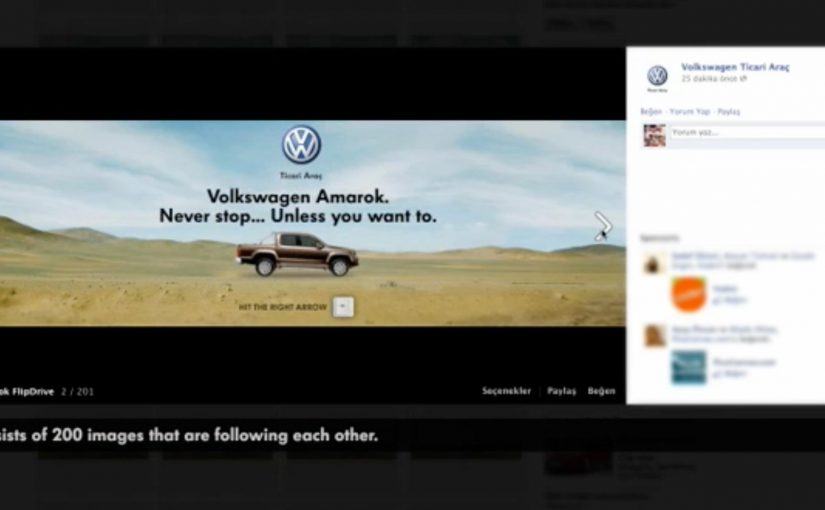
You open a Facebook photo gallery called Amarok FlipDrive, click the first image, and keep the right arrow button pressed. The photos flip fast enough to feel like a running movie. A flipbook, built out of a Facebook album.

The reference point. A “commercial” powered by a Twitter feed

In April, Mercedes Smart in Argentina created the first of its kind Tweet Commercial using its Twitter stream. Here, “Tweet Commercial” means the Twitter feed is the engine behind the spot. Now Volkswagen Amarok in Turkey has created the Facebook alternative.

The idea. An all-terrain truck that can even “drive” on Facebook

The Volkswagen Amarok is positioned as an ultimate all terrain vehicle. It can go everywhere. From the city to sand to water. With some creativity from McCann Erickson Istanbul, it can even go on Facebook.

This is the kind of platform-native execution worth copying because it treats navigation as the media layer, not just a way to browse.

How it works. 201 images in sequence

201 images that follow each other in sequence are uploaded to the Amarok FlipDrive Facebook photo gallery. Opening the first photo and keeping the right arrow button pressed makes the photos flip by fast and gives the effect of a running movie.

In global brand marketing teams looking for attention inside social feeds, this is a reminder that interface behavior can be the format.

Why it lands. Viewer control becomes playback

Because the user can hold one familiar key to control speed, the sequence feels like motion without needing a video player. The real question is whether your idea can be expressed as a repeatable gesture the platform already trains people to do.

Extractable takeaway: If a platform has a predictable navigation gesture, you can sequence stills so the gesture becomes playback and the user becomes the “play button”.

The reality check. Caching changes the experience

The flipbook experience is very jerky the first time, but once all the photos are cached (loaded locally after the first pass), it plays as seen in the video below.

What to borrow from Amarok FlipDrive

  • Turn one navigation action into “play”. Upload frames in strict sequence, then let holding the right arrow key act as the playback control.
  • Design for the first-run experience. Expect jerkiness until images are cached, and make sure the idea still reads even when playback is imperfect.
  • Use native mechanics as the “player”. Streams, galleries, and navigation keys can carry a social commercial without introducing a separate media layer.

A few fast answers before you act

What is the Volkswagen Facebook Flipbook?

It is a Facebook photo gallery that behaves like a flipbook-style animation when you move quickly through sequential images by holding the right arrow key.

How many images does it use?

201 images, uploaded in sequence.

What does the user do to “play” it?

Open the first photo in the album and keep the right arrow key pressed to flip through the sequence fast enough to feel like motion.

Why is the first run jerky?

Because the images are not yet cached. Once the browser has loaded them once, playback becomes smoother.

What is the broader pattern?

Using native platform mechanics, such as streams, galleries, and navigation keys, as the media layer for a social commercial.