
SAS: Up for Grabs on Facebook

SAS: Up for Grabs on Facebook

To promote a million-seat fare sale, Scandinavian Airlines (SAS) and Crispin Porter + Bogusky Stockholm ran a Facebook competition where fans could “grab” a free trip. The ask was visual and dead simple, and it turned participation into the media.

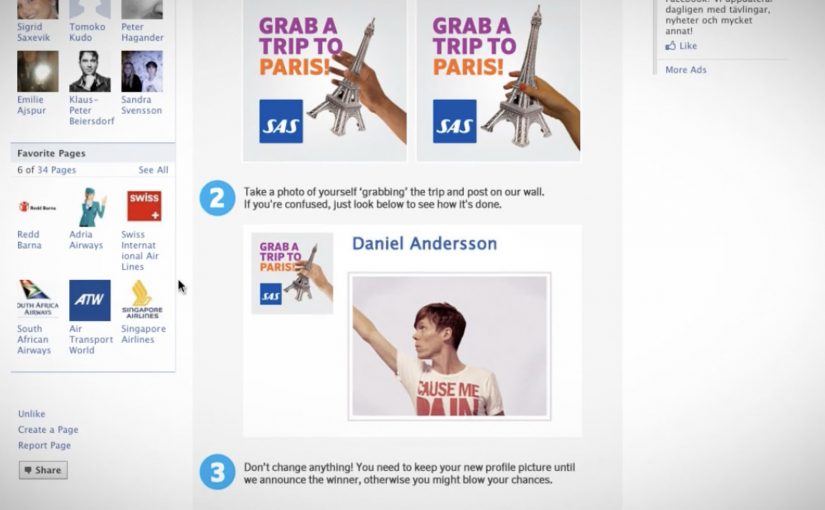
Fans changed their profile picture into a custom “Up For Grabs” image, then posted a matching photo on the SAS Facebook wall where they physically “grabbed” the trip. Every entry looked like an ad, and every ad looked like a friend.

The mechanic that turns fans into distribution

The campaign’s mechanism was a two-step loop. First, replace your profile image with a branded frame that signals you are “in”. Second, publish a playful photo on the brand wall that demonstrates the concept, grabbing the prize. That wall then becomes a live gallery of social proof, with each new post re-selling the fare sale in a more human way than a banner ever could.

In airline marketing, promotions that convert participation into shareable images can outperform price-only fare announcements.

Why it lands

It turns an abstract offer into a physical gesture. “Grab a trip” becomes something you can perform, photograph, and show. The profile-picture switch is a light commitment that broadcasts intent, and the wall post is a public performance that invites imitation. The momentum comes from visibility, because the more entries you see, the more “normal” it feels to join.

Extractable takeaway: When you need scale fast, design one participation artifact that doubles as an ad unit, and make the action easy enough that people will copy it without instructions.

What the shutdown reveals about the strategy

The campaign was reportedly against Facebook promotion terms, and it was shut down. That ending is part of the story, because it highlights the tightrope of social-first promotions. The creative is built on a behavior Facebook historically restricts for contest entry, asking people to publish specific content as a condition of participation, even if the idea is clever and the buzz is real.

The real question is whether the participation mechanic can spread the offer without depending on a platform behavior that can be switched off overnight.

The stronger strategic read is that the creative idea is right, but the distribution mechanic is too dependent on borrowed platform rules.

What to steal for your own launch

  • Make the entry format the message. If the entry itself demonstrates the offer, you get free repetition of the proposition.
  • Use a low-friction first step. Profile-picture frames and templates work because they are fast and socially legible.
  • Design a single visual trope. “Grabbing” is a trope anyone can reproduce, and that consistency creates a recognizable feed.
  • Build compliance in from day one. If the mechanic depends on prohibited platform behaviors, plan a compliant alternative before launch.

A few fast answers before you act

What is the core idea of Up for Grabs?

A Facebook contest where fans change their profile picture to a branded frame and post a “grabbing the trip” photo on the SAS wall to compete for a free flight.

Why does the profile-picture step matter?

It turns participation into persistent visibility. The frame signals “I am in”, and it spreads through everyday browsing without requiring an additional media buy.

What made the campaign travel beyond the SAS page?

Each entry was both participation and promotion. When fans changed their profile picture and posted a matching photo, the fare sale moved into personal networks instead of staying inside brand media.

Why was it shut down?

It was reportedly closed for violating Facebook promotion rules by conditioning entry on specific platform actions, such as posting photos on the wall.

How do you keep the upside without the platform risk?

Keep the visual template and the “grab” trope, but move the submission mechanic to a compliant entry flow, then allow optional sharing that is not required to participate.
Fey & Co: Lullaland

Fey & Co: Lullaland

Around the world, people say good night on Twitter, often with #goodnight. Jung von Matt/Elbe collected those tweets for mattress manufacturer Fey & Co and turned them into a daily, shareable sleep ritual.

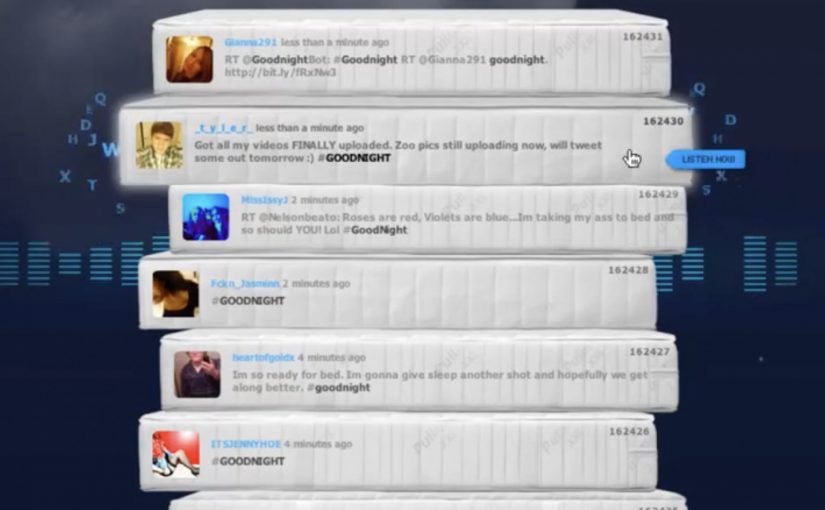
Every good night tweet automatically became part of the campaign. With a simple retweet, users were invited to www.lullaland.net, where short tweets were converted into melodic “lullatweets” for the world. Fey & Co positioned itself as an ambassador for good sleep inside the bedtime behavior of a digital generation.

How Lullaland turns tweets into lullabies

The mechanic is a tight translation loop. Capture tweets containing the hashtag. Convert the letters into tones to generate a simple melody. Store and present the results as a browsable collection, so each new tweet becomes both content and invitation. That works because the system turns an existing bedtime signal into branded content without adding effort.

In consumer categories built on comfort and routine, attaching the brand to an existing nightly habit is a durable way to earn repetition without forcing a new behavior.

Why it lands

It respects the moment. “Good night” is already intimate and low-energy, so the idea stays lightweight and fits the mood. The conversion from text to sound also makes participation feel magical without requiring people to do anything beyond what they already do, tweet.

Extractable takeaway: When you want to own an emotional territory, do not only advertise the feeling. Embed the brand into a recurring micro-ritual, then turn real audience behavior into the content that keeps the ritual alive.

What the brand is really buying

This is not a mattress demo. It is salience at the exact time the category is most relevant, right before sleep. Each contribution expands the library, each retweet can recruit new contributors, and the campaign accrues credibility because it is built from real messages rather than brand copy.

The real question is how a sleep brand earns a place in the bedtime habit before the purchase decision is even active.

What to steal from Lullaland

  • Use an existing verb. Build on a habit people already perform daily, then add one small layer of transformation.
  • Translate data into emotion. Turning text into music creates feeling fast, even when the input is mundane.
  • Make participation automatic. Lower friction by letting normal behavior qualify as entry.
  • Create a browsable archive. A growing collection gives the idea longevity beyond a launch spike.

A few fast answers before you act

What is Lullaland in one sentence?

A campaign that collects #goodnight tweets and converts them into short lullaby-like melodies, linking Fey & Co to a nightly digital ritual.

Why does converting tweets into music matter?

It turns a familiar social action into an emotional artifact, which makes the participation feel more meaningful than a normal hashtag post.

What makes this effective for a mattress brand?

It shows up at bedtime, uses real “good night” behavior, and reinforces sleep as a cultural moment rather than a product feature list.

What is the main risk with ritual-based campaigns?

If the experience is slow, confusing, or repetitive, people do it once and stop. The conversion has to feel instant, and the output has to feel varied enough to revisit.

What should brands copy from this idea?

Start with a recurring user behavior, add one simple transformation that creates emotion, and make the output easy to browse or share so the system keeps renewing itself.

The Swedish Post: The Sound of Green

The Swedish Post: The Sound of Green

The Swedish Post has a collection of pre-stamped parcels that makes it easy to send things. The task for ad agency Åkestam Holst was to tell people that it was possible to send almost anything overnight with these pre-stamped parcels.

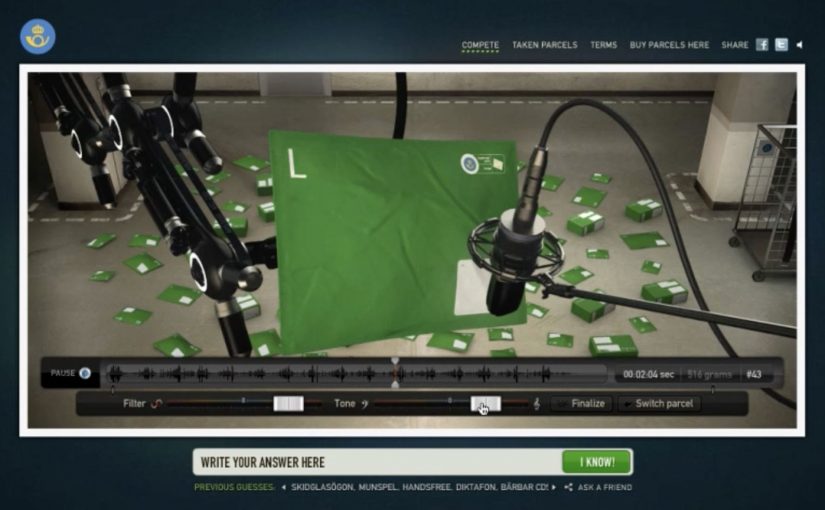
So they packed 80 parcels with all sorts of stuff and recorded 80 specific sounds. Those sounds powered “The Sound of Green” competition. Users picked a parcel, listened closely, and guessed what was inside. If they got it right, the Swedish Post sent the same parcel to the winner the very same day.

After a reported 140,240 guesses, the competition finally came to an end.

When proof beats promise

The mechanism is a neat translation of capability into play. Instead of listing what you can ship, you create 80 mystery parcels, record what they sound like, and let the public test their attention. The prize is not a voucher or a discount. The prize is the actual thing, delivered fast, which quietly demonstrates the core promise.

In consumer postal markets where “overnight delivery” sounds like a commodity claim, capability stories land better when they are demonstrated through a simple, repeatable experience.

The real question is whether the brand can make overnight delivery felt before someone ever ships a parcel.

Why it lands

This works because it turns logistics into curiosity. Sound is intimate and surprisingly hard to fake, so the listener leans in. The guessing format also creates a low-friction reason to spend time with the brand, and the same-day fulfilment makes the payoff feel real, not promotional.

Extractable takeaway: If you are selling an invisible service, build a public game that forces the benefit to show up as evidence, not copy.

What service brands can borrow

  • Demonstrate the promise. Replace “we can do anything” with proof people can experience.
  • Use a constraint to create focus. 80 sounds is large enough to feel rich, small enough to feel curated.
  • Make the prize the product. Shipping the parcel is the cleanest way to validate shipping.
  • Design for repeat attempts. A guessing mechanic naturally invites “one more try”.

A few fast answers before you act

What is “The Sound of Green”?

An online competition by the Swedish Post and Åkestam Holst where people listen to recorded parcel sounds, guess the contents, and winners receive the same parcel delivered the same day.

What is the core mechanism?

Pack real parcels, record the sounds they make, then let users choose a parcel sound and submit a guess. Correct guesses trigger real fulfilment.

Why use sound instead of photos?

Sound forces attention. It is less immediately obvious than visuals, and it creates a stronger sense of discovery when you finally figure it out.

What does this teach about marketing service businesses?

Claims are easy to ignore. Demonstrations are harder to dismiss, especially when the demonstration is interactive and ends in real delivery.

How do you keep a contest like this from feeling gimmicky?

Make the payoff identical to the promise. In this case, the reward is the service itself, delivered fast.