A social experiment built on the “evil twin” feeling
If you have ever reckoned you have an evil twin somewhere else in the world, or that you were separated at birth but no one has got round to telling you, Coke Zero’s “worldwide social networking experiment” plays directly into that curiosity.
Coke Zero created a Facebook app called the “Facial Profiler” with one clear aim: find your online lookalike.
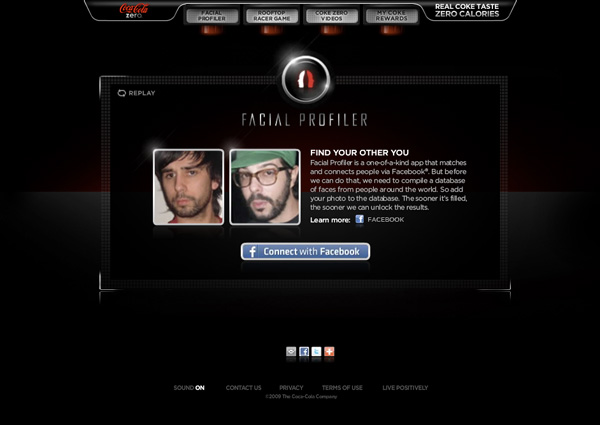
The mechanic is simple and self-explanatory. You upload a photo to the database. Coke analyses the facial characteristics and attempts to find the nearest match from other uploaded images.
In global FMCG marketing, lightweight social utilities can turn personal identity-curiosity into mass participation with minimal friction.
Why it spreads without feeling like an ad
This works because the “reward” is social, not transactional. People want to see the result, they want to show friends, and they want friends to try it back, which increases the pool of uploaded images and improves the matching for everyone.
There is also a built-in tension that keeps it sticky: the match is never perfect, which invites replay, comparison, and conversation rather than closure.
Where the brand message sits in the experience
The campaign does not argue product attributes head-on. Instead, it borrows the logic of the product proposition and turns it into a human metaphor: “close enough” can still be compelling.
The idea behind the campaign is: ‘If Coke Zero has the taste of Coke…is it possible that someone out there has your face?’.
What to steal for your next participation mechanic
- Start with a universal itch. Identity, comparison, and “who do I look like” is instantly legible in any market.
- Make the first step frictionless. One upload, one result, immediate payoff.
- Let the community improve the product. Every participant makes the experience better for the next one.
- Encode the proposition in the mechanic. The “same taste” claim becomes a story people can experience, not just hear.
A few fast answers before you act
What is Coke Zero’s Facial Profiler?
It is a Facebook application that invites people to upload a photo and then returns the closest lookalike match from other uploaded images in the database.
How does the campaign mechanic work?
Participation creates the asset. Users contribute photos, the system compares facial characteristics, and the database grows with every upload, which increases the chance of finding a “near match”.
Why does this kind of idea get shared?
Because the output is personal and social. The result is fun to show, fun to debate, and it prompts friends to try it too, which naturally amplifies reach.
What is the business intent behind the experience?
To make the Coke Zero proposition memorable by translating “close enough to Coke” into a human analogy, so the brand message is felt through participation rather than explained through claims.
What is the most transferable lesson for digital campaigns?
Build a simple loop where the audience action creates the content, the content creates conversation, and the conversation recruits the next participant.



