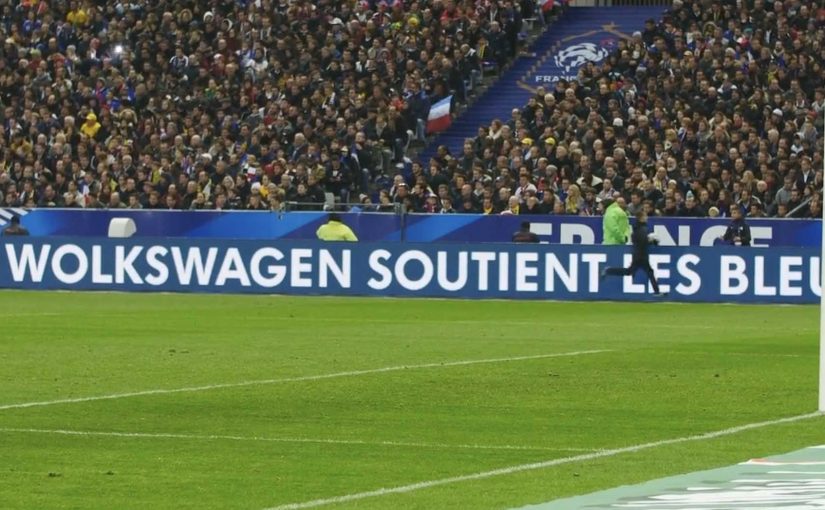
During a France vs Brazil football match in Paris, the LED boards around the pitch display a brand name that looks wrong. “Wolkswagen.”
Volkswagen leans into a simple human impulse. People love being the first to notice a mistake. So the campaign plants one at maximum scale and lets the crowd do what it always does. Point it out, correct it, and spread it.
The mechanism is the typo itself. A deliberate misspelling placed where 80,000 spectators and millions of TV viewers will see it, creating a wave of “they got it wrong” conversations that carries the real message. Volkswagen is present, watching, and ready to announce itself as a major partner of French football.
The psychology of a “correctable” brand moment
This works because correcting a visible public error lets people display attention and share the fix. Here, a “correctable” moment means a public cue that looks wrong but is safe and easy for the audience to fix. Noticing a typo feels like competence. Sharing it feels like helping others notice. The stunt converts that impulse into earned distribution, and it does it without asking anyone to watch a film or click a banner.
Extractable takeaway: If you want mass attention in a high-noise moment, design a safe, obvious “error” people can correct in public, then attach your actual announcement to the moment they point out and share the correction.
In live sports broadcasts, audiences are primed to scan for anomalies, and correcting them is a social reflex that spreads faster than the original message.
What the partnership announcement is really buying
The stated goal is awareness of a new relationship with French football. This is stronger than a standard sponsorship reveal because the audience helps distribute the news. The real question is how to make a routine partnership announcement impossible to ignore. The deeper goal is memorability. Sponsorship news is usually forgettable. A planted mistake is sticky, because people remember the moment they noticed it.
What to steal from this stadium-board stunt
- Use one unmistakable deviation. The “wrongness” must be instantly readable from far away.
- Make the correction harmless. The audience should feel clever, not manipulated or misled.
- Deploy where attention is already concentrated. Stadium boards and live broadcast moments amplify small creative moves.
- Ensure the reveal is clean. The moment must resolve quickly into the intended message, or it stays a gimmick.
A few fast answers before you act
What is the Wolkswagen idea?
A live stadium-board stunt that intentionally misspells “Volkswagen” as “Wolkswagen” to trigger public correction and attention, then uses that attention to support a football partnership announcement.
Why does an intentional typo generate more attention than a normal logo placement?
Because it activates a correction reflex. People engage to point out the “mistake,” and that engagement becomes the distribution channel.
What makes this feel like a live moment instead of an ad?
Placement and timing. It appears inside the live match environment, where audiences treat what they see as real-time context, not preplanned messaging.
What is the main risk with this pattern?
If the audience believes the brand genuinely made an error, the story can turn into ridicule. The execution needs a clear resolution so it reads as deliberate.
When should you use a “deliberate mistake” stunt?
When you have a time-bound announcement, a high-attention venue, and a brand that can credibly play with perception without damaging trust.