
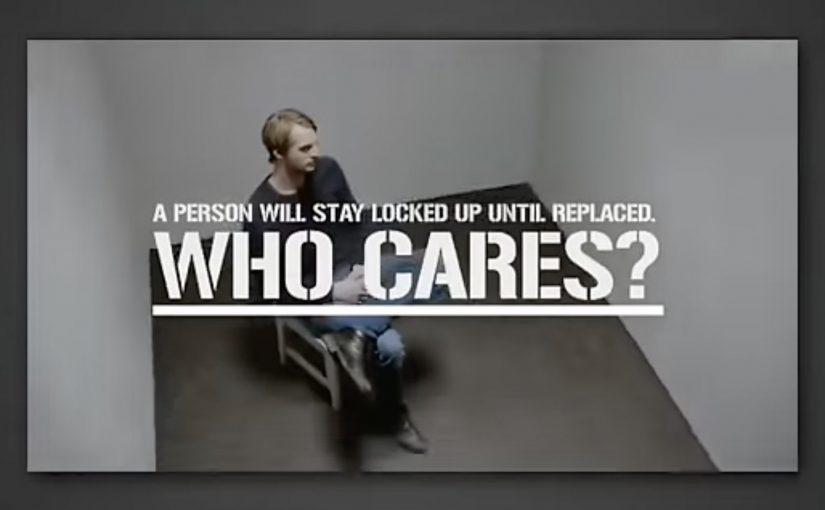
Swedish Armed Forces: Who Cares?

The Swedish Armed Forces needed to recruit young people to an occupation that, in many ways, requires giving up personal comfort in order to help others. To highlight that trade-off, DDB Stockholm created a digitally integrated event in Stockholm, meaning a live experience amplified online but solved only through offline action, to test how far people were willing to go for one another.

One person agreed to sit in a small boxed room and give up his freedom. The experiment was live-streamed over the internet, and nobody could help him via social media. The only way to help was to physically take his place yourself.

Would you have entered that room?

A recruitment test you cannot “like” your way out of

The mechanism is a single constraint with a hard rule. A person stays locked in a box until someone else arrives and swaps places. “Digitally integrated” here means the story travels through live video and online conversation, but the action can only happen in the physical world.

In public-sector recruiting, sacrifice is rarely persuasive as a slogan, so demonstrations that make the cost tangible tend to cut through faster than promises.

Why it lands

This works because the hard swap rule turns abstract values into a visible choice with a real cost. Watching a live stream makes you a witness, but the rule forces a sharper question. The real question is whether you care enough to surrender comfort, not whether you can signal support from a distance. The gap between those two states is the point of the experiment, and it makes the recruitment message feel earned rather than announced.

Extractable takeaway: If your role requires commitment, build a mechanic where commitment has a visible cost, and make the only path to “help” require real participation.

What the Armed Forces are actually testing

On the surface this is a recruitment film and an event. Underneath, it is a filter for mindset. This is recruitment built on proof, not persuasion. The work asks whether a young audience is willing to trade comfort for responsibility, and it frames that trade-off in the simplest possible form. One person is stuck. Only another person can free him.

What to steal from this participation mechanic

  • Make the value measurable. “Caring” becomes an action with a clear threshold.
  • Use digital for scale, not for the solution. Let the internet amplify, but keep the decisive moment real.
  • Design a rule people can retell. “He gets out only if you go in” travels in one sentence.
  • Let tension do the storytelling. A live situation creates attention without extra explanation.

A few fast answers before you act

What is “Who Cares?” in one line?

A Swedish Armed Forces recruitment experiment where a person remains locked in a box until someone physically arrives to replace him.

Why is the “no social media help” rule important?

It blocks low-effort participation and forces a real-world decision, which aligns with the message about giving up comfort to help others.

What does “digitally integrated event” mean here?

The event is distributed through live streaming and online conversation, but the only effective intervention is an offline, physical action.

What is the main psychological trigger?

It turns spectatorship into a moral fork. Watching is easy. Acting carries a cost, and that contrast creates the impact.

When does this pattern work best?

When you need to recruit or motivate for roles that require real commitment, and you can express that commitment through a simple, uncheatable rule.


Magnum Pleasure Hunt: AR bonbons in Amsterdam

Earlier on in April Magnum launched the second edition of its hit online game Magnum Pleasure Hunt. To extend the campaign further, a real time mobile augmented reality game takes the hunt to the streets of Amsterdam.

The game is currently ongoing and participants between April 22nd and April 29th can use a special mobile app to hunt down 150 chocolate bonbons hidden across 9 locations in Amsterdam, described in some write-ups as centered around the city’s Nine Streets area. The one who claims the most bonbons wins a free trip to New York, while the rest are rewarded with the new Magnum Infinity ice cream.

Why this is a smart extension of a digital hit

The original online game is built for reach and replay. The Amsterdam version adds scarcity and locality: the same “collect the bonbons” mechanic, but tied to time, place, and physical movement, which makes participation feel more like an event than a link.

In European FMCG launches, location-based AR hunts work best when the rules are obvious in seconds and tiered prizes make “one more try” feel worth it.

The real question is whether your AR layer gives people a reason to move now, not just a new way to look at the same brand world.

What the AR layer adds to the experience

The AR layer keeps the mechanic simple, but changes the context by making the hunt visible in public and limited to specific dates and locations.

Extractable takeaway: When you take a proven digital mechanic into the street, pair it with a short window and clear rewards so participation feels like an event, not an app demo.

  • Instant purpose. You are not browsing a branded world. You are on a hunt with a clear target.
  • Real-world urgency. Limited dates and specific locations make the challenge feel live.
  • Social proof by default. People playing in public become the campaign’s moving media.

A quick comparison to Vodafone Buffer Busters

I find the Magnum mobile game to be a toned down version of the Vodafone Buffer Busters game that ran in Germany last September. Either way, this is the right direction. More brands should treat augmented reality as a medium of engagement, not a gimmick.

What to copy from Magnum’s Amsterdam hunt

  • Make the first action obvious. People should understand the goal and the first tap in seconds.
  • Limit the window. A short time period turns “I’ll try it later” into “I should go now.”
  • Use rewards that scale. A big winner prize plus smaller payoffs keeps both competitive and casual players engaged.

A few fast answers before you act

What is Magnum Pleasure Hunt Across Amsterdam?

It is a time-limited mobile augmented reality game that moves Magnum’s “collect the bonbons” mechanic from the web to real locations in Amsterdam.

How do players participate?

Players use a mobile app while out in the city to find and collect virtual bonbons placed at specific locations during the campaign window.

What makes it different from the online Pleasure Hunt?

The online version is a digital-only chase. The Amsterdam version adds time and place, turning the hunt into a real-world activity with location-based stakes.

Why are prizes so central to this format?

Because the effort is physical. A clear top prize plus smaller “everyone gets something” rewards keep motivation high across both competitive and casual players.

What is the key design lesson for AR brand games?

Keep onboarding friction low. If people cannot understand the goal and the first action immediately, they will not start, especially outdoors.

Magnum Pleasure Hunt 2: bigger, bolder sequel

Last year, to launch the all new Magnum Temptation Hazelnut ice-cream, Swedish agencies Lowe Brindfors and B-Reel created an advergame, a branded game built to promote a product, called “Magnum Pleasure Hunt Across The Internet”. In the game, players are taken across 20 well known websites as they collect Bon Bons, the special ingredient of the Magnum Temptation Hazelnut ice-cream.

Since the game did exceedingly well, Magnum and team came up with round 2, enhanced with 3D graphics. This time players were taken on a run in New York, made to fly over Paris, and surf the waves in Rio De Janeiro, using a map and street-view style interface as the playground.

What changes from round 1 to round 2

The first game is a browser-bending sprint that treats the wider internet as a set of levels. The sequel shifts the same chase mechanic into city environments, with more depth, more spectacle, and clearer “set pieces” you can remember after one play.

In global FMCG brand launches, advergames like this work when they turn “a product promise” into a simple, replayable challenge people can explain in one sentence.

The real question is whether your sequel escalates the world without changing the one rule people already learned.

  • Round 1: web-hopping levels and Bon Bons as the core collectible.
  • Round 2: city-based runs plus a stronger 3D feel for movement, obstacles, and momentum.

Why it lands: it feels like discovery, not advertising

This is not a microsite you click once and forget. It is designed as a time-and-score loop. You play again to improve your route, your timing, and your collection count, and that repeat play is where the brand association gets built. It also matches Magnum’s “pleasure seeking” positioning with a mechanic that is literally a hunt. Because the loop rewards replay with visible improvement, the hunt association gets reinforced without asking the player to read a product pitch.

Extractable takeaway: When the brand promise is an action verb, make that verb the gameplay loop, and make replay the fastest way to feel the promise again.

The smart brand logic behind the Bon Bons

Bon Bons are a neat choice because they let the product story travel inside the gameplay. You are not only collecting points. You are collecting the “ingredient” that makes the new variant feel specific, even if you never read a product description.

I think it is a great follow up to the first version. Magnum Pleasure Hunt 2 could be experienced at www.pleasurehunt2.mymagnum.com.

Sequel campaign rules worth copying

  • Keep the core rule the same. Sequel energy comes from familiarity, then escalation.
  • Upgrade the world, not the instructions. New environments create novelty without re-teaching the game.
  • Build signature moments. New York, Paris, and Rio act like memorable chapters, not just backgrounds.
  • Make it easy to share a result. If the outcome is a score or time, people instantly understand what “good” looks like.

A few fast answers before you act

What is Magnum Pleasure Hunt?

It is a branded advergame where players chase and collect Magnum Bon Bons, originally by racing across well known websites as game levels.

What is different about Magnum Pleasure Hunt 2?

The sequel moves the action into city environments, adds a more cinematic 3D feel, and turns New York, Paris, and Rio into distinct stages of the chase.

Why does the “hunt” mechanic fit the Magnum brand?

Because it translates the idea of “pleasure seeking” into a simple action loop. Keep moving, keep collecting, keep chasing the next reward.

What makes an advergame replayable enough to matter?

Clear scoring, short rounds, and visible improvement. If players can beat their own time or score, they come back.

What is one practical takeaway for marketers?

If you plan a sequel, keep the rules familiar and escalate the world. That is how you get “new” without losing the audience you already earned.