
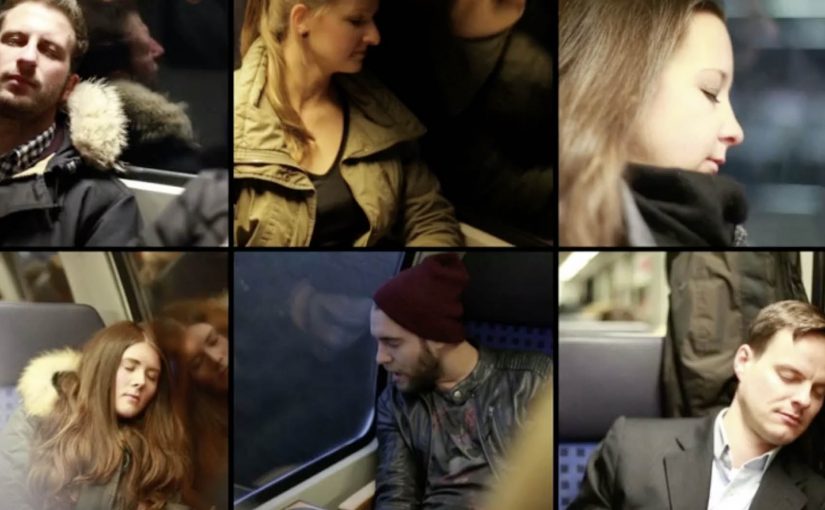
Sky Go: The Talking Window

Train passengers who get bored during travel often lean their head against the window. Sky Go uses that exact micro-moment as an attention trigger, without asking anyone to look up from their seat.

BBDO Germany, together with Audiva, a bone conduction specialist, developed a small transmitter that attaches to the train window and delivers an audio message in a way that feels oddly personal. Bone conduction means transmitting sound to the inner ear through skull vibrations rather than through the air into the ear canal.

How the window “talks”

The transmitter emits an inaudible, high-frequency vibration through the glass. When a passenger rests their head against the window, those vibrations travel through the bones of the skull to the inner ear. The brain interprets the vibration as sound, so the person leaning on the window hears the message while nearby passengers hear nothing.

Bone conduction is the conduction of sound to the inner ear through skull vibrations, rather than through the air into the ear canal.

In public transport advertising, tying a message to a predictable body posture can create “only I can hear this” intimacy without turning the whole carriage into noise.

Why this lands

This works because it is activated by a natural behavior, not by a request. There is no screen to seek, no QR code to scan, no app to open in the moment. The novelty is also self-explaining. The passenger experiences the medium first, then understands the message.

Extractable takeaway: If you want attention in a distraction-heavy environment, design an opt-in trigger that happens through normal movement, and deliver the payload as a private experience rather than a public interruption.

What the campaign is really testing

The real question is where clever intimacy stops and intrusion starts in ambient media.

This format is strongest when the trigger feels voluntary and the message stays restrained. It is not audio quality being tested as much as tolerance. This kind of “whisper only to you” media explores how far ambient advertising can go before it feels intrusive, and where the line sits between clever targeting and unwanted interruption.

What ambient media can borrow from this

  • Exploit a reliable posture. Build around something people already do on autopilot.
  • Make the medium the headline. A new delivery mechanism earns attention before the message even lands.
  • Keep it private. Personal sound beats shared noise in confined public spaces.
  • Design for instant comprehension. If someone needs an explainer to “get it,” the ambient magic collapses.

A few fast answers before you act

What is the Sky Go “Talking Window”?

It is a train-window activation that delivers an audio message only to people who lean their head against the glass, using bone conduction vibration.

Why can only one person hear it?

The sound is carried through the glass and into the listener’s skull when they make contact. People not touching the window do not receive the vibration path.

Is this facial recognition or tracking?

No. The described trigger is physical contact with the window, not identity detection.

What is bone conduction in plain terms?

It is hearing sound through skull vibrations, where the vibration reaches the inner ear without traveling through the air into the ear canal.

What is the main risk of this format?

If it startles people or feels unavoidable, it can be perceived as invasive. The creative and frequency need restraint.
smart fortwo: parKING

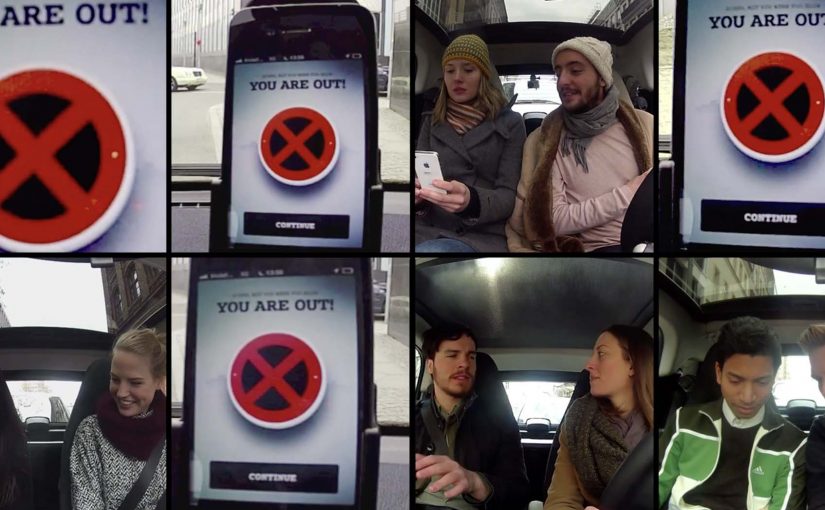
Parking in the city is rarely fun, so BBDO Germany turns a regular test drive for the smart fortwo into an interactive parking game inspired by musical chairs.

An iPhone app plays music and directs teams around central Berlin. When the music stops, teams have to find a parking spot immediately. The last team to park and verify their location with a photo upload is eliminated. The competition runs out of the smart Center Berlin, where eight teams battle to become Berlin’s first “parKING”. In this activation, “parKING” names the elimination-style parking race where the last team to park when the music stops is out.

How the game works as a test drive

The mechanism is simple. A timed audio cue creates urgency. GPS-style direction turns the city into the board. Photo proof keeps it honest. Underneath the playfulness, every round forces the product truth the brand wants to dramatize. In a dense city, a small car that can slip into tight spots changes the outcome. Because the win condition is parking fast in tight spots, the fortwo’s city-fit advantage shows up as a competitive edge.

In urban European mobility marketing, turning a functional advantage into a public game is a reliable way to make a test drive feel like entertainment rather than evaluation.

The real question is whether the rules make the product truth decide the winner, without narration.

For city-mobility brands, this rule-first approach beats a standard test drive because it turns a claim into observable proof.

Why it lands

It converts a daily friction into a competitive moment, then makes the proof visible. People do not need to be told that parking is painful. They already feel it. The activation reframes that pain as a challenge where speed, composure, and the vehicle’s city fit are the deciding factors.

Extractable takeaway: If your product benefit only matters in a real context, stage a rule-based experience that forces the context to happen. Then let the rules make the benefit obvious without narration or feature lists.

Steal the parKING activation pattern

  • Build the experience around one constraint. Here it is time pressure when the music stops. One constraint keeps the story legible.
  • Use verification that audiences trust. Photo proof is simple and public. It prevents the “this is fake” reaction.
  • Turn the environment into the media. The streets of Berlin are not a backdrop. They are the gameplay.
  • Make the rules do the branding. When the win condition is aligned with the product truth, the brand message arrives naturally.

A few fast answers before you act

What is parKING in one sentence?

It is a city-wide parking game that turns a smart fortwo test drive into musical chairs, guided by an iPhone app and enforced with photo verification.

Why does a game work better than a normal test drive here?

Because it creates stakes and a clear outcome. A standard test drive is private and subjective. A game produces winners, losers, and shareable proof.

What makes this feel “made for Berlin” instead of generic?

The rules depend on dense city parking reality. The city’s constraints are the point, so the activation feels native to the environment.

What is the main risk when brands copy this pattern?

Misaligned rules. If the game’s win condition does not directly demonstrate the product truth, you end up with a fun event that does not build the intended belief.

What is the minimum viable version of this mechanic?

A single timed cue, simple navigation to keep teams moving, and one proof step such as a photo upload. Strip everything else.

Denon VisYOUalizer: feel the music

Denon wants to bring to life the idea that with its line of lifestyle headphones you do not just hear the music, you feel it. So BBDO New York, described alongside Jam3 in production write-ups, creates an engaging experience for younger audiences who are not yet familiar with Denon’s long-running audio heritage.

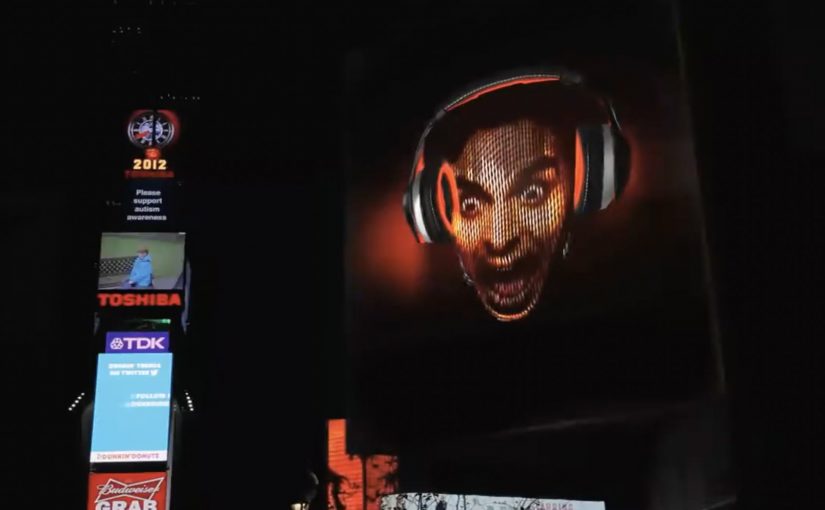
A Denon VisYOUalizer app is created that lets people try on the headphones virtually and turn their faces into a dynamic, customized music visualizer.

How the VisYOUalizer turns “sound” into something you can see

The mechanic is simple. Your face becomes the canvas, the music becomes the driver. You line up to a camera, the headphones snap into place virtually, and the experience maps a moving visual layer to your expression and the track’s energy. Because the visual layer responds in real time to both the track and your expression, the “feel it” promise reads as proof rather than copy.

In consumer electronics and lifestyle brands, face-based interactivity works best when the visual payoff is immediate and the product benefit is embodied rather than explained.

Why it lands for a younger audience

Headphone marketing often leans on specs, heritage, or famous musicians. This goes the other way. It starts with play and self-expression, then backfills the brand story through the experience and its share value. The real question is whether you can make an intangible promise visible enough that people want to play with it before they care who you are. When awareness is the constraint, a participatory demo beats a spec-led pitch.

Extractable takeaway: If your benefit is sensory or emotional, make the user’s own face or movement the proof, and deliver the payoff before you ask for attention to the brand story.

That matters when awareness is the real problem. If people do not know Denon, a participatory demo can earn attention faster than a product film.

What the brand is really doing here

This is a virtual try-on wrapped around a music visualizer. The try-on makes the product tangible. The visualizer makes the “feel it” claim legible. And the combination gives Denon an interaction that people can show to friends without needing to explain anything.

Steal this for your next “feel it” product idea

  • Turn an abstract benefit into a visible response. If “feel” is the promise, show a reaction that moves with the input.
  • Make the first 10 seconds rewarding. The hook should work before anyone reads instructions.
  • Use virtual try-on as the entry point. It lowers friction because people already know what to do.
  • Let personalization do the marketing. When people see themselves in the output, they are more likely to share.

A few fast answers before you act

What is the Denon VisYOUalizer?

It is a face-based interactive experience that lets you virtually try on Denon lifestyle headphones and transforms your face into a music-driven visualizer.

What product message is it designed to prove?

It translates “you do not just hear the music, you feel it” into a visual reaction that changes in real time with the sound and the participant’s presence.

Why combine a visualizer with a virtual try-on?

The try-on makes the product concrete and recognizable on your face, while the visualizer supplies the emotional payoff that makes people stick around and share.

What do you measure to judge success?

Time spent, completion rate, share rate, repeat plays, and click-through to product pages are more meaningful than raw impressions for an experience like this.

What is the biggest failure mode for this format?

If the camera alignment is finicky or the output looks generic, people bounce fast. The experience needs instant feedback and obvious personalization.