
Flair: Fashiontag

Flair: Fashiontag

Women are always looking for inspiration for their wardrobe and most of the time they find this inspiration by looking at other women.

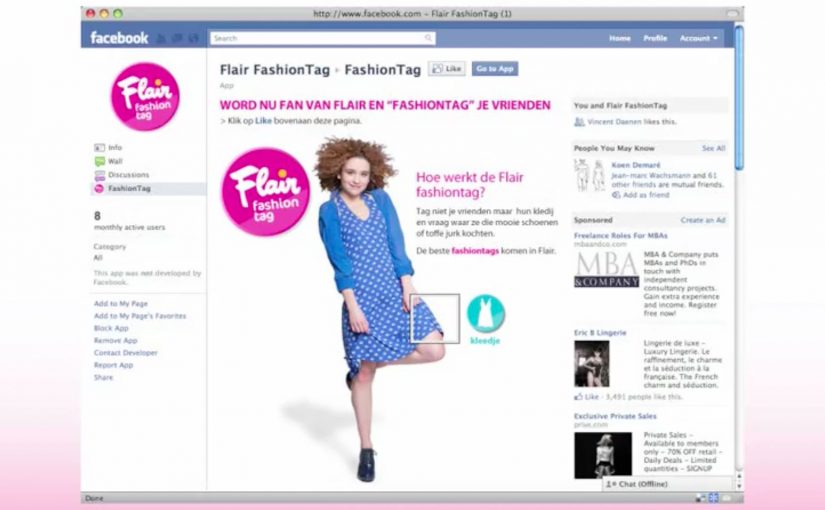
This inspired agency Duval Guillaume to create a Flair Fashiontag Facebook app for Belgian women’s magazine Flair. In the app, instead of tagging people, you can tag people’s clothes or accessories and ask them where they got them.

All fashiontags are displayed in a Facebook gallery, and the best are published in the weekly edition of Flair. This way there is constant interaction between the Facebook application and the magazine itself.

Turning social curiosity into a repeatable format

The mechanism is a simple swap. Replace social tagging of people with social tagging of products. A photo becomes a shoppable question. The owner of the outfit becomes the source. The magazine becomes the curator that elevates the best finds from feed to print.

In fashion and lifestyle publishing, converting casual “where did you get that” moments into a structured loop is a practical way to keep community activity and editorial output feeding each other.

The smart move here is to treat wardrobe curiosity as a content engine, not as a side effect of social chatter. The real question is how to turn that curiosity into a repeatable loop that helps readers in the moment and gives the magazine something worth curating.

Why it lands

This works because it formalizes a behavior that already exists. People already look at outfits, notice details, and ask friends for sources. Fashiontag simply gives that behavior a native interface and a public gallery, then adds a prestige layer by featuring the best tags in the weekly magazine.

Extractable takeaway: If your audience already asks each other for product sources, build a lightweight format that captures those questions in the moment and rewards the best contributions with visible amplification.

What to steal from Fashiontag

  • Swap the object of attention: tag the item, not the person, when product discovery is the real intent.
  • Close the loop with curation: a gallery is useful. Editorial selection makes it aspirational.
  • Make participation low-friction: one tag, one question, one shareable output.
  • Bridge channels on purpose: use print, site, and social as a single system, not separate campaigns.
  • Protect the social contract: ensure the person in the photo is comfortable with tagging and featuring, especially when content moves into a magazine.

A few fast answers before you act

What is Flair Fashiontag?

It is a Facebook app for Flair magazine that lets users tag clothes or accessories in photos and ask where those items were purchased.

What makes it different from normal photo tagging?

Normal tagging identifies people. Fashiontag identifies items. It turns fashion curiosity into a structured question-and-answer interaction.

How does the magazine benefit from the Facebook app?

The app creates a steady flow of wardrobe inspiration and real questions from readers. The magazine then curates and publishes the best tags, which reinforces participation.

Why is this a strong community mechanic?

Because it rewards helpfulness. People contribute sources and recommendations, and the gallery plus print selection turns that help into recognition.

What is the biggest risk in this format?

Consent and comfort. Tagging items in someone’s photo can feel intrusive if the person did not opt in, especially if content can be featured publicly in print.


AXA: Mobile Service Home i-Mercial

AXA: Mobile Service Home i-Mercial

In 2010, AXA was the first insurance company in the market to launch an iPhone application for car insurance. In 2011, AXA took this one step further and developed an iPhone application for fire insurance.

“Mobile Service Home” is described as a first for the Belgian insurance market, so the product was launched with a method designed to feel just as inventive. AXA and ad agency Duval Guillaume Antwerp. Modem developed what they called an i-Mercial, a television spot for viewers to step into.

How the i-Mercial works

The mechanism is a second-screen bridge: the TV spot includes an on-screen code, and the viewer uses an iPhone to scan it. That scan unlocks an extended layer of the story on the phone, so you move from watching the house on TV to exploring what happened inside it on your own screen. Because the scan happens while the spot is still running, the viewer stays in the narrative and experiences the service logic instead of just hearing about it.

In European insurance markets, this kind of second-screen interactivity turns a passive TV spot into a hands-on service demonstration.

The real question is whether the second-screen bridge proves the service promise in the moment, not whether the format feels novel.

Why it lands

It makes “mobile service” tangible. If the promise is speed and guidance in stressful moments, an interactive format is a better proof than a claim.

Extractable takeaway: Interactive advertising works when the phone is used as a second screen to continue the story and demonstrate the service. The TV spot creates the prompt. The mobile interaction delivers the proof.

  • It gives the viewer control. The audience is not asked to remember a URL later. The action happens in the moment, and the phone becomes the interface for continuing the narrative.
  • It turns a CTA into an experience. Scanning is not a bolt-on gimmick. It is the creative idea, because it lets the viewer literally step into the ad.

Second-screen launch moves

  • Design the interaction to be immediate. If the action cannot happen in seconds, most viewers will drop.
  • Make the “next layer” worth it. The mobile extension should add narrative, clarity, or utility, not just extra footage.
  • Ensure the format matches the product. A mobile service is best launched through a mobile-driven interaction.

A few fast answers before you act

What is an “i-Mercial” in this case?

A TV commercial designed to continue on an iPhone, so the viewer can interact with the ad rather than only watch it.

How does the viewer “step into” the TV spot?

By scanning an on-screen code with an iPhone during the broadcast, which unlocks an extended experience on the phone.

Why is this a smart launch method for an insurance app?

Because it demonstrates mobile-guided service behavior immediately, instead of asking viewers to imagine how the app helps.

What is the main risk with this format?

Link rot. If the scan destination or app flow is no longer maintained, the core mechanic breaks and the campaign loses its point.

What is the most transferable lesson?

When you want people to believe a mobile service, make the first brand interaction mobile, interactive, and simple enough to complete in the moment.

Mobistar: Basta Call Center Prank

Mobistar: Basta Call Center Prank

Mobistar is long described as one of Belgium’s leading mobile operators and one of the country’s biggest advertisers. Over time, it also becomes known in public conversation for frustrating customer service.

So on January 10, 2011, Belgian TV makers at VRT decide to prank Mobistar, and the segment later airs on their new comedy show, Basta. A Mobistar security guard named Mathieu becomes the unlikely hero, largely because he stays calm and friendly throughout.

The prank that turns “call center pain” into a live experience

The execution is cruelly simple. A physical setup triggers a phone call. That phone call leads into an intentionally endless customer-service loop of transfers, hold music, dead ends, and “let me check with my boss” deflections. The joke is not the person calling. The joke is the system that can trap anyone, even someone trying to do the right thing.

In European telecom markets, customer service reputation can outweigh product features in the public conversation.

Why it lands: it exposes the gap between message and reality

Modern consumers get tired of overpromising brand messages, especially when the lived experience does not match. This prank goes viral because it dramatizes that mismatch without a lecture. You can feel the frustration build, and you recognize it instantly if you have ever battled a helpdesk script.

Extractable takeaway: If your brand invests heavily in advertising but underinvests in service, someone else will eventually tell your story for you. The narrative people remember will be the experience, not the tagline.

The uncomfortable lesson for big advertisers

The real question is whether your marketing is amplifying a service experience worth talking about, or drawing more attention to one people already resent.

The punchline carries a serious point. If brands want trust, they need to fund the product and the service before they fund the promise. Great campaigns amplify a great experience. They cannot replace it for long.

What to steal if you run CX, service, or brand

  • Audit your “moments of truth”: contact centers, chat, returns, and complaints shape reputation faster than brand film.
  • Measure friction, not just satisfaction: transfers, resolution time, and repeat-contact rate are where trust is won or lost.
  • Stop advertising around known pain: fix the root issue first, then scale the promise.
  • Turn service into a brand asset: when service is excellent, it becomes shareable for the right reasons.
  • Protect frontline humans: if your system is broken, your staff and customers suffer together.

A few fast answers before you act

What happened in the Mobistar prank?

A TV team stages a scenario that forces a Mobistar employee into an exaggerated, endless customer-service loop, mirroring the frustrations customers report when they seek help.

Why did Mathieu become the “hero” of the clip?

Because he stays polite and persistent while the system around him becomes increasingly absurd. His demeanor contrasts with the experience the prank is criticizing.

What is the business takeaway for brands?

Advertising cannot sustainably outshine poor service. When the lived experience disappoints, culture and media will surface the truth faster than any campaign can mask it.

How should a telecom brand respond to criticism like this?

Fix operational drivers first: staffing, escalation paths, first-contact resolution, and transparency. Then communicate improvements with proof, not slogans.

What should leaders measure to prevent this kind of reputational damage?

Resolution time, transfer rate, repeat-contact rate, complaint volume by issue, and sentiment in customer conversations. These tend to predict reputation better than awareness metrics.