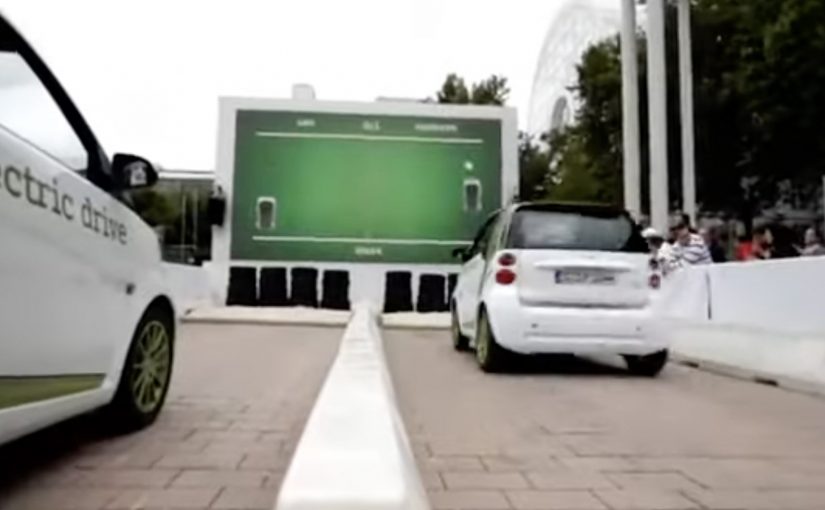
At the Frankfurt Motor Show (IAA) in 2011, Daimler promoted the third generation smart fortwo electric drive with a special interactive game event. Berlin-based Proximity BBDO designed a game called eBall that translates the joy of a highly responsive car into something visitors can play.
Visitors sign up with their driver’s license, get quick instructions on forward and reverse, and then step into a live ping pong duel. Instead of a controller, they use the car itself. Driving forward and back moves the “paddle,” with measurement technology tracking the rally on a large display.
When “responsive” becomes the gameplay
Electric drive messaging often struggles because it is full of abstractions. Efficiency, torque, responsiveness. eBall makes one of those claims physical. The faster and more precisely you control forward and reverse, the better you play. That is a rare alignment. The product behaviour is the mechanic.
Extractable takeaway: If your product promise is about control, speed, or precision, build an experience where performance is visible to a crowd and felt by the participant in under a minute.
In European automotive launches, live interaction works best when it turns a technical attribute into a simple skill people can feel and repeat.
The real question is whether your interaction turns the claim into a repeatable skill, not a slogan.
The tech trick is invisible on purpose
As described in coverage of the installation, the paddles on the LED wall are controlled by two real smart fortwo electric drive cars using laser measurement and transmission technology. The important detail is not the hardware. It is the immediacy. When the wall responds instantly, the player trusts the cause-and-effect and stays in the duel.
Why the driver’s license step matters
The license check does two jobs. It manages safety and liability, and it creates a small “this is real” threshold. You are not playing a simulator. You are operating a vehicle in a branded arena. That seriousness increases attention, and it makes the win feel earned.
What smart is really selling here
eBall does not try to convince you with specs. It frames the car as a fun, responsive object that behaves like a sports device in the hands of the driver. The subtext is clear. If it can play ping pong with precision, it will feel effortless in tight city driving too.
Moves worth copying in event mechanics
- Translate one attribute into one action. “Responsive” becomes “hit the ball back.” No extra storytelling required.
- Design for spectators. The LED wall makes the game readable from distance, so the crowd becomes the amplifier.
- Keep the control model binary. Forward and reverse is legible, teachable, and low-cognitive-load.
- Make the feedback immediate. Interactivity only feels truthful when response is fast.
- Engineer the queue. A duel format naturally builds anticipation and repeat attempts.
A few fast answers before you act
What is smart eBall?
It is a live event game where visitors play a ping pong style duel by driving a smart fortwo electric drive forward and backward to control a digital paddle on a large screen.
Why does ping pong fit an electric city car story?
Because it is a precision game. It makes responsiveness and control visible in a way a brochure cannot, and it fits the “small, agile, quick” associations smart wants to own.
What makes this different from a normal driving simulator?
The controller is the vehicle, and the outcome is public. That changes the psychology from private play to performance, which increases energy, memorability, and word of mouth.
What is the biggest operational risk with this kind of activation?
Latency, safety, and throughput. If the system lags, people stop trusting the interaction. If safety or queue management fails, the experience becomes stressful instead of fun.
What should brands measure in a “playable product demo” like this?
Participation rate, average dwell time, repeat plays, audience size over time, and how many people capture and share the experience, plus any downstream test-drive or lead signals.