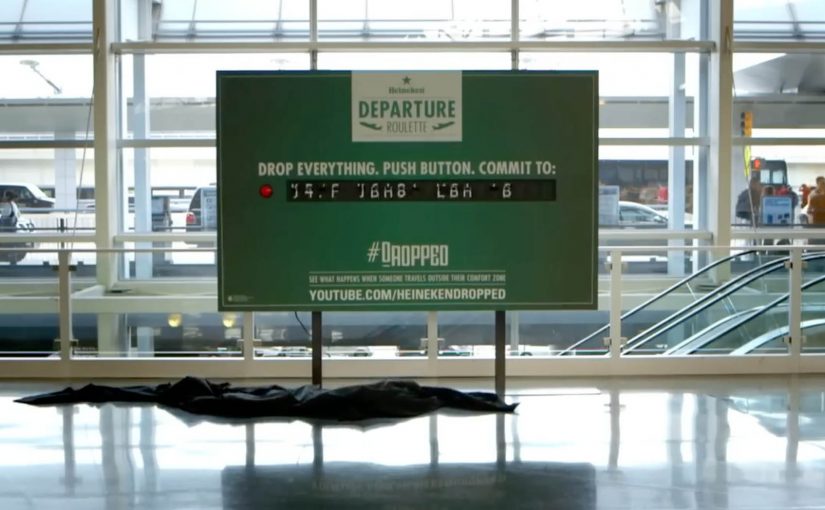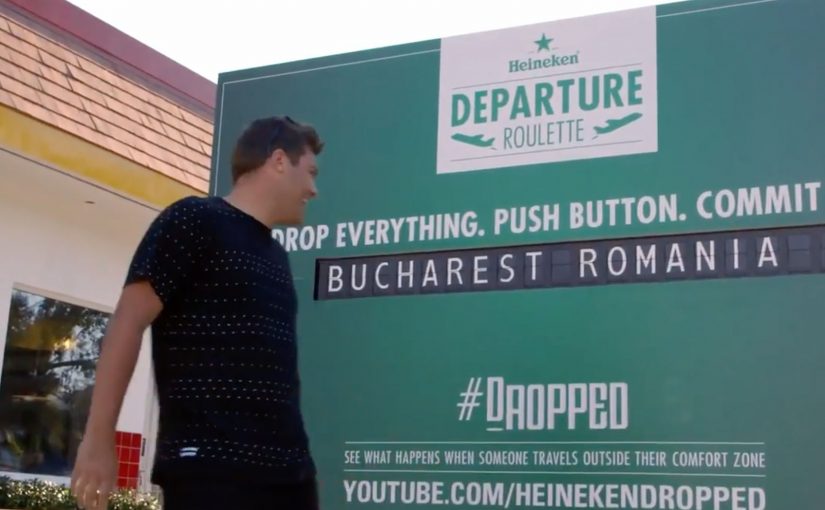
Heineken spots the tweets. Then they make them real. People watch the original Departure Roulette stunt and post the inevitable line on Twitter: “I’d press the button.” Heineken takes that public intent seriously. They track down a few of the people who tweet about wanting to play. Then they offer them the chance to play Departure Roulette on the spot. Real time, real commitment, no rehearsal.
If you want the backstory first, the original Departure Roulette activation sets the frame: a physical roulette board at JFK Terminal 8. One red button. Press it and you accept a new destination immediately. Read about the original here.
What “En Route” gets right: it turns social intent into action
The smartest part of this follow-up is not the surprise. It is the mechanism. Heineken treats social conversation as a live signal of willingness, not just commentary. Here, “social intent” means an explicit public statement like “I’d press the button,” not passive engagement. By acting on that signal fast enough to feel connected, the brand turns curiosity into a credible story of commitment.
Extractable takeaway: When people declare intent in public, treat it as an opt-in trigger. Respond fast with a real commitment moment, and make the decision itself the content.
The real question is whether you can turn “I’d do that” intent into a real commitment fast enough to feel causal, while keeping consent and safety airtight.
If you cannot deliver the commitment reliably in real time, you should not run this pattern.
It rewards declared intent in public
A tweet is a lightweight commitment. Heineken upgrades it into a real decision. The gap between “I would” and “I did” becomes the content.
It closes the loop from earned media to owned experience
The original stunt earns attention. The follow-up re-enters the stream where that attention lives. Social becomes a trigger for a real-world activation, not just a distribution channel.
It stays consistent with the campaign’s core promise
Departure Roulette is about spontaneity and courage. The follow-up keeps the same proposition, just delivered to a different moment and audience.
In global consumer brands running real-time social and experience programs, the advantage comes from turning explicit public intent into a safe, opt-in moment of commitment.
What to measure beyond views
- Intent volume. How many people explicitly say they would do it.
- Conversion rate. Percentage of selected participants who actually commit when approached.
- Time-to-response. How quickly you move from trigger to activation.
- Amplification quality. Replies and quote-posts that debate “would you do it,” not just “nice video.”
- Brand linkage. Whether the audience repeats the core idea (spontaneity, adventure), not just the prank.
Risks and guardrails that matter
- Consent and privacy. Do not approach people in a way that feels extractive. Keep it clearly opt-in.
- Safety and duty of care. High-stakes travel stunts need hard boundaries, support, and contingencies.
- Credibility. The offer must be unquestionably real, or the story collapses into suspicion.
- Operational readiness. The logistics are the product. If ops fail, the story turns.
How to reuse this pattern without copying the stunt
- Define the “press the button” moment. Pick one unmistakable action that proves intent.
- Listen for explicit triggers, not vague sentiment. Look for “I would,” “I want,” or “If you did this I’d…” rather than likes alone.
- Respond fast enough that it feels connected. If the follow-up arrives too late, it reads like a promotion, not a story.
- Make the commitment real, but safe. Build constraints on timing, eligibility, logistics, and consent.
- Capture the decision, not just the reward. The moment of choice is the asset. The prize is the justification.
A few fast answers before you act
What is Departure Roulette En Route in one line?
It is a social-powered follow-up where Heineken turns “I’d press the button” tweets into a real-world chance to do exactly that.
Why does it spread?
Because it stages a high-stakes, relatable decision in public: keep your plan, or choose the unknown.
What is the reusable strategy?
Treat public intent as a trigger for action. Then deliver a real experience that proves the brand promise.
What is the minimum viable version for a brand without travel budgets?
Reward declared intent with an immediate upgrade: surprise access, exclusive drop, instant appointment, or fast-track service.
Where does this go wrong fastest?
When it feels like surveillance, or when the logistics do not deliver on the promise.