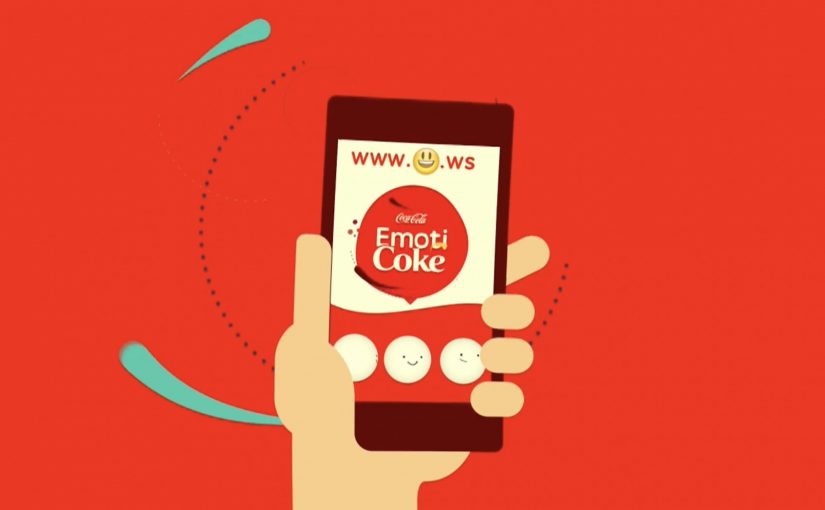
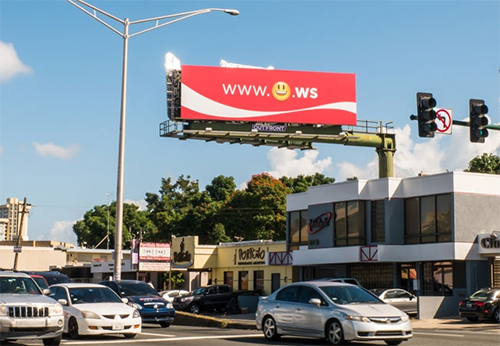
Coca-Cola, through its campaign in Puerto Rico, tries to make the internet a happier place by turning emojis into a mobile call-to-action. The brand is described as registering web addresses for the emojis that convey happiness, then using huge outdoor ads to push people to try them on their phones.
Those emoji web addresses route visitors to a landing page, www.EmotiCoke.com, where people could sign up for a chance to win the emoji web addresses for themselves.
The mechanic: emoji addresses that redirect to one place
The execution hinges on a simple redirect loop. Type a “happy” emoji as the web address (with a supported suffix), land on the same destination, then convert curiosity into sign-up. Under the hood, these are internationalized domain names (IDNs) represented in a DNS-safe format, even if the user experience is “just type the emoji.” This works because every emoji address resolves to one destination, so the user does not have to learn multiple URLs to get the payoff.
In mobile-first out-of-home campaigns, the simplest call-to-action wins because the billboard has only seconds to convert attention into a tap.
Why it lands
It takes a behavior people already practice, using emojis to express mood, and repurposes it as navigation. That small twist is the hook. It is instantly legible from a distance, it is fun to try, and it creates a low-friction bridge from street-level attention to a trackable digital interaction. The real question is whether your call-to-action can be copied from a distance and tried instantly on a phone.
Extractable takeaway: When you need mass participation from a passive channel like OOH (out-of-home), make the call-to-action both copyable and inherently playful. “Try this now” works best when the first step feels like a game, not a form.
Why .ws shows up in the story
For anyone wondering why .ws shows up, it is the country-code suffix for Samoa. The campaign is described as choosing .ws because emoji characters were not accepted on common top-level domains like .com, .net, and .org at the time. The additional brand rationale mentioned in coverage is that “.ws” could be read as “We smile,” which fits the happiness positioning.
Steal this pattern: emoji URLs as a CTA
- Optimize for retyping, not explaining. If someone cannot replicate it from memory, you lose the moment.
- Use one destination. Let novelty drive entry, then keep the conversion path clean and consistent.
- Make the first interaction instant. If the page loads slowly or the redirect breaks, the idea collapses.
- Plan for platform variance. Emoji rendering differs by OS and font. Keep the creative readable even when the glyph changes.
A few fast answers before you act
What is EmotiCoke in one sentence?
It is a Coca-Cola Puerto Rico activation that uses emoji-based web addresses on billboards to drive mobile users to EmotiCoke.com to sign up for a chance to claim those emoji URLs.
How do “emoji URLs” work in practice?
They rely on internationalized domain name support. The emoji the user sees is encoded into a DNS-compatible form, then redirected to a standard landing page.
Why did the campaign use the .ws suffix?
Because the campaign is described as needing a suffix that accepted emoji characters, and .ws was positioned as a workable option. Coverage also cites the “We smile” wordplay as a fit for Coca-Cola’s happiness theme.
Are emoji web addresses reliable everywhere?
No. Support varies across browsers, keyboards, registrars, and operating systems. Emoji appearance also changes by platform, which can affect recognition and retyping accuracy.
What are the biggest execution risks?
Broken redirects, slow mobile load times, unclear typing instructions, and inconsistent emoji rendering across devices. Any of these adds friction and kills the novelty fast.