KLM Connecting Seats

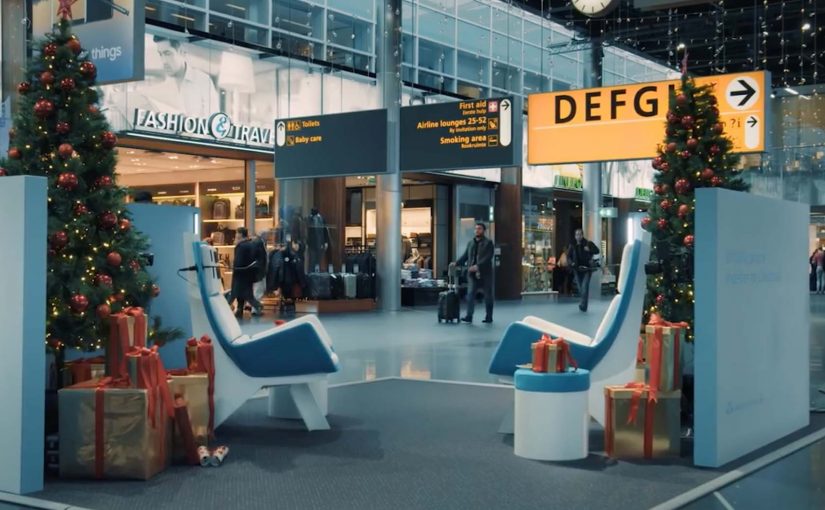
Airports are crowded with people from different backgrounds. This Christmas, KLM brings them together with Connecting Seats. Two seats that translate every language in real time, so people with different cultures, world views, and languages can understand each other.

The experience design move

KLM does not try to tell a holiday message. It creates a small, human interaction in a high-friction environment. You sit down. You speak normally. The barrier between strangers is reduced by the seat itself.

Why this works as a Christmas idea

Christmas campaigns often rely on film and sentiment. This one uses participation. It makes connection visible. It gives the brand a role that feels practical rather than promotional.

The pattern to steal

If you want to create brand meaning in public spaces, this is a strong structure:

  • Pick a real-world tension people already feel (crowded, anonymous, culturally mixed spaces).
  • Introduce a simple intervention that changes behaviour in the moment.
  • Let the interaction carry the message, not a slogan.

A few fast answers before you act

What are KLM Connecting Seats?

Two seats designed to translate language in real time, so strangers can understand each other.

Where does this idea make sense operationally?

In airports and other transient spaces where people from different backgrounds sit near each other but rarely interact.

What is the core brand outcome?

A memorable, lived proof of “bringing people together,” delivered through an experience rather than a claim.

KLM Live High Five

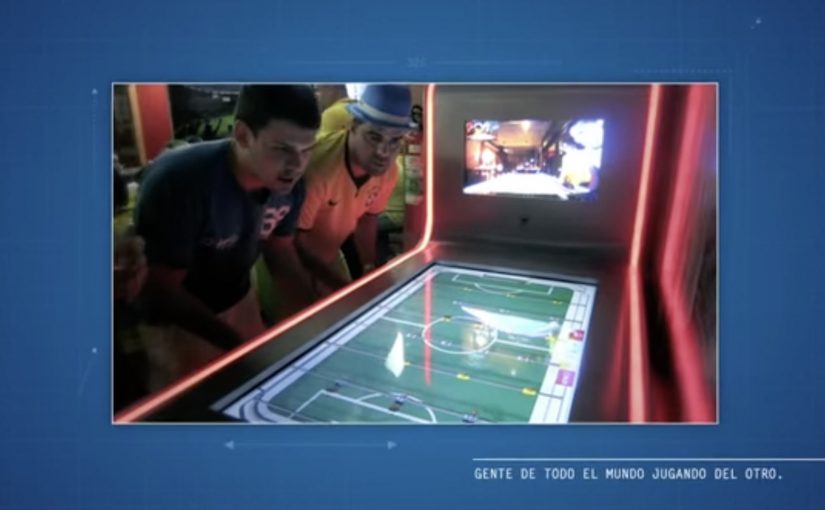
On 28th of August, KLM connected hundreds of people in Amsterdam and New York via a live interactive video display. The display let people on the streets of the two cities come face to face with one another, just as the French railway (SNCF) had done with Lyon and Brussels in 2012.

However the KLM version had a contest built into it. The connected people were asked to High Five each other and for every successfully timed High Five, the participants got two tickets to New York or Amsterdam.

LEGO: Builders of Sound barrel organ

The 3D premiere of Star Wars Episode 1 in early 2012 was a cinematographic milestone for the Star Wars saga. To celebrate it, LEGO and Serviceplan Munich created a unique LEGO sound installation that actually plays the Star Wars main theme.

The installation is a huge barrel organ built from over 20,000 LEGO pieces. Four Star Wars worlds (Hoth, Tatooine, Endor and the Death Star) are constructed on the turning barrel. As it rotates, LEGO elements trigger mechanical sensors that strike the keys of a built-in keyboard, playing the tune.

In European entertainment and toy launches, the strongest activations turn fandom into something people can physically operate, not just watch.

A Star Wars theme you can crank with your hands

The most effective detail is the constraint. There is no “press play” button. You have to turn the organ. That one decision makes the experience feel earned. The song arrives as a result of your motion, not as background audio triggered by a screen.

Standalone takeaway: When a brand idea is about “bringing something into a new dimension,” the fastest route is to convert a familiar object into a physical interface and let the audience generate the outcome.

How bricks become music

This is not a metaphor. It is a mechanical translation. LEGO pieces are arranged to behave like pins on a traditional barrel organ. The rotation sequence becomes a score, and the score becomes the melody via real key strikes. The four worlds on the barrel are not just decoration. They turn product and story into one continuous surface.

Why it lands as a cinema activation

Star Wars fans already love collectibles and craft. This installation rewards that mindset with a live proof of “impossible build meets real output.” It also gives the audience a clean social script. Stop. Watch someone crank it. Step in. Try it yourself. Film it. Share it.

What the launch is really doing for LEGO

It positions LEGO Star Wars sets as more than toys. It frames them as a medium. Something that can build worlds, build machines, and even build music. That is a stronger proposition than “new sets available now,” especially around a film re-release where attention is already concentrated in cinemas.

What to steal from Builders of Sound

  • Make the mechanism the message. The build itself should prove the claim, not just support it.
  • Use one obvious action. Turning a crank is universally understood, and it invites participation.
  • Design for bystanders. The experience should be readable from a distance, even before someone tries it.
  • Let sound do the heavy lifting. A recognisable theme turns a mechanical demo into an emotional moment.
  • Extend the experience online without changing the core gesture. If the physical version is “crank,” the digital version should feel similarly tactile.

A few fast answers before you act

What is LEGO “Builders of Sound”?

It is a LEGO Star Wars activation built around a giant barrel organ made from over 20,000 LEGO pieces. When the barrel is turned, the mechanism triggers keys to play the Star Wars main theme.

Why a barrel organ for a Star Wars release?

Because it turns a familiar, physical music machine into a participatory interface. The audience does not just hear the theme. They generate it, which makes the moment feel personal and shareable.

What makes this more than a sculpture?

Mechanical output. The build produces a real, repeatable result. That cause-and-effect shifts it from “impressive object” to “experience people line up to try.”

How do you translate a physical installation like this into an online experience?

Keep the core gesture and the immediacy. In this case, the online version is described as playable via a simple control input that mimics the physical turning action.

What should a brand measure for an installation like this?

Participation rate, repeat interactions, dwell time, the volume of user-recorded video, and any downstream actions tied to the product, such as set interest or ordering intent.