
LEGO: Life of George

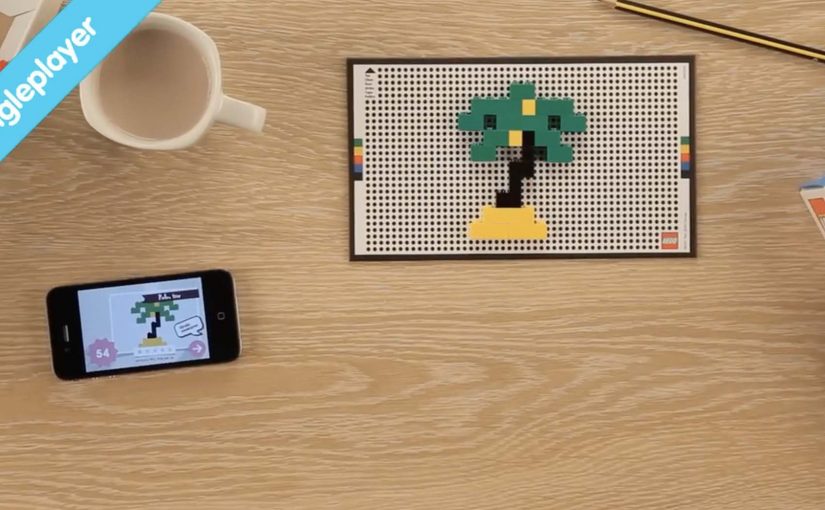
George shows you a photo from his travels and challenges you to rebuild it, fast, using real LEGO bricks. You scramble through a small set, build the scene on a dotted playmat, snap a picture, and the app scores you for speed and accuracy. The game is pretty useful as kids do not need to lug their entire LEGO collection around. While for parents the game helps in teaching counting and hand-eye coordination as you need to find blocks as quickly as possible and then put them together.

It is an exciting time for 12 year olds as they witness the first wave of electronic gaming. Digital-to-physical gameplay. Last year Disney announced a new line of toys called Disney Appmates that worked in tandem with the iPad. Now with “Life of George”, LEGO combines real bricks with an app for iOS and select Android devices.

Definition tightening: Digital-to-physical gameplay uses a screen to set the challenge and validate the outcome, while the actual play happens with real objects in the room.

The mechanic that makes it feel like a “real” game

The loop is clean. The app presents a reference image. You recreate it with 144 pieces. You photograph your build on the dotted playmat. The app reads the build using image recognition, then awards points based on how close you got and how quickly you did it.

In global toy categories where screens compete for attention, hybrid play wins when the device camera becomes a bridge back to hands-on making.

The real question is whether the app uses the screen to replace LEGO play, or to make physical LEGO play faster, clearer, and more replayable.

Why it lands for kids and parents

For kids, the fun is the time pressure and the treasure hunt. Finding the right brick and placing it correctly becomes the challenge, not navigating menus. For parents, the value is that the rules structure the chaos. Counting, pattern matching, and hand-eye coordination are baked into the race.

Extractable takeaway: The strongest digital-to-physical games treat the screen as referee, not as the playground. They keep the “doing” physical, and use the device only to prompt, verify, and reward.

What to steal from this format

  • Make the rules visual. A single reference image beats a paragraph of instructions.
  • Use the camera as validation. Let players “submit” their physical work in one tap.
  • Keep the kit portable. A small curated set can travel, unlike a whole LEGO tub.
  • Reward speed and accuracy. Those two levers create replay without adding complexity.

A few fast answers before you act

What is LEGO Life of George?

A hybrid LEGO game where the app shows a picture challenge, you rebuild it with real bricks on a playmat, and the app scores your photo using brick recognition.

What is the core mechanism?

Prompt with an image. Build physically. Photograph on a patterned play surface. Use computer vision to validate and score speed and accuracy.

Why does the dotted playmat matter?

It standardizes the photo capture so the app can recognize scale and placement more reliably, which makes scoring feel fair.

What is the main benefit versus classic LEGO play?

Structure and portability. A small set plus timed challenges creates a “game” you can play anywhere without carrying a full collection.

What is the most reusable lesson for digital-to-physical products?

Use the device to create clear prompts and instant feedback, but keep the core activity tangible and social in the real world.
LEGO: Builders of Sound barrel organ

The 3D premiere of Star Wars Episode 1 in early 2012 was a cinematographic milestone for the Star Wars saga. To celebrate it, LEGO and Serviceplan Munich created a unique LEGO sound installation that actually plays the Star Wars main theme.

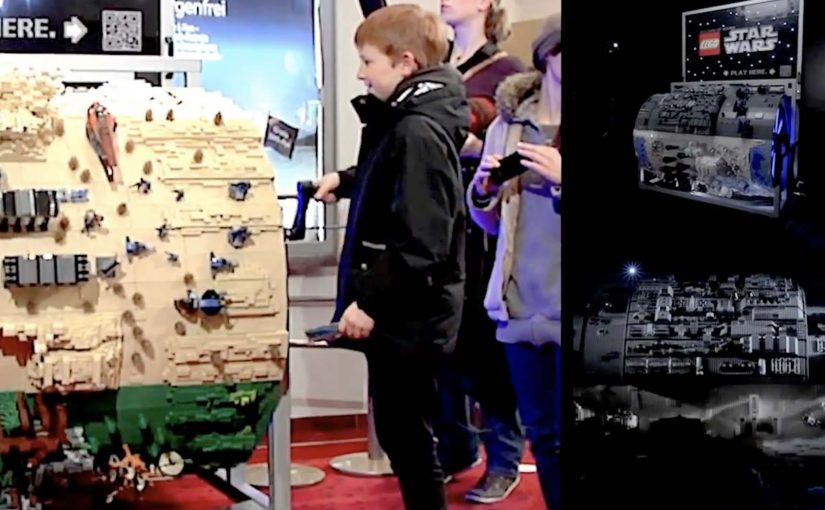
The installation is a huge barrel organ built from over 20,000 LEGO pieces. Four Star Wars worlds (Hoth, Tatooine, Endor and the Death Star) are constructed on the turning barrel. As it rotates, LEGO elements trigger mechanical sensors that strike the keys of a built-in keyboard, playing the tune.

A Star Wars theme you can crank with your hands

The most effective detail is the constraint. There is no “press play” button. You have to turn the organ. That one decision makes the experience feel earned. The song arrives as a result of your motion, not as background audio triggered by a screen.

How bricks become music

This is not a metaphor. It is a mechanical translation. LEGO pieces are arranged to behave like pins on a traditional barrel organ. The rotation sequence becomes a score, and the score becomes the melody via real key strikes. The four worlds on the barrel are not just decoration. They turn product and story into one continuous surface.

In European entertainment and toy launches, the strongest activations turn fandom into something people can physically operate, not just watch.

Why it lands as a cinema activation

Star Wars fans already love collectibles and craft. This installation rewards that mindset with a live proof of “impossible build meets real output.” It also gives the audience a clean social script, meaning a simple sequence people can follow without instructions. Stop. Watch someone crank it. Step in. Try it yourself. Film it. Share it.

Extractable takeaway: When a brand idea is about “bringing something into a new dimension,” the fastest route is to convert a familiar object into a physical interface and let the audience generate the outcome.

What the launch is really doing for LEGO

The real question is whether your launch gives people one obvious action that produces a repeatable, shareable payoff.

It positions LEGO Star Wars sets as more than toys. It frames them as a medium. Something that can build worlds, build machines, and even build music. That is a stronger proposition than “new sets available now,” especially around a film re-release where attention is already concentrated in cinemas.

Steal-worthy moves from Builders of Sound

  • Make the mechanism the message. The build itself should prove the claim, not just support it.
  • Use one obvious action. Turning a crank is universally understood, and it invites participation.
  • Design for bystanders. The experience should be readable from a distance, even before someone tries it.
  • Let sound do the heavy lifting. A recognisable theme turns a mechanical demo into an emotional moment.
  • Extend the experience online without changing the core gesture. If the physical version is “crank,” the digital version should feel similarly tactile.

A few fast answers before you act

What is LEGO “Builders of Sound”?

It is a LEGO Star Wars activation built around a giant barrel organ made from over 20,000 LEGO pieces. When the barrel is turned, the mechanism triggers keys to play the Star Wars main theme.

Why a barrel organ for a Star Wars release?

Because it turns a familiar, physical music machine into a participatory interface. The audience does not just hear the theme. They generate it, which makes the moment feel personal and shareable.

What makes this more than a sculpture?

Mechanical output. The build produces a real, repeatable result. That cause-and-effect shifts it from “impressive object” to “experience people line up to try.”

How do you translate a physical installation like this into an online experience?

Keep the core gesture and the immediacy. In this case, the online version is described as playable via a simple control input that mimics the physical turning action.

What should a brand measure for an installation like this?

Participation rate, repeat interactions, dwell time, the volume of user-recorded video, and any downstream actions tied to the product, such as set interest or ordering intent.