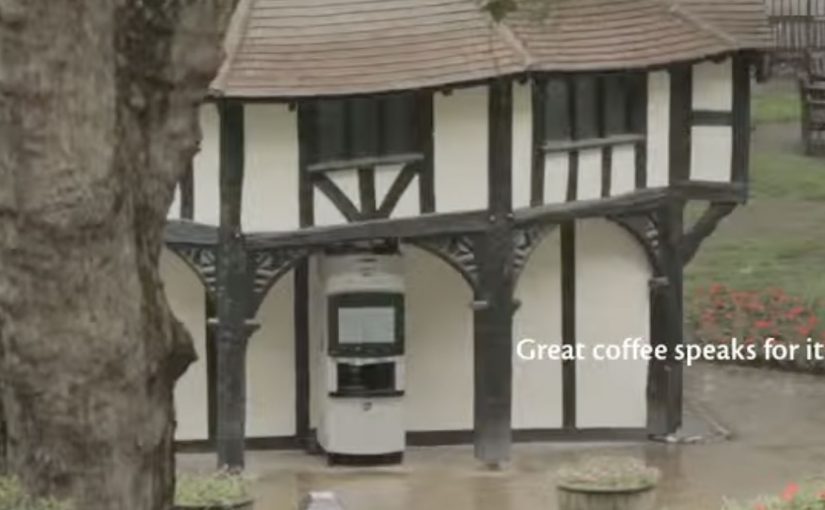
Kenco Millicano’s whole bean instant coffee is positioned as the closest thing to a proper coffee from a vending machine. However, people often have negative perceptions about drinking instant coffee from a machine. So, to engage and excite people enough to consider swapping their coffee shop routine for a vending option, Kenco Millicano worked with its agency team on a talking vending machine. The voice for the machine was provided by comedian and voice actor Mark Oxtoby, who spent a whole day in Soho Square interacting with passers-by.
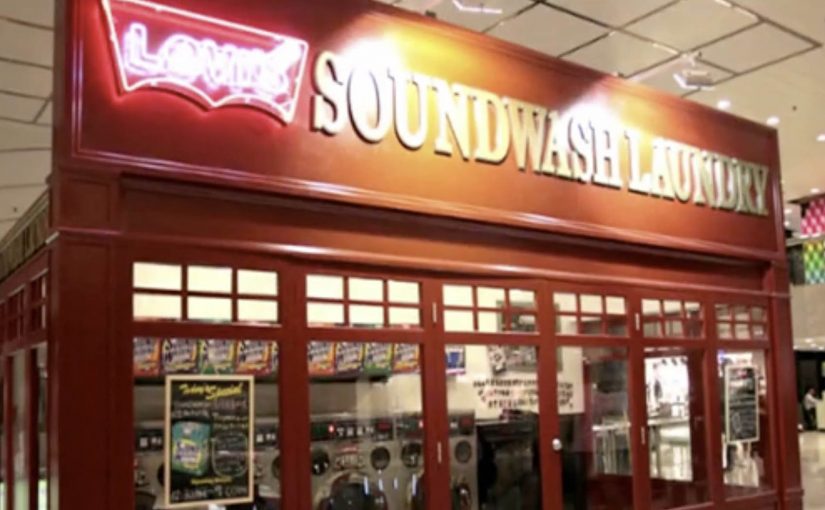
Similarly in Hong Kong, Levi’s worked with TBWA on a talking phone booth dubbed the “Levi’s Summer Hotline”. Inside the booth, two popular local radio hosts connected via video and challenged visitors to answer questions or do stunts. The crazier the stunt, the bigger the prize. The prize printed out in the booth like a receipt, and could be redeemed at nearby Levi’s stores. The activation was reported to have drawn more than half a million interactions over three days and to have driven a 30% sales uplift.
Two executions. One shared trick
Both ideas take a familiar street object. A vending machine. A phone booth. Then they add something people do not expect from an object like that. A voice, a challenge, a human response, and a reward that arrives immediately.
How the “talking interface” mechanic works
A “talking interface” is a familiar street object that responds with voice, turning a simple transaction into a short ask, response, reward loop.
- Interrupt the script. People approach expecting a predictable transaction, then the unit talks back.
- Create a small social contract. You do something simple or slightly brave, and the unit rewards you.
- Turn participation into theatre. Bystanders can understand what is happening fast, and the crowd recruits the crowd.
In busy public places where attention is scarce, interactive installations win when the first five seconds are obvious and the payoff is immediate.
The real question is whether you can make a vending moment feel like a social interaction, not a compromise.
Why it lands
The “talking” element is not a gimmick. It flips an inanimate object into a social moment, which makes the interaction feel personal even when it is happening in public. That shift changes the emotional framing from “machine coffee” to “a quick story I was part of”. For brands, that is how you replace a negative perception without arguing about it.
Extractable takeaway: If you want people to try something they think they dislike, do not debate the product. Change the moment around the product so the first experience feels human, surprising, and worth retelling.
What these activations are really doing for the brands
Kenco’s machine makes “vending” feel warmer, and it makes the product choice feel less like compromise. Levi’s booth turns brand interaction into a game with a tangible receipt-style reward that pushes people towards a nearby store. Both installations are a conversion point and a content engine at the same time.
Steal this loop for street activations
- Use a familiar object. Familiarity reduces explanation time and increases participation.
- Make the first step low-risk. A small action opens the door to a bigger payoff.
- Keep the loop short. Ask. Respond. Reward. Long flows die in public space.
- Design for onlookers. The audience around the participant is the multiplier.
- Make redemption effortless. If the reward requires extra effort later, participation drops.
Vending machines are one of my favourite formats for street-level innovation. I have featured plenty of them on Ramble. If you want to go deeper, browse the vending-machine archive.
A few fast answers before you act
What is a “talking vending machine” in marketing terms?
It is an interactive out-of-home installation where a vending unit uses live or scripted voice interaction to trigger participation, then delivers an immediate reward to reframe the product experience.
Why does “talking back” increase participation?
Because it breaks the expected script of a transaction. That surprise creates curiosity, and curiosity pulls people closer long enough for the reward loop to start.
What makes these ideas work in high-footfall locations?
They are instantly legible, fast to complete, and entertaining for bystanders. The environment supplies the amplification through crowd behaviour.
What is the biggest execution risk?
Throughput and reliability. If interactions slow down, misfire, or confuse people, the installation becomes friction, not fun.
How do you measure success beyond views?
Participation rate per hour, completion rate, average dwell time, sentiment, and whether the activation produces measurable trial or store redemption lift.