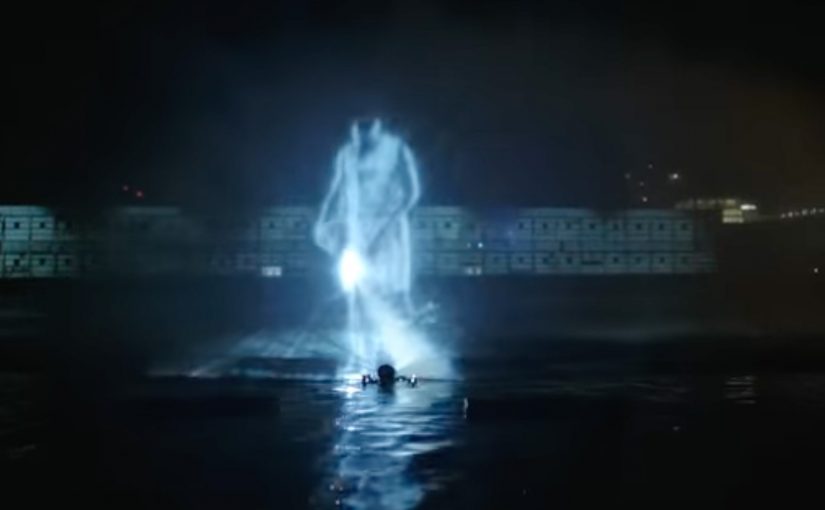
I have seen plenty of projection mapping in the last year or so, but this Nike execution for the Jordan Melo M8 takes a different route. Instead of treating a building as the canvas, it turns the Hudson River into the screen and uses a water curtain to make the visuals feel alive.
Trade coverage describes the launch as a live event at Pier 54, where a crowd gathered for performances and then got hit with a large-scale water projection moment featuring Carmelo Anthony and the Melo M8, layered with mapped effects that made the “explosive” theme feel physical.
When projection mapping stops being “mapping”
The mechanic is simple and smart. Water gives you motion for free, so the visuals do not need to do all the work. Every splash, ripple, and mist edge amplifies the animation and makes the illusion feel bigger than it would on a flat wall.
It also creates a built-in contrast. The shoe is a hard, engineered object. The canvas is fluid and unpredictable. That tension is what makes people stare.
In global sportswear launches, the fastest way to earn attention is to make the product reveal feel like a public event, not a private ad.
Why the water screen is the brand message
The most important thing this stunt communicates is not “this is a new shoe”. It is “this is an event-level product”. The audience reads production scale as product importance, especially in a category where new drops appear constantly.
Using water also supports the narrative hook that appears in reporting around the event. Melo “walks on water” as a visual flex. Whether you call it projection, illusion, or theatre, the point is the same. The launch gives people a story they can retell without describing a single feature.
Business intent
This is launch-week acceleration. Get a live crowd. Create a spectacle that looks unreal on camera. Seed the footage. Then let the audience do the distribution, because the clip is more shareable than a standard product film.
What to steal
- Choose a canvas that adds value. Water, smoke, ice, and mirrors all contribute “movement” that visuals can ride.
- Make the environment part of the claim. A river-scale reveal says “major” before any copy does.
- Design for the recap video. If it does not look unbelievable on a phone screen, it will not travel.
- Give people one sentence to repeat. “They projected Melo and the shoe onto the Hudson” is enough.
A few fast answers before you act
What is a water screen projection?
A water screen projection uses a thin curtain of mist or falling water as the surface. A projector throws imagery onto it, creating a floating effect that feels more dimensional than a wall projection.
Why does projection on water feel more “real”?
Because the surface moves. Ripples and spray add natural variation, so the visuals feel integrated with the environment rather than pasted onto it.
What makes this kind of stunt effective for a product launch?
It signals importance through scale, creates immediate talk value, and produces recap footage that performs better than a standard reveal because it looks like an event, not an ad.
What is the main operational risk?
Reliability. Water, wind, sightlines, and crowd control can all degrade the experience. If the image is not crisp and the moment does not land fast, the spectacle becomes confusion.
What metrics matter most?
Earned pickup, social share rate of the hero clip, completion rate, and correct retelling of the mechanic. If people remember “Hudson water projection” and connect it to the shoe, the stunt did its job.