Nike Football “My time is now”

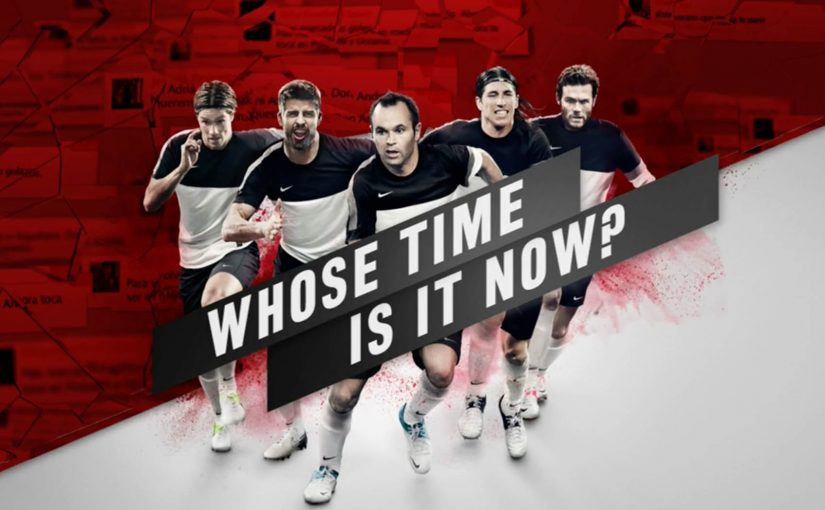
In Puerta del Sol, Madrid’s epicenter, a huge Nike “static” banner behaves like a live scoreboard. As Euro 2012 conversations spike, the face on the banner changes. Each day, the Spanish player who dominates social chatter becomes the protagonist on the canvas. Two fan messages appear alongside him, selected from submissions flowing in through Nike’s Facebook experience.

What the campaign does in public

Turn real-time social conversation into real-world status. Then make “My Time Is Now” visible, in public, every day.

What Nike and DoubleYou build during Euro 2012

Nike works with DoubleYou on a real-time social media monitoring campaign focused on Spanish national-team players. The system tracks mentions and engagement across Facebook and Twitter, then turns that data into a live ranking.

Fans see the leaderboard through a custom Facebook app integrated into Nike Football Spain. The ranking updates continuously, creating a daily “who owns the moment” race that mirrors what is happening on the pitch.

How it works

Step 1. Capture the conversation in real time

The activation monitors references to players across Twitter and Facebook.

Step 2. Translate the conversation into a live ranking

Inside the Facebook experience, the campaign visualizes comments and produces an automatically updated ranking of who is generating the most conversation, refreshed minute by minute.

Step 3. Publish the result into the physical world

Each day, the player who attracts the most social conversation becomes the ambassador of Nike’s message “My Time Is Now” on the large-format placement in Puerta del Sol. A static billboard turns into an interactive billboard because it is connected to the live social pulse.

Step 4. Let fans write onto the execution

From the app, fans also submit messages linked to the player of the day. Nike selects two of those messages and publishes them next to the player on the banner.

In sports sponsorship, the scalable advantage is not just hearing fan momentum, but turning it into a public signal people can rally around.

Why this is more than “social listening”

The real question is how to make live conversation feel consequential while the event is still unfolding. This is not monitoring for reporting. It is monitoring as a publishing engine. Nike turns fan conversation into a daily public decision about who carries the brand line. That mechanism works because it converts abstract buzz into visible status, giving fans a reason to watch, react, and return.

Extractable takeaway: Real-time marketing gets more powerful when the signal changes something public, visible, and easy to argue about, not when it just updates a dashboard.

The business intent is to keep fans returning to Nike’s owned experience during the tournament, while tying that repeat attention back to sponsored players and the brand line.

  • The social layer has consequence. The ranking determines who gets featured publicly.
  • The physical layer gives the digital behavior weight. People do not just see a number in an app. They see a player crowned in the center of Madrid.
  • The loop is fast enough to feel like sport. The leaderboard updates continuously, so fans experience momentum, not a static end-of-day recap.

The line that makes the whole thing sticky

At the end, the leading player is set to bear Nike’s message of “My Time Is Now”.

And the player is…

What to steal from Nike’s live ranking billboard

  • Turn chatter into a scoreboard: Convert real-time conversation into points people can instantly understand and debate.
  • Reward the behaviour you want repeated: Make fans check back by updating standings during the event, not after it.
  • Use sponsorship as a story engine: Anchor the mechanic to the athletes you sponsor so the brand connection stays tight.
  • Make the output social by default: Put the ranking in a format that is easy to share and argue about inside the platform.
  • End with a single “hero moment”: Let one clear winner carry the slogan so the campaign lands as a climax, not a dashboard.

A few fast answers before you act

What is the campaign in one sentence?

A real-time social monitoring system ranks Spanish players by conversation volume and makes the top player the daily face of a live billboard in Puerta del Sol.

Where do fans see the ranking?

Fans see the ranking in a custom Facebook app integrated into Nike Football Spain.

What makes this different from a normal “second screen” mechanic?

The data output is not just a dashboard. It changes a public, real-world media placement and publishes user messages alongside the hero player.

Why does the billboard matter more than the app alone?

The billboard turns digital attention into visible public status, so the campaign feels culturally present rather than trapped inside a social feed.

What is the repeatable pattern for brands?

If you can connect live signals to live publishing, you turn attention into status. That is how real-time becomes culturally meaningful.

Nike Golf: No Cup Is Safe

Nike Golf has released a TV spot in which Tiger Woods and Rory McIlroy turn a practice session into a small competition on the golf course. The joke is simple. When two world-class players share a range, even the targets feel under threat.

A practice range that plays like a duel

The mechanism is a clean escalation. Start with casual shots. Introduce a visible target. Add one-upmanship. Then let the athletes do what they do best. Make the impossible look repeatable. The “no cup” line is the punchline because it turns accuracy into a kind of harmless menace. That works because a simple duel structure makes elite skill legible in seconds.

In performance-driven sports categories, the fastest brand wins are often built on demonstrations that feel like entertainment rather than instruction.

Why it lands

The spot works because it respects the viewer’s intelligence. No spec sheet. No product sermon. Just elite talent, a familiar rivalry energy, and a challenge you can understand in one second. It sells Nike Golf as the gear behind precision and confidence, without ever having to say those words.

Extractable takeaway: If your product promise is “performance”, design a proof that reads instantly. Use a simple rule, a clear target, and a visible outcome that makes the capability undeniable.

What Nike is really doing here

This is also roster storytelling, where the pairing itself signals what kind of competitive culture the brand owns. The real question is whether Nike can turn a practice-range stunt into a broader signal of competitive credibility.

Nike gets this right because pairing Woods with McIlroy frames the brand as the home of golf’s competitive edge across generations. The tone stays light, but the subtext is serious: these are the players you associate with winning, and they are wearing this swoosh while they do it.

How Nike turns proof into a brand asset

  • Turn a feature into a game. Accuracy becomes a challenge, not a claim.
  • Let the product stay “off camera”. When the proof is strong, the brand earns belief without showing close-ups.
  • Build with escalation. Start normal, then raise the stakes in small steps so the payoff feels inevitable.
  • Make the line a summary, not a slogan. “No Cup Is Safe” works because the viewer already saw why.

A few fast answers before you act

What is Nike Golf’s “No Cup Is Safe” spot?

It is a Nike Golf commercial built around Tiger Woods and Rory McIlroy turning a practice session into a target competition where cups become the bullseye.

What is the main message?

Elite precision is entertaining, and Nike Golf is positioned as the brand behind that performance mindset.

Why use two athletes instead of one hero?

Competition creates story. Rivalry gives the viewer a reason to watch longer, and it makes the proof feel earned rather than staged.

What does the line “No Cup Is Safe” communicate?

That the shots are so accurate the targets are in danger. It is a humorous shorthand for confidence and control.

How can other brands apply this pattern?

Find a single capability you can prove visually, wrap it in a simple game mechanic, and let the outcome do the persuasion work.

Nike SPARQ: Immersive Digital Training

When training becomes the differentiator. Nike SPARQ goes digital

Not too long ago, talent determined greatness. Today, talent is a given, but training is what separates the exceptional from the merely promising. So to help athletes everywhere reach their true potential through better training, Nike along with ad agency R/GA New York created an immersive digital experience for the SPARQ program (Speed, Power, Agility, Reaction, and Quickness).

Athletes could now follow the same training regimens as professional athletes through detailed, customized video demonstrations delivered via iPods or handheld video players that made it accessible anywhere. The SPARQ website also let athletes set goals, track progress, find Nike SPARQ Trainers across the country, get an official SPARQ rating, and purchase gear.

The smart move: make elite training portable and personal

The experience does two things at once. It brings pro-level drills to anyone with a device, and it makes training feel individualized through customization and video guidance. That combination shifts SPARQ from “program” to “daily habit.”

In sports-performance brands and youth training programs, the winners make instruction portable enough to survive real life.

Why this feels bigger than content

The real question is whether your digital experience builds a habit-forming training loop, or just publishes drills. Because it is not just inspiration. It is infrastructure. Video demonstrations give you the “how,” goal setting and tracking give you the “keep going,” the rating gives you a yardstick, and trainers plus gear connect the digital loop to the real world. Here, the digital loop is the cycle of instruction, goals, tracking, and feedback that pulls you into the next session. Treat training as infrastructure, not content, if you want durable engagement.

Extractable takeaway: Pair instruction with goals, tracking, and feedback loops so progress is visible and practice becomes a habit.

The business intent hiding in plain sight

Build a performance ecosystem that increases commitment over time. The more you train, track, and compare, the more SPARQ becomes the platform you return to. And the more natural gear purchase becomes inside that flow.

Steal the habit loop, not just the videos

  • Ship a loop, not content. Guidance, goals, tracking, and a measurable score.
  • Design for anywhere use. Portability turns intention into repetition.
  • Connect digital motivation to real-world touchpoints. Trainers, ratings, and commerce.

A few fast answers before you act

What does SPARQ stand for?

Speed, Power, Agility, Reaction, and Quickness.

What did Nike and R/GA New York build?

An immersive digital experience for SPARQ that delivered customized training video demonstrations and a supporting website for goals, tracking, trainers, ratings, and gear.

How did athletes access the training content?

Through detailed video demonstrations delivered via iPods or handheld video players, making the training accessible anywhere.

Why did this feel bigger than training videos?

Because it combined instruction with goal setting, tracking, a rating, and connections to trainers and gear, creating a repeatable training loop.

What made the SPARQ website useful beyond videos?

It let athletes set goals, track progress, find SPARQ trainers, get an official SPARQ rating, and purchase gear.

What is the simplest principle to copy from SPARQ?

Pair guidance with goals and feedback so people can see progress and have a reason to return.