
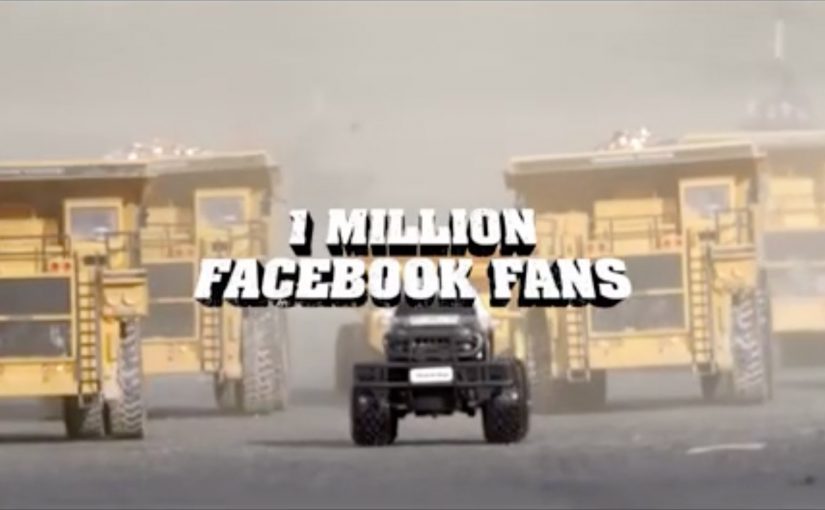
Media Markt “Money Trucks”

A security team clears the street in a quiet neighborhood. Neighbors step outside. Then a tiny convoy rolls in. 193 miniature “money trucks”, each loaded with 1-cent coins, drives up to the winner’s home and unloads one million cents into a growing pile in the driveway. It is a cash delivery staged like a movie scene, except the payoff is real.

The idea in one line

Celebrate a social milestone by turning “one million” into a physical spectacle people can watch, share, and retell.

What Media Markt does to mark 1 million Facebook fans

Over the last couple of years I have seen a handful of brands reach the 1 million fans milestone. To celebrate, most of them create really nice and innovative thank-you videos. A good example is Tic Tac “Likes” Matt. Media Markt hits the same milestone, but takes a very different route. It turns the number into a physical stunt people can watch, share, and retell.

Media Markt on reaching 1 million fans on Facebook launched a contest: “How many small trucks do you need to transport 1,000,000 cents?” The activation was created by Ogilvy & Mather Frankfurt.

The business intent is simple: turn a fan milestone into participatory attention that travels beyond the Facebook page itself.

How the campaign plays out

Step 1. Start with a guess that feels simple and sticky

The mechanic is deliberately basic: one question, one number, one prize framed as a million small units. It is easy to participate, and easy to share.

Step 2. Make the prize physically absurd

The winner does not receive a bank transfer. She receives €10,000 as 1-cent coins, delivered using the exact number of miniature trucks the contest asks people to estimate.

Step 3. Turn delivery into content

The delivery is filmed as a “cash-in-transit” moment: security clearing streets, convoy arriving, coins dumped into a heap. The documentation becomes the story asset that travels beyond Facebook.

In retail and mass-market marketing, milestone campaigns travel further when the audience can see the scale in the real world, not just read the number on a screen.

The numbers that make it feel “earned”

  • The correct answer is 193 trucks.
  • The winner is in Saßmicke (western Germany), and the stunt is played as a neighborhood event, not a private handover.

Why it works

This works because the mechanic turns an abstract fan count into a visible, countable spectacle people can grasp in seconds.

Extractable takeaway: If a brand milestone matters to you, convert it into a physical event with one simple unit people can instantly understand and retell.

It converts an online number into a physical reality

“One million fans” is abstract. One million coins is instantly legible, and the convoy makes the number feel even bigger.

The stunt is engineered for repeatable media beats

Announcement. Guessing phase. Winner selection. Convoy “journey” updates. Final delivery video. The campaign creates multiple moments people can follow, not one single post.

It is brand-consistent in one glance

Electronics retail competes in a world of deals and hype. This behaves like a deal, but acts like a story. The spectacle fits the loud, “big gesture” brand posture without needing product claims.

The deeper point

The real question is how to turn a passive social milestone into a public event people want to witness and retell.

This is a better move than another thank-you video because it makes participation and spectacle do the distribution work.

If you want people to care about a community milestone, do not announce the number. Stage the number. Make it participatory, then make the payoff visual enough that the community wants to distribute it for you.

How to stage a milestone people retell

  • Turn a milestone into a game: “1 million fans” becomes a concrete challenge with one guessable number.
  • Make the prize a proof object: Delivering “1 million cents” as physical trucks makes the claim visual and press-friendly.
  • Use a single, memorable unit: “Cents” is simple. People instantly understand the scale without explanation.
  • Let the reveal be the content: The answer plus the delivery moment is the story, not a brand speech.
  • Design for retelling: If someone can summarize it in one sentence, it will travel.

A few fast answers before you act

What is the campaign mechanic?

A Facebook contest asks fans to guess how many miniature trucks are needed to transport one million cents.

What is the actual prize?

€10,000 delivered as 1,000,000 one-cent coins, transported by 193 miniature trucks.

Why does the “193 trucks” detail matter?

Because it closes the loop. The answer is not just “correct”. It becomes the logistics and the spectacle of the payout.

Who creates the campaign?

Ogilvy & Mather Frankfurt.

What is the reusable pattern?

Turn a social milestone into a simple prediction game, then make the reward delivery so visual that it becomes the main distribution asset.
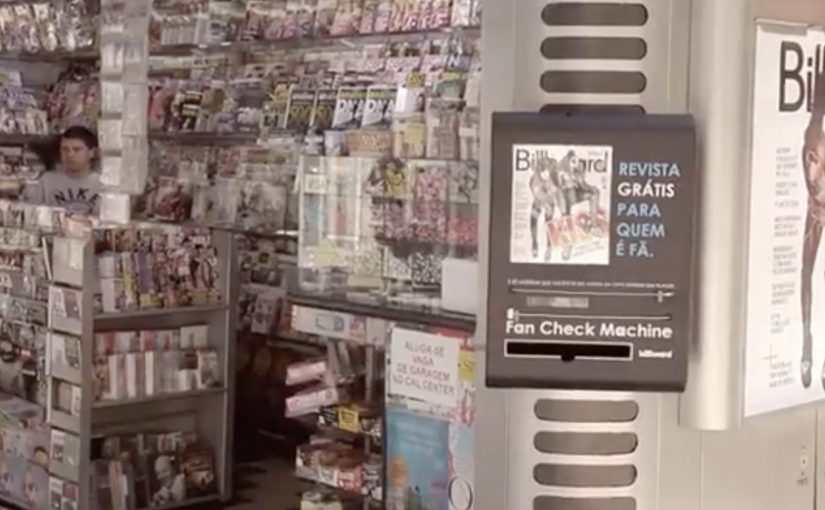
Billboard Fan Check Machine

You walk up to a Billboard Magazine dispenser, plug in your iPhone, and let the machine scan your music library. If it finds more than 20 songs by the artist on the cover, it dispenses a free copy of the magazine.

How the Fan Check Machine works

Not every music fan reads Billboard Magazine, but every music fan has music on their phone. Ogilvy & Mather Brazil turns that into a simple proof-of-fandom mechanic. Here, “proof of fandom” means using your existing listening history as the credential. Because the verification happens in the moment, the reward feels earned instead of arbitrary. The real question is how you turn an existing behavior into a self-serve credential people understand instantly.

In retail and live-event environments, this kind of “prove it, then get it” interaction creates participation without staff explaining the rules.

Why this format feels fair to fans

The exchange is transparent. You do not enter a sweepstake or fill a form. You prove you are genuinely into the artist on the cover, and you get rewarded immediately. That immediacy makes the activation memorable, and the “fan verified” moment becomes the story people share.

Extractable takeaway: When access is gated by a behavior people already do, the reward feels fair, and the activation becomes easy to retell.

What this teaches about shopper activations

This is a strong pattern for retail and event environments. Use an existing behaviour as the credential, keep the threshold clear, and make the reward instant. This is a better giveaway pattern than generic sampling when you care about perceived fairness and the story people retell. When the rule is simple and the payoff is immediate, participation scales without staff explaining it over and over.

Steal this pattern for your next giveaway

  • Credential: Use an existing behavior as the proof, not a form-fill or “enter to win.”
  • Threshold: Make the requirement unmissable, with one clear pass or fail rule.
  • Payoff: Deliver the reward instantly, so the moment becomes the story.
  • Friction: Remove staff dependence so participation scales on its own.

A few fast answers before you act

What is the Billboard Fan Check Machine?

It is a magazine dispenser that gives away a free Billboard issue if you can prove you are a fan of the cover artist by plugging in your iPhone and scanning your music library.

What is the “fan” threshold in this activation?

If the machine finds more than 20 songs by the artist on the cover of Billboard Magazine, you get the magazine for free.

Why does “proof of fandom” beat generic giveaways?

Because it targets real fans and makes the reward feel earned. That increases perceived fairness, reduces waste, and creates a stronger story than a random handout.

What should you keep simple if you replicate this pattern?

The rule, the verification step, and the payoff. People should understand the requirement instantly, complete it in seconds, and receive the reward without friction.

Lacta: Love in the End

Lacta, a leading chocolate brand in Greece, has been creating innovative film content since 2009 around its strategy of being a symbol for the sweetness of love.

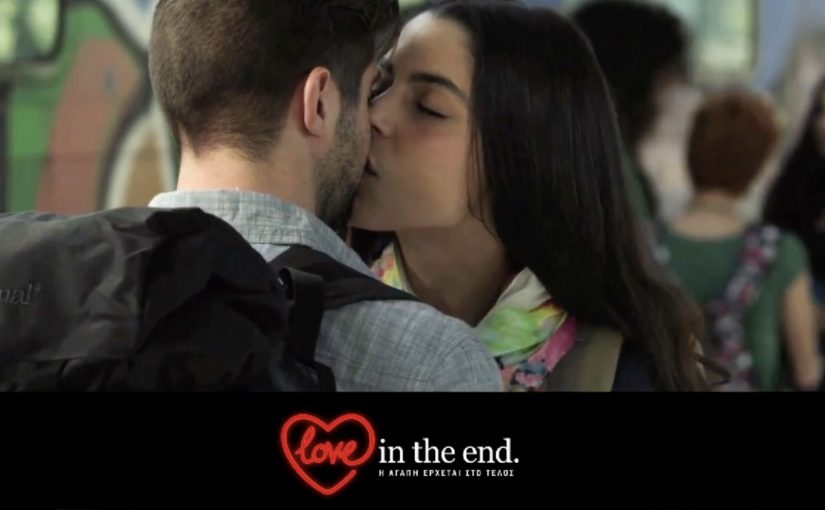
For this installment, Lacta invited fans to submit their stories of unfulfilled love, with the promise to give them the happy end they never had. On the cinema screen.

Finally three stories formed the basis of a film screenplay, entitled “Love in the end”, that was released on Valentine’s Day 2013. A transmedia campaign promoted the film and it became a big hit with audiences in Greece. Here, transmedia means connected teasers and social storytelling across channels that all build anticipation for the same release.

From real stories to a cinema-screen happy end

The mechanism is an audience-to-cinema pipeline. Collect true stories of unfulfilled love, select a small number that can carry a broader narrative, adapt them into a screenplay, then build anticipation through connected channels so the audience feels ownership before opening night. The real question is whether a brand can turn private emotion into a public release without draining it of authenticity. That structure works because early participation creates emotional investment before release, so the opening feels like a shared payoff rather than a pushed campaign.

In European FMCG branded entertainment, this kind of storytelling works best when participation is a source of meaning, not just a source of reach.

Why this lands

This works because it makes the brand the enabler, not the author. The stronger strategic move is to let audience truth carry the emotion and keep the brand in the enabling role. Lacta does not just “tell a love story”. It invites vulnerability, then pays it back with a public resolution in a culturally heavyweight format. The cinema.

Extractable takeaway: If you want a branded film to feel earned, start with real human input, curate hard, and give the audience a clear public moment to rally around, so anticipation becomes part of the product.

The results the campaign reported

Campaign reporting stated that 17% of the Greek internet population saw the online teasers, generating 700,000 views and hundreds of rave comments.

Reported social momentum was also strong. Lacta’s Facebook fans increased by 100,000, making its Facebook page the biggest for any brand in Greece at the time, with 650,000 fans.

On release, the film was described as having the biggest opening night for any Greek movie in the last five years, with more than 75% of all movie tickets being sold for it.

Here are the past film based campaigns

What to borrow from Lacta’s film playbook

  • Use a human intake. Real stories create emotional permission that scripted copy rarely earns.
  • Curate into a single release. Selection and adaptation turn raw submissions into a coherent film people can anticipate.
  • Build anticipation with episodic crumbs. Teasers and social updates make a film feel like a season.
  • Anchor to a calendar moment. Valentine’s Day creates a natural reason to care now.

A few fast answers before you act

What is “Love in the end”?

It’s a Lacta branded-entertainment film built from fan-submitted stories of unfulfilled love, adapted into a screenplay and released on Valentine’s Day 2013.

What does “transmedia campaign” mean in this case?

It means the film was promoted through multiple connected channels using teasers and social storytelling to build anticipation before the main release.

What results were reported for the online teasers?

Reported results said 17% of the Greek internet population saw the teasers, producing 700,000 views and hundreds of positive comments.

What results were reported for Facebook growth?

Reported results said Lacta gained 100,000 new fans, reaching 650,000 fans and becoming the biggest brand page in Greece at the time.

What was reported about opening night?

The film was described as the biggest opening night for a Greek movie in the last five years, with more than 75% of all movie tickets sold for it.