
Corona Extra: Luna Corona

Corona Extra and their ad agency Cramer-Krasselt worked with astronomers, planetariums, and universities in the USA to calculate the positioning of the moon, aiming to capture a moment where it would align perfectly with an image of a Corona Extra beer.

The moment was timed so the billboard’s “missing lime” is completed by the moon’s crescent alignment on the nights of June 14 and 15.

When the sky completes the creative

The mechanism is engineered perspective plus a fixed window in time. The billboard artwork is designed so that from a specific viewing position, the crescent moon appears exactly where a lime wedge would normally sit on a Corona bottle. The media placement then turns into a scheduled viewing, because the “full ad” only exists when the moon cooperates.

In out-of-home advertising, aligning a message with a real-world phenomenon can turn a static placement into a time-limited event people actively seek out.

Why it lands

This works because it makes a familiar brand ritual feel discovered rather than advertised. The payoff is not a new claim. It is a real-world moment that feels improbably perfect, which gives people a reason to stop, watch, and tell someone else where and when it happened. The real question is how far a brand can make the physical world do the storytelling for it. The stronger move here is using the moon to deliver the brand cue instead of adding more message.

Extractable takeaway: If you can make the environment complete your creative, you turn passive exposure into participation. That participation becomes the distribution.

What to steal from Luna Corona

  • Design for one unmistakable illusion: one clean visual trick beats multiple clever details.
  • Use time as a feature: a narrow viewing window creates urgency without discounts or gimmicks.
  • Make the “rule” explainable: people should be able to describe it in one sentence.
  • Choose a ritual people already associate with you: the lime wedge is an instantly legible brand cue.
  • Capture proof: the video is not decoration. It is how the idea travels beyond the street corner.

A few fast answers before you act

What is “Luna Corona”?

It is an out-of-home idea where a Corona billboard is positioned and designed so the crescent moon visually becomes the lime wedge on the bottle during a specific time window.

Why involve astronomers and universities?

Because the illusion depends on precise timing and angle. You need accurate lunar position predictions to know when the crescent will “land” in the right spot from the viewer’s perspective.

Is this interactive?

Not in the device sense. The interaction is physical. People move into position, wait for the right moment, and witness the alignment as it happens.

What makes it more than a clever billboard?

The scarcity. It only “works” at certain times, so it behaves like an event, not just media inventory.

What’s the biggest risk with ideas like this?

Fragility. If weather, timing, sightlines, or location details are off, the reveal fails. The planning and production tolerance must be treated like a live event.

Cornetto: Love Plane

A couple tweets a love message with a hashtag, and a few minutes later it appears on a banner flying over the beach. Cornetto’s Love Plane turns summer flirting into public media, with the sky as the timeline.

A Twitter feed you can read in the air

Summer is the season of crazy, unexplainable romances. Cornetto launches the Love Plane in Spain and attaches a Twitter-based banner feed to it.

The mechanism: hashtag in, banner out

People who want to declare their love both online and in the sky tweet using the hashtag #cornettoskytweet. The most popular tweets are then painted on the banner and flown over the beach. To keep things moving, the banner creative is changed every 15 minutes.

In European FMCG summer activations, a simple real-time mechanic can turn social posting into a shared public moment that people notice even if they are not online.

Why this lands

This works because it upgrades a small, personal gesture into something you cannot ignore. A tweet becomes physical, scarce, and time-bound, which raises the perceived stakes and makes participation feel like a mini event rather than just another post.

Extractable takeaway: If you want social participation at scale, convert digital inputs into a visible, time-boxed output in the real world, so the reward is public and immediate, not buried in a feed.

What Cornetto is really doing

Cornetto is smart to make participation public instead of leaving the interaction inside Twitter. The brand is borrowing the emotional energy of summer romance and using it to create a repeatable content loop. By a repeatable content loop, this means each new tweet can create another visible banner moment and another round of attention.

The real question is how a brand turns disposable social chatter into a public moment people want to trigger and watch.

People supply messages. The campaign outputs spectacle. Onlookers become an audience. Participants become distributors.

What summer activation teams should steal

  • Make the reward unmistakably public. Participation feels bigger when others can witness it.
  • Use a simple popularity rule. “Most popular tweets win” is easy to understand and easy to compete in.
  • Keep the cadence fast. Refreshing every 15 minutes creates urgency and repeat attention.
  • Match channel to emotion. Romance works when the output feels bold, not subtle.

A few fast answers before you act

What is the Cornetto Love Plane?

It is a plane flying over beaches with a banner that displays selected tweets, turning social posts into a public sky message.

How do people participate?

They tweet a message using the hashtag #cornettoskytweet. The most popular tweets are selected to appear on the banner.

Why change the banner every 15 minutes?

Frequent updates create urgency and make the activation feel live, which encourages repeated participation and attention.

What does this communicate about the brand?

That Cornetto “owns” summer romance moments, and that the brand can turn small gestures into shared experiences.

What is the main operational risk with this idea?

Moderation and logistics. You need tight filtering for messages, plus reliable production timing so the “real-time” promise holds.

Adshels with Difference: IKEA LEDshel and ANAR

Here are two adshel innovations currently doing rounds online. An adshel is a street shelter advertising unit, typically at a bus stop. Both use the media surface itself as the message, not just a place to hang a poster.

Ikea LEDshel

IKEA swapped the regular neon tubes found in adshels around Vienna with its LED range. The product becomes the medium, and the demonstration happens at full scale in the street. Credited to DDB Tribal Vienna, the move turns “better light” into something you can experience, not just read about.

Only for children

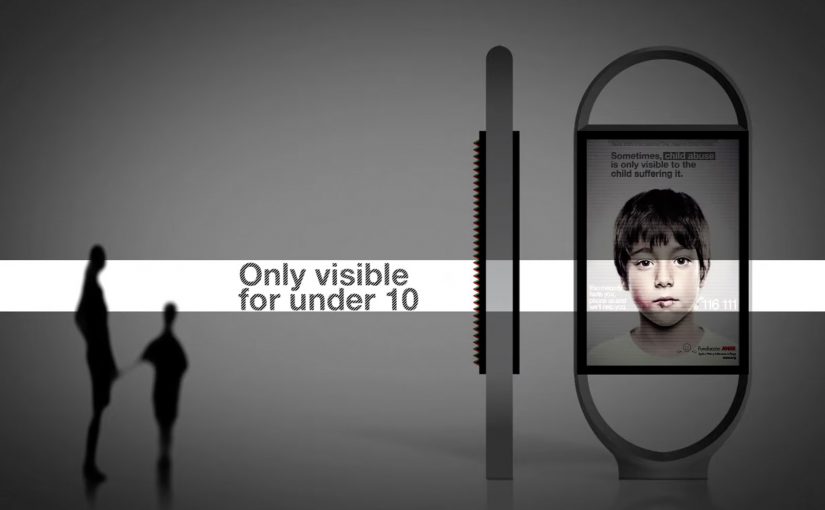
In an effort to give abused children a safer way to reach out for help, the Spanish organization Fundación ANAR created an ad that displays a different message to adults and children at the same time.

The poster uses a lenticular top layer to show different images at varying angles and heights. An adult sees the image of a sad child with the line: “sometimes, child abuse is only visible to the child suffering it.” A child sees bruises and a direct help message with a phone number. This work is widely credited to Grey Group España.

What makes these “adshels with difference”

The shared mechanism is simple: upgrade the shelter from a passive frame into an active communicator. One example changes the hardware so the ad site demonstrates the product. The other changes the optical layer so the message adapts to who is looking.

Because the shelter itself performs the claim, the viewer can grasp the argument in seconds, which is why these ideas travel in public space.

In European city out-of-home media, small physical changes to the site often persuade more powerfully than a clever headline alone.

The real question is whether your out-of-home idea still works when the media unit itself has to do the explaining.

These are the out-of-home ideas worth borrowing because the medium carries the proof, not just the copy.

Why it lands

It makes the proof unavoidable. IKEA does not claim “LED looks better.” It lets the street lighting show it. ANAR does not claim “victims can’t speak safely.” It builds a channel that protects the child in plain sight.

It respects context. Adshels sit in public space where attention is brief. Both ideas communicate at a glance, because the medium itself is doing part of the explanation.

It uses targeting without data. The lenticular execution “targets” by viewpoint and height, not cookies. It is a physical interface decision, not a digital one.

Extractable takeaway: Out-of-home innovations travel when the site behavior carries the argument. If the medium demonstrates the product, or adapts the message to the viewer’s vantage point, the campaign becomes self-explanatory and hard to ignore.

Borrowable adshel moves

  • Turn the placement into the demo. If the product has a sensory benefit, make the environment show it.
  • Use physical segmentation. Angle, distance, height, light, and motion can personalize a message without any personal data.
  • Design for public constraints. Fast comprehension wins. The structure should communicate before the copy finishes.
  • Let the medium do the persuasion. When the execution is the proof, the message needs fewer claims.

A few fast answers before you act

What is an “adshel” in this context?

A street shelter advertising unit, typically at bus stops, that combines a poster frame with lighting and protective glass.

What is the IKEA LEDshel idea actually demonstrating?

LED lighting quality in real conditions. The shelter itself becomes a live showroom for the light range.

How does the ANAR poster show two messages at once?

Through a lenticular layer that changes what is visible based on viewing angle and height, so adults and children see different visuals and text.

Why is this more effective than a standard awareness poster?

Because it delivers a help message to the child without alerting the accompanying adult, which is the real constraint in the situation.

What is the reusable principle across both examples?

Make the media unit behave like the idea. When the medium demonstrates, adapts, or protects, the campaign does not need heavy explanation.