
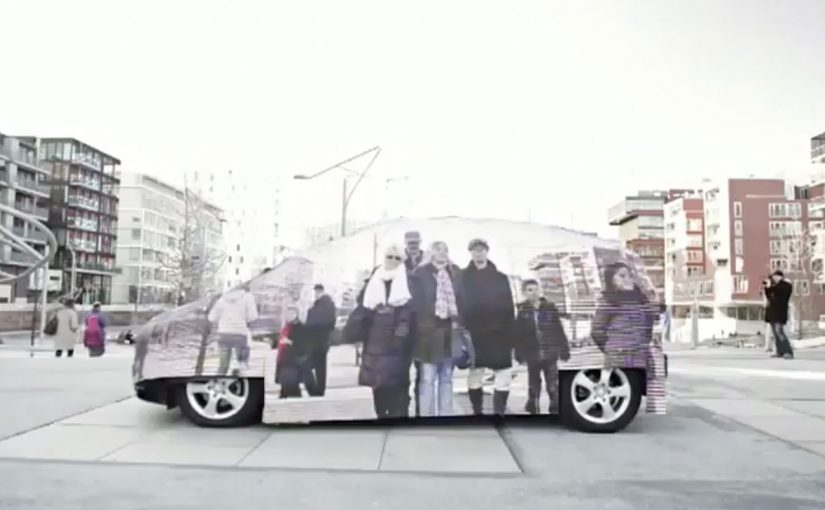
Mercedes-Benz F-CELL: The Invisible Drive

To demonstrate the claimed low impact of its new fuel cell vehicle, Mercedes-Benz has created an “invisible” car that blends into its surroundings.

The trick is a simple, showable hack. One side of the car is covered with LEDs. A camera captures what is on the opposite side, then the LED side displays that live feed so the vehicle appears to disappear from a specific viewpoint.

Stunts like this turn abstract emissions claims into a single, watchable proof-of-idea.

The mechanism that makes the metaphor work

This is not magic and it does not need to be. It is optical camouflage framed as a brand statement. Optical camouflage here means using a camera view and a display surface to mimic the background from a chosen angle. If the vehicle’s impact is close to “nothing,” the car should look like “nothing.” The LED-and-camera setup makes that metaphor instantly legible, even to someone who has never heard the term “fuel cell.” Because the illusion happens live on the car, the metaphor reads as evidence instead of post-production.

In enterprise automotive and mobility marketing, visual proof beats technical proof when the audience is not willing to parse specs.

The real question is whether your claim can be understood and repeated from a single viewpoint without the brochure. This is a strong sustainability communication move when the trick is honest and the metaphor stays tighter than the explanation.

Why it lands

It creates a physical moment people can point at. Sustainability messaging often lives in numbers, claims, and fine print. Here, the message is experiential. You see the effect with your own eyes, and you can describe it in one sentence.

Extractable takeaway: When your product promise is invisible, build a demonstration that makes the promise visible in under five seconds, using a single repeatable rule people can explain to someone else.

Steal the invisibility demo pattern

  • Pick one metaphor and commit to it. The entire execution serves one idea. That focus is why it travels.
  • Use real-world physics, not post-production. Even when the audience knows it is a trick, they trust it more when it is happening live.
  • Design for the shareable angle. Viewpoint-dependent illusions work because they are built for cameras and spectators, not just participants.
  • Make the explanation part of the experience. The best stunts include a built-in “how it works” story that spreads with the clip.

A few fast answers before you act

How does the “invisible car” effect work?

LED panels on one side of the car display a live video feed captured from the opposite side, creating a camouflage illusion from a particular viewpoint.

What is the brand point of using invisibility here?

It turns an environmental claim into a visual metaphor. If the impact is minimal, the car is presented as visually minimal within the scene.

Why do these technology stunts get attention when product specs do not?

They compress the story into a single moment people can see, record, and retell. That makes the promise easier to believe and easier to share.

What is the main risk when copying this approach?

Overcomplicating the trick. If the audience needs a long explanation to understand the effect, the stunt stops being a stunt and becomes a demo.

How do you keep a metaphor stunt from feeling like greenwashing theater?

Keep the claim narrow, make the trick transparent, and ensure the metaphor points to a product attribute you can substantiate elsewhere, even if most people never read the detail.
Homecenter: The Man Who Gave Everything Away

Homecenter is a large retail chain in Latin America that deals in goods related to home improvement and construction.

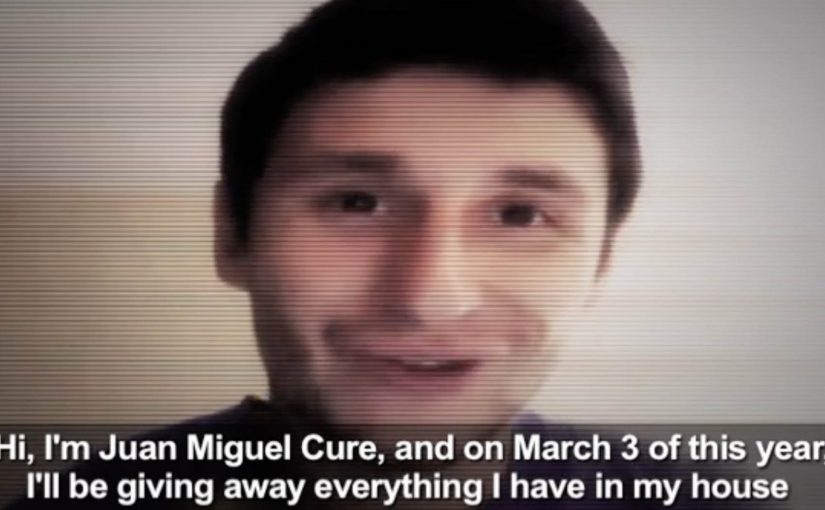
To create buzz for the opening of their new store (in March), Young & Rubicam Colombia got Juan Miguel Cure to give away everything from his house.

A launch story built on real sacrifice

Most store openings lean on discounts, flyers, and a ribbon-cut photo. This one flips the script by making the “offer” feel personal and public. One person gives up his stuff, and the opening becomes a story people want to repeat.

How the mechanic works

The mechanic is simple. Here, “mechanic” means the branded action that makes the story travel. Pick a relatable figure. Strip his home of its belongings. Turn that act into a public event and a piece of film that people can share. The brand is not trying to outshout competitors. It is trying to earn attention through a narrative that feels larger than retail.

In retail marketing for big-box home improvement brands, openings are won through local word-of-mouth and press amplification as much as through paid media.

Why it lands

Giving everything away is an extreme signal. It creates instant curiosity and a moral tension. Why would someone do this. That tension keeps people watching, and it makes the brand’s opening feel like something happening in the community, not something happening to the community. The generosity angle also changes the default posture toward promotion. Instead of “come buy”, it reads as “come witness”. Because the giveaway turns a retail opening into a witnessed act of sacrifice, people process it as a story worth passing on, not just a promotion to ignore.

Extractable takeaway: If you can attach your launch to a human-scale story with a clear sacrifice, you convert opening-day marketing from “announcement” into “news”, and news travels further than ads.

The business intent behind the generosity

The real question is whether the stunt can convert local attention into store traffic and brand memory. This is a smart launch idea because the stunt gives the store opening a memory structure, not just a promotional wrapper. This is a classic buzz play. It creates a shareable film asset, it seeds conversation locally, and it frames the new store as culturally present before the doors even open. The giveaway is the hook, but the real objective is simple. Get people to show up, talk about it, and remember the brand when they need home improvement goods.

What to steal for launch marketing

  • Choose one bold proof point. Extreme beats complicated. One clear act is easier to retell.
  • Build a narrative people can summarize in one sentence. If the story cannot be repeated quickly, it will not travel.
  • Make the brand role legible without forcing it. The brand can frame the moment, but the human story must stay in front.
  • Design for local amplification. Openings benefit from community sharing and local media interest more than global cleverness.
  • Plan the follow-through. When attention spikes, the store experience must be ready to convert curiosity into habit.

A few fast answers before you act

What is the core idea behind “The Man Who Gave Everything Away”?

Turn a store opening into a human story. A real giveaway becomes the headline, and the opening becomes the payoff.

Why does this work better than a normal “grand opening” campaign?

Because it behaves like news. A surprising, emotional act is more likely to be shared, discussed, and covered than a standard promotional announcement.

What is the biggest execution risk?

If it feels staged, manipulative, or unclear why the brand is involved, the audience will reject it. The motive must read as coherent, not exploitative.

How can a retailer adapt this without copying the stunt?

Use the same structure. One decisive act, one human lead, one simple story that points to the opening. The act does not have to be “everything away”, it just has to be unmistakable.

How do you measure whether the buzz actually helped?

Track opening-period footfall uplift, local share-of-voice, earned mentions, branded search lift, and conversion into repeat visits in the weeks after launch.

McDonald’s: Dollar Drink Days Ice Sculpture

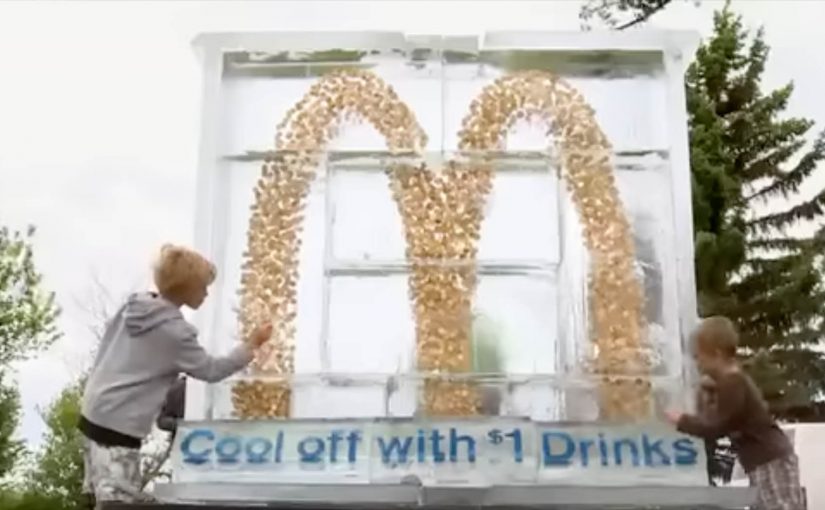
McDonald’s Canada and Cossette Vancouver brought to life one of the first interactive ice sculptures this summer on behalf of McDonald’s Restaurants in Alberta. The objective was to drive consumer interest in the company’s Dollar Drink Days campaign. Here, “interactive” means people can physically engage with the installation and change it in real time.

Hosted in the town of Sylvan Lake, the stunt saw 8,000 pounds of ice moulded into a seven-foot tall installation containing over 4,000 sparkling loonies, shaped into McDonald’s famous Golden Arches. The ice melted on a summer Saturday, and consumers chipped away at the sculpture to collect their bounty.

To attract high levels of interaction, the sculpture was strategically placed near the Sylvan Lake Pier, an area frequented by young adults and families. The day also featured a DJ, street promotional teams, hula hooping, limbo contests and giveaways.

In quick-service promotions, especially in seasonal, high-footfall leisure locations, the hard part is converting “cheap” into “must-see”.

The real question is how you turn a simple price offer into a moment people choose to chase.

Price promotions are forgettable until you give people a physical action that earns a visible payoff.

Why this activation pulls people in

The reward is visible and the deadline is unavoidable. Because the coins sit inside melting ice, the mechanism turns curiosity into action and keeps people moving from watching to participating.

Extractable takeaway: If you want a price promo to travel, make the payoff visible, put it behind one simple action, and bake in a deadline people can feel.

  • A clear, physical payoff. The value is visible and tangible, and the “win” is earned through participation.
  • Built-in urgency. Melting ice creates a natural time limit, which pushes people to act now rather than “later”.
  • Placement does the heavy lifting. Putting it at a high-traffic summer spot turns curiosity into crowds.

Reusing the melting-deadline mechanic

This is a strong example of turning a price promotion into a real-world spectacle. Instead of telling people “Dollar Drink Days is on”, the brand created a moment people wanted to be part of, and then made participation the mechanism for reward.

  • Make the payoff obvious. Put the value where people can see it before they commit.
  • Use a deadline that enforces itself. A physical countdown beats a marketing one, because it changes what people do right now.
  • Let the location supply the audience. Choose a place that already has the right crowd, then make the moment easy to join.

A few fast answers before you act

What was the Dollar Drink Days ice sculpture?

It was a seven-foot interactive ice installation in Sylvan Lake, Alberta, shaped like the Golden Arches and packed with thousands of loonies for visitors to collect as it melted.

How did people interact with it?

As the sculpture melted during the day, people physically chipped away at the ice to reach the coins inside.

Why stage it near Sylvan Lake Pier?

The location is naturally busy with young adults and families in summer, which increases footfall and keeps participation high.

What is the core pattern worth reusing?

Give people one simple action that unlocks a tangible reward. Add a natural deadline, and stage it where the right crowd already gathers.