
VGT: Fur iAd that bleeds when you swipe

VGT (an association combating animal factories), working with Austrian agency Demner, Merlicek & Bergmann, created an iAd, an interactive tablet ad unit, for the iPad edition of DATUM magazine.

The iAd shows a young woman wearing a fur coat. When the iPad user tries to continue browsing with the familiar finger-wipe movement, each swipe leaves a blood stain on the fur. The more you try, the more blood appears, turning a simple “next page” gesture into the message.

A navigation gesture that becomes the accusation

The clever part is that nothing “extra” is required from the user. No quiz. No mini game. No new behaviour. The iAd hijacks the most natural behaviour on the device. Swiping to move on. That is why it feels so sticky. The ad does not ask for attention. It punishes avoidance.

The mechanism: friction by design

Most advertising tries to reduce friction. This does the opposite. It introduces deliberate friction at the exact moment the audience normally exits. That choice forces a small pause, and that pause is where the ethical point lands. For tablet units, this kind of purposeful friction beats bolt-on interactivity that can be ignored.

In tablet-first media environments, gesture-based interactivity can turn a standard placement into a moral confrontation.

The real question is whether your interaction makes the viewer complicit, or merely entertained.

Why it lands even if you dislike shock tactics

This is not shock for spectacle. It is shock attached to an action the viewer chooses. You create the stains. That’s what makes the experience uncomfortable in a more personal way than a static image could. It also matches the medium. The iPad is intimate. It’s held close.

Extractable takeaway: When touch is the medium, tie consequence to a habitual gesture so the argument is felt in the hand, not just read on the screen.

How to borrow this for tablet units

  • Exploit a native gesture. Swipe, pinch, tap, drag. If the gesture is already habitual, the learning curve disappears.
  • Make the interaction mean something. The response should be the argument, not just a visual flourish.
  • Use friction sparingly and intentionally. Only add resistance when the resistance is the point.
  • Design for instant comprehension. The first swipe should explain the whole idea.
  • Earn the discomfort. If you push people emotionally, the payoff must be clarity, not confusion.

A few fast answers before you act

What is the VGT iAd concept in one sentence?

An iPad iAd that prevents an easy page swipe by leaving blood stains on a fur coat every time you try to move on.

Why use the swipe gesture instead of a video or a static image?

Because swiping is an action the user performs. When the consequence appears immediately, the viewer feels involved rather than merely informed.

Is this an example of “interactive storytelling” or “interactive persuasion”?

Both. The story is minimal, but the persuasion is embodied. The interaction itself carries the moral logic.

When does this kind of tactic backfire?

When the shock feels disconnected from the cause, when the friction blocks people without a clear point, or when the execution reads as manipulation rather than meaning.

What is the simplest way to apply this pattern ethically?

Use a familiar gesture, create an immediate consequence tied to the message, and ensure the user can still exit once the point is delivered.

Go Vote: Or You Let Others Decide

An integrated experience-based campaign was created by DDB Budapest on behalf of the Hungarian Democracy to support the 2010 Hungarian elections.

Instead of relying only on posters and TV spots, the idea is built around lived moments that make one point unavoidable: if you do not vote, you still get an outcome. You just did not choose it.

When “apathy” becomes something you can feel

The line “go vote, or you let others decide for you” is easy to agree with in theory, and easy to ignore in practice. The creative move here is to stop arguing and start staging: put people into situations where “someone else decides” is no longer an abstract civic warning, but an immediate, personal experience.

The mechanic: make the consequence tangible

The campaign uses real-world experiences as the delivery system. The experience is the message: you lose control when you opt out. That emotional truth lands faster than any rational explanation of why voting matters.

In public-interest communication, experience-led campaigns often work best when they translate a distant consequence into a simple, physical moment.

Why it lands: it reframes voting as self-protection

Many turnout messages talk about duty. This approach talks about ownership. The real question is not whether people agree that voting matters, but whether the campaign makes the cost of opting out feel personal enough to trigger action. The stronger strategy is to make non-participation feel immediate, not just irresponsible. It positions voting less as a moral obligation, and more as the minimum action required to keep your right to choose.

Extractable takeaway: If you need mass behavior change, do not just explain the benefit. Stage a short, memorable moment that lets people experience the cost of inaction. When the cost feels personal, the call-to-action becomes easier to act on.

The intent: turnout through a stronger trigger than guilt

The business of any election participation push is motivation. This work is a reminder that motivation does not need to be inspirational. It can be visceral. A compact experience can achieve what a long message cannot: it creates a story people retell, and that story carries the prompt forward.

What to steal for your own participation campaign

  • Start with a single, sharp sentence: one idea, no debate, no footnotes.
  • Translate the idea into an experience: let people feel the message before you ask them to act.
  • Keep it non-partisan by design: focus on participation, not outcomes or parties.
  • Make it retellable: if someone can describe it in one line, it will travel further.
  • Reduce the distance to action: the closer the experience sits to the voting moment, the stronger the conversion.

A few fast answers before you act

What kind of campaign is this?

It is a get-out-the-vote public awareness campaign that uses real-world experiences to dramatize the idea that non-participation still produces outcomes.

Why use experiences instead of just ads?

Because experiences create emotion, memory, and conversation quickly. They can make an abstract civic point feel immediate and personal.

How do you keep a turnout campaign non-partisan?

Keep the message focused on participation, avoid references to parties or policies, and design the experience around the universal right to choose.

What should you measure for effectiveness?

Reach and recall are basics. More useful are participation rates in the experience, social sharing, earned media pickup, and any localized uplift signals available near the activation footprint.

When can this approach backfire?

If the experience feels humiliating, unsafe, or coercive, it can trigger resentment. The best versions create urgency without disrespecting the audience.

Live interactive billboard against agression

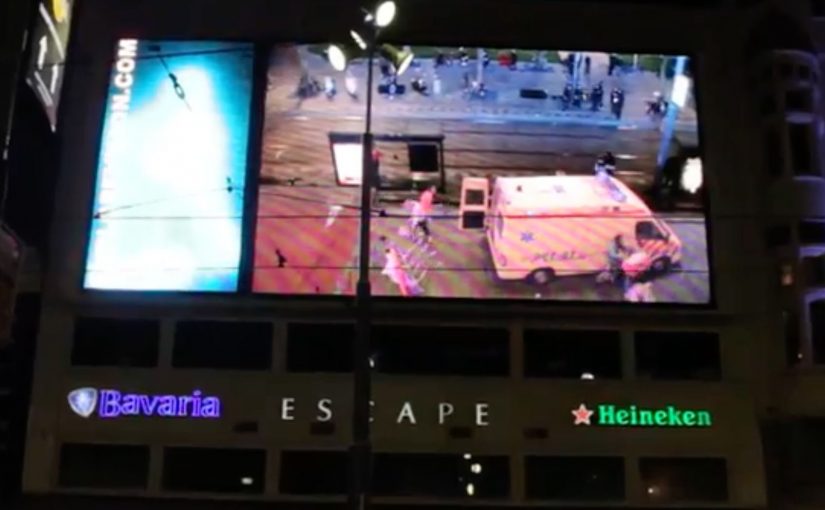
You walk past a giant outdoor screen in Amsterdam or Rotterdam and suddenly find yourself inside a street-violence scenario. Public service employees in the Netherlands face aggression and violence on the streets more and more often. Onlookers unfortunately do not intervene often enough when they encounter a situation like this. A live interactive billboard places people in a similar situation and confronts them with their inactivity.

Here, “live interactive” means recorded confrontation scenes are blended with a real-time street feed so passers-by appear inside the event.

What the billboard is designed to trigger

This is not entertainment. It is a public-awareness intervention. It puts the bystander role on display and forces a moment of self-recognition. If you do nothing, you see yourself doing nothing. The campaign intent is to turn passive awareness into a stronger sense of responsibility when aggression happens in public.

How the “live” effect is created

The experience blends previously recorded footage with a live street feed, so passers-by feel like the scenario is happening in their space, with their presence in the frame.

Why this works as a behaviour nudge

Because the live blend moves people from observer to participant, it turns an abstract social issue into a personal moment, and that is why the message sticks. In public-sector behaviour-change work, the hard part is not awareness alone but making bystanders feel immediate personal responsibility before the moment passes.

Extractable takeaway: When a campaign can place people inside the consequence of their inaction, reflection becomes harder to avoid and the desired behaviour feels more immediate.

The real question is how to make passive witnesses feel accountable before the moment passes.

For serious behaviour-change topics, participation works better than passive messaging when the mechanic stays clear and the context feels real.

What behaviour-change teams can borrow

  • Put the audience inside the situation. When people recognise themselves in the moment, the message stops being abstract.
  • Use context as the trigger. A street setting and a live feed make the behaviour question feel immediate, not theoretical.
  • Design for self-recognition, not spectacle. The point is reflection and responsibility, not entertainment value.
  • Keep the mechanic explainable in one line. If the concept cannot be repeated quickly, it will not travel beyond the location.

A few fast answers before you act

What is this interactive billboard trying to change?

It targets bystander inaction. It makes people aware of how often they do not intervene when witnessing aggression and violence against public service employees.

Why use “live” interaction instead of a normal poster?

Because the live element increases personal relevance. When people recognise themselves in the situation, the message becomes harder to dismiss as “someone else’s problem”.

What is the core mechanic in one line?

A staged violence scenario is combined with a live feed so passers-by see themselves present in a situation that calls for action.

When is this approach appropriate for brands or public bodies?

When the goal is behaviour change, not awareness alone, and when the topic is serious enough that participation creates reflection rather than trivialisation.

What has to be true for this format to work?

The blend between staged footage and live context has to be instantly legible. If people cannot understand the setup quickly, the reflection moment is lost.