

Happy Holiday Videos 2013: Agency Stunts

Welcome back. Hope everyone had a great holiday season. Now for a great start to 2014.

Taking off from my last post, here are a series of holiday action videos created by agencies around the world in their lead up to Christmas 2013. By “holiday action videos” I mean greetings built around a single visible action or interaction, not a passive message.

Holiday greetings that behave like products

The mechanism across this set is simple. Use the “holiday card” moment as permission to ship a stunt, an installation, or an interactive video that people can experience rather than merely watch.

In global agency culture, holiday cards are a low-stakes sandbox for experimentation that teams can ship fast and share widely.

The real question is whether your greeting can demonstrate something people can experience, not just a sentiment you can post.

This format is worth copying because it turns a seasonal hello into proof of craft.

Why this format keeps working

These pieces earn attention because they trade greeting-card sentiment for an observable action. Put in a coin. Click a button. Gather people in front of a webcam. One clear trigger, one visible result.

Extractable takeaway: If you want something to travel during peak-season noise, design a one-step interaction that produces a visible payoff, and make the payoff easy for someone else to describe in a sentence.

Christmas Chocolate Coin Factory by W+K London

Wieden+Kennedy London turned their Hanbury Street office window into a Christmas installation. Passers-by who inserted a 1 pound coin into Dan & Dave’s Chocolate Coin Factory activated the machine on display which then dispensed a special gold Belgian chocolate coin at the other end. All the money collected from this coin factory was donated towards building a new playground for Millfields Community School in Hackney, East London.

Disrupted Christmas by Holler

Holler, an agency from Sydney, created a live interactive installation that gave the general public a chance to disrupt the agency as it worked throughout the day. Electric Muscle Stimulation (EMS) units were hacked and hooked up to the Internet via IP cameras. Then key members of the agency were connected to the EMS units, and the Internet via a live stream. The public could then watch the agency staff online and instantaneously zap them at will with the click of a button.

For each disruption the agency donated $1 to The Factory, a local community centre with a long history of supporting socially and economically disadvantaged local residents.

The More the Merrier by Publicis Groupe

The Publicis Groupe was back again with another Maurice Lévy holiday video. This time they worked with DigitasLBi to create a video that uses your webcam to detect how many faces are watching together, and then adapts the video based on the number of viewers.

The Epic Christmas Split by Delov Digital

Delov Digital from Hungary used Chuck Norris to top Jean-Claude Van Damme’s epic Volvo split with the help of some serious digital enhancement.

A repeatable structure for next year’s greeting

  • Give the audience one trigger. A single action that anyone can explain and repeat.
  • Make the payoff visible. Something that changes on-screen or in the real world, immediately.
  • Design for retellability. If the idea cannot be summarized in one sentence, it will not spread.
  • Let craft do the selling. Use the holiday excuse to demonstrate what you can build, not just what you can say.

A few fast answers before you act

What makes “holiday action videos” different from normal holiday ads?

They are built around a visible action or interaction. The greeting is the excuse. The experience is the asset that people talk about and share.

Why do agencies use holiday cards as a playground for experimentation?

The stakes are lower and the audience is receptive. That creates room to try unusual formats, technical tricks, and interactive mechanics that would be harder to justify in a client campaign.

What is the common mechanism across the best ones?

One clear trigger and one clear payoff. Insert a coin and get a coin back. Click a button and something happens. Add more people and the video changes.

How do you choose a mechanic that people will actually try?

Pick a one-step trigger that feels effortless, then make the payoff obvious within seconds. If someone cannot explain both in one sentence, the interaction will not travel.

How do you keep it from feeling like a gimmick?

Anchor the interaction in a simple human reward. Delight, togetherness, surprise, or a small act of good. Then keep the mechanic effortless so the idea does not collapse under friction.
Happy Holiday Videos 2012: Agency Stunts

Welcome back. Hope everyone had a great holiday season. Now for a great start to 2013.

Taking off from my last post, here are a series of holiday action videos created by ad agencies around the world in their lead up to Christmas 2012. By “holiday action videos,” I mean greetings built around a simple interaction or trigger with a visible payoff.

Holiday greetings that behave like products

The mechanism across this set is consistent. Use the “holiday card” moment as permission to ship something people can experience, not just watch. A hacked player, a tweet-triggered donation, a synchronized “orchestra,” a physical gag product.

In global agency culture, the holiday card is a low-risk moment to test interactive mechanics and craft that can later show up in bigger client work.

Why this format keeps working

These pieces earn attention because they trade greeting-card sentiment for an observable action. The real question is whether your greeting demonstrates a capability people can experience, not just a sentiment they can scroll past. You should treat the holiday card as a tiny product launch, not a branded message. The viewer is not only receiving wishes. They are triggering something, learning something, or being surprised by a mechanism that is simple enough to retell.

Extractable takeaway: If you want something to travel during peak-season noise, design a one-step interaction with a visible payoff, and make the payoff describable in a single sentence. That is retellability, meaning a friend can summarize it in one sentence.

Maurice Lévy’s Digital Wishes by Publicis Groupe

Maurice Lévy, the chairman and chief executive of Publicis Groupe, traditionally records a holiday greeting-card video. This year, through a special deal with YouTube, Publicis modified the function buttons of the video player and embed tricks into what seems like another long, boring address by an ad industry veteran.

TwinterWonderland by 360i

To celebrate the arrival of the holiday season and provide assistance to those affected by Hurricane Sandy, 360i wanted to do something big. For every #TwinterWonderland tweet they received, 360i donated $5 to an aid organization helping with the post-Sandy cleanup effort.

25th Anniversary Holiday CompuCard by TBWA\TORONTO

To celebrate their 25th anniversary, TBWA\TORONTO brought in their digital expert from 1988, who then, through an e-card, tried to capture the spirit of their past along with their digital future.

Buzzed Buzzer by Havas Worldwide Chicago

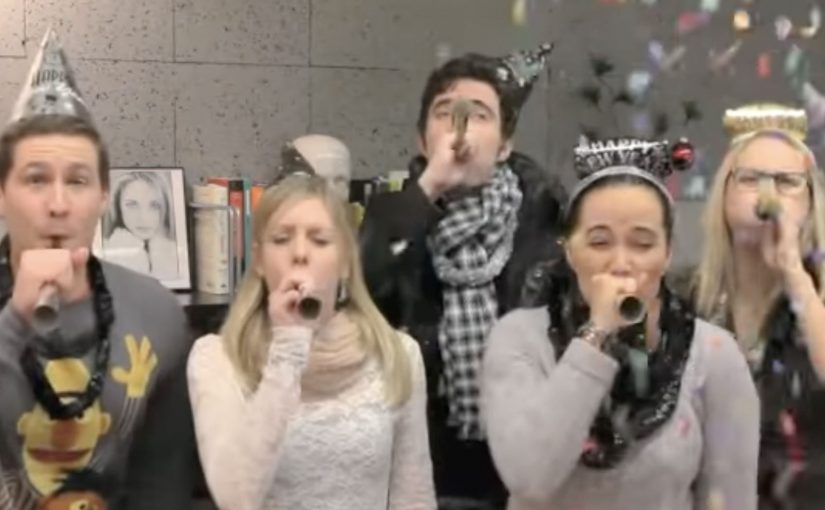
The first New Years Eve noise maker that only works when you’re drunk.

Christmas carol played on food by FullSIX Spain

To wish happy new year to customers and friends, FullSIX transformed typical Spanish Christmas food into a carol-playing piano.

Click here to watch video on the AdsSpot website.

The Snow Machine by Weapon7

Passers-by were invited to Tweet #snow to @thesnowmachine Twitter account. For every tweet received, the machine gave ten seconds of snow flurry. The event ran all day, was seen by thousands of people and generated over one thousand tweets.

Stealable patterns for next year’s greeting

  • Give the audience one trigger. One hashtag, one button, one simple mechanic.
  • Make the payoff visible. Something changes immediately, on-screen or in the real world.
  • Design for retellability. If the idea cannot be summarized in one sentence, it will not spread.
  • Let craft do the selling. Use the holiday excuse to demonstrate capability, not just sentiment.

A few fast answers before you act

What makes “holiday action videos” different from normal holiday ads?

They are built around a visible action or interaction. The greeting is the excuse. The mechanism is what people experience, talk about, and share.

Why do agencies use holiday cards as a playground for experimentation?

The stakes are lower and the audience is receptive, so it is easier to try unusual formats, technical tricks, and interactive mechanics that would be harder to justify elsewhere.

What is the common mechanism across the strongest examples?

One clear trigger and one clear payoff. A hacked player that surprises you, a tweet that causes a donation, a simple “instrument” that performs when activated.

How do you keep it from feeling like a gimmick?

Anchor the interaction in a human reward. Delight, generosity, togetherness, or a simple shared joke. Then keep friction low so the idea survives first contact.

How do you test retellability before you publish?

Ask someone outside the project to explain the idea back to you after a 10-second description. If they cannot say the trigger and payoff in one sentence, simplify the mechanic.

Sprint: Unlimited Love Billboard in Times Square

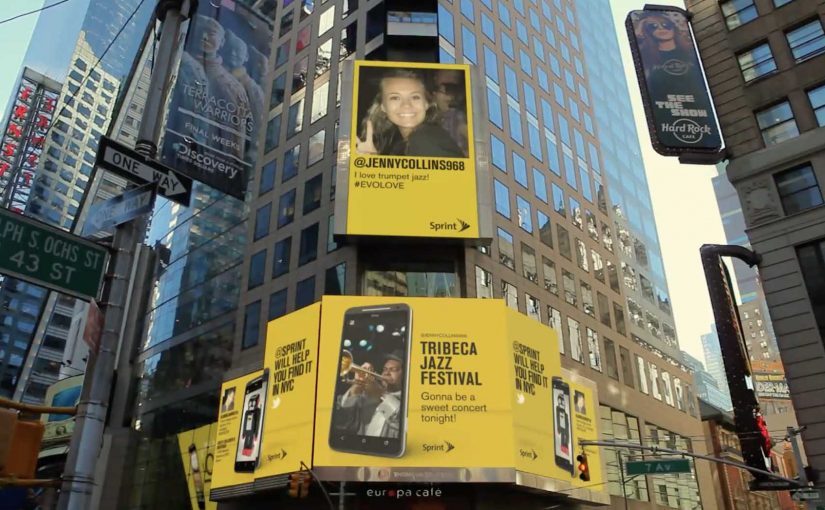
You are in Times Square and a billboard asks a simple question. What do you love. You tweet your answer with #EVOLOVE to @sprint, and the screen answers back with places in New York City where you can find it.

Sprint in the USA created an integrated advertising campaign for the launch of the HTC EVO 4G LTE phone on their network. To launch EVO in New York City they set up an interactive billboard in Times Square that encouraged visitors to tweet things they love with #EVOLOVE to @sprint. Then, with the help of local experts, the billboard re-tweeted locations of where these things of love could be discovered in New York City.

Why the mechanic works

The mechanism is a clean exchange. You give the brand a public signal. A tweet about something you love. The brand gives you an immediate, useful response. A location you can act on right now. That “reply with value” is what turns a hashtag prompt into participation.

Extractable takeaway: Interactive OOH works best when the public input reliably triggers a fast, specific reply that helps someone decide what to do next.

It also creates a visible social proof layer. The billboard is not only showing Sprint’s message. It is showing other people’s messages, which makes the campaign feel alive and current while you are standing there.

In consumer technology launches and telco marketing, a social-to-DOOH loop, where a social post immediately changes what the screen shows, turns a landmark screen into a real-time recommendation engine that people can influence from their own phones.

What Sprint is really buying

This is a launch tactic that behaves like service. It positions the EVO as a device you use to discover the city, not just a phone with specs. At the same time, it lets Sprint demonstrate “unlimited” as a lived experience. Always on, always connected, always responding in real time.

The real question is whether you can keep the reply layer fast, relevant, and brand-safe in public.

If you cannot operationalize that reliably, a simpler DOOH idea will outperform an “interactive” one that feels slow or generic.

Steal this reply-with-value billboard pattern

  • Make the input obvious. One hashtag. One handle. One sentence prompt.
  • Return something concrete. Maps, directions, a nearby place, a clear next action.
  • Curate the response layer. “Local expert” guidance beats generic automation for relevance and trust.
  • Design for the crowd and the clip. The street moment should be fun to watch. The video should still work without being there.

A few fast answers before you act

What is the Sprint #EVOLOVE Times Square billboard?

A digital billboard that invites people to tweet what they love with #EVOLOVE to @sprint, then responds by showing where in New York City they can find that thing.

Why connect Twitter to a billboard instead of running a normal DOOH spot?

Because participation becomes the content. The screen stays fresh, people feel seen, and the interaction creates a public spectacle that attracts more participants.

What is the “value exchange” in this campaign?

The user provides a public message and attention. The brand provides a timely, useful recommendation and makes the user visible on a high-profile screen.

What makes this different from simply displaying tweets on a screen?

The reply layer. The billboard does not only mirror tweets. It answers them with specific places and directions, which turns social chatter into utility.

What is the biggest execution risk?

If the responses feel slow, generic, or off-topic, people stop playing. The campaign only works when the replies feel genuinely relevant in the moment.