
T-Mobile ‘Tell Me Why’: The Live-Retail Play

A boy-band button in Times Square. And a very deliberate question

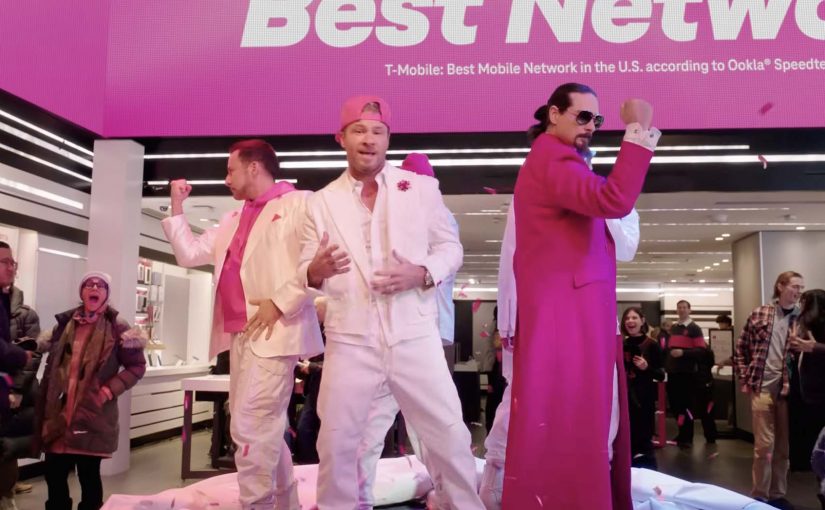
T-Mobile’s Super Bowl LX spot opens inside its Times Square Signature Store, surrounded by real customers, with a plain prompt on-screen: “Why is it better over here?” Then someone hits a big red button, the Backstreet Boys appear, and the “answer” arrives as a reimagined performance of I Want It That Way, with cameos from Druski, mgk (Machine Gun Kelly: Colson Baker) and Pierson Fodé. The commercial is credited to Panay Films and was slated to run as a :60 in the second quarter of the February 8, 2026 Big Game broadcast.

What matters is not the celebrity stack. It is the structural move: a telecom brand turning a comparison claim into a moment people can watch happening to other people.

How “Tell me why” turns a service claim into a stageable event

The core mechanic is simple on purpose. A single question frames the ad like a customer challenge, not a brand monologue. A physical trigger, the button, converts messaging into cause and effect. A live performance inside a real retail space supplies social proof because the audience is already there and reacting in-frame.

You can call this retail-as-stage. By retail-as-stage, I mean a physical store that functions as content set, event venue, and credibility engine at the same time.

When you turn a service comparison into a witnessed moment in a real store, with real reactions, belief shifts from “do I trust this claim?” to “I just saw why it’s true.”

The real question is how you make an invisible network promise feel provable in the moment, not just plausible in a chart.

The fastest path to belief is to turn an invisible network promise into a shared, watchable moment.

In telecom marketing, most value is felt after purchase, so “proof” has to be engineered before the contract is signed.

Why the nostalgia remix works, and why it is not just “a pop-culture hook”

Yes, it is familiar. But the stronger psychological play is fluency. A chorus people can finish in their head reduces processing effort, then that freed-up attention gets spent on the new lyric payload. The button adds perceived transparency. When a brand invites “why,” then stages an immediate “answer,” it signals it can withstand scrutiny.

Extractable takeaway: If your offering is hard to evaluate because it is invisible, abstract, or overloaded with fine print, stop trying to explain it better. Engineer a moment where the audience can watch someone else receive the answer in real time, because observed reactions become the credibility layer your claims cannot earn on their own.

Rewritten lyrics are inherently risky because they can feel like a jingle wearing a costume. This spot reduces that risk by grounding the musical in a real place, with real customers, and a visible trigger that creates a story arc worth retelling.

What T-Mobile is really trying to shift in 60 seconds

Look past the network line and you see a category-level repositioning attempt.

  • From coverage to a value stack. The ad frames the carrier choice as network plus bundled value plus experience, not just bars and price.
  • From switching pain to switching ease. The broader message is “make it easy to reconsider,” while the spot’s job is to create emotional permission to do so.
  • From brand assertion to customer interrogation. Opening with “why” signals the brand is answering scrutiny, which is a more credible posture in a high-skepticism category.

The Europe echo: making a network promise watchable

It should feel familiar. This “make connection visible” move has shown up before, by turning a network promise into a shared public moment you can actually witness.

Back in 2011, Deutsche Telekom executed a multi-city Christmas activation where Mariah Carey appeared as a hologram simultaneously across five European countries, with audiences linked across cities to experience the same performance at once.

The shared mechanic across both campaigns is consistent.

  • Make the promise tangible by creating a collective moment that can only exist because connection exists.
  • Use a universally recognizable song layer to synchronize emotion across audiences.
  • Build a reveal structure so the audience has a story arc worth retelling.

For the full Germany case, see Deutsche Telekom’s hologram Christmas surprise.

Steal the retail-as-stage pattern for “invisible products”

  • Start with a question the customer would actually ask. Not a tagline. A test.
  • Build one physical trigger. Buttons, switches, taps, scans. One action that says “watch this.”
  • Make the audience part of the evidence. Real reactions often land harder than any graphic.
  • Use music as memory infrastructure, not decoration. A familiar melody can carry new meaning fast.
  • Design for retellability. If it is easy to summarize, it is easier to spread.

A few fast answers before you act

What is the big idea behind “Tell Me Why” in one line?

It turns a telecom comparison claim into a witnessed moment in a real retail setting, using a familiar chorus and real-customer reactions to make “why” feel observed rather than asserted.

What is the core mechanic that makes it work?

A single customer-style question plus a physical trigger, the button, that immediately produces the “answer” as a performance, with the crowd reaction acting as the credibility layer.

Why does the Backstreet Boys remix outperform a normal benefits list?

Because audiences already encode the melody automatically. The rewritten chorus becomes a fast memory container for new information, and the live-style staging reduces skepticism.

What is the strategic intent beyond awareness?

To shift evaluation from “coverage and price” toward “network plus value plus experience,” and to lower switching resistance by making reconsideration feel emotionally safe.

What is the transferable lesson from the Deutsche Telekom hologram example?

If your product promise is invisible, create a synchronized public moment that can only exist because your promise exists, then let the shared reaction do the persuasion work.
Snickers: Hungry Purchase Resale

The global Snickers platform “You’re not you when you’re hungry” has generated plenty of buzz. To extend it in Dubai, and make the downside of hunger feel more real, Impact BBDO created “Hungry Purchase Resale”.

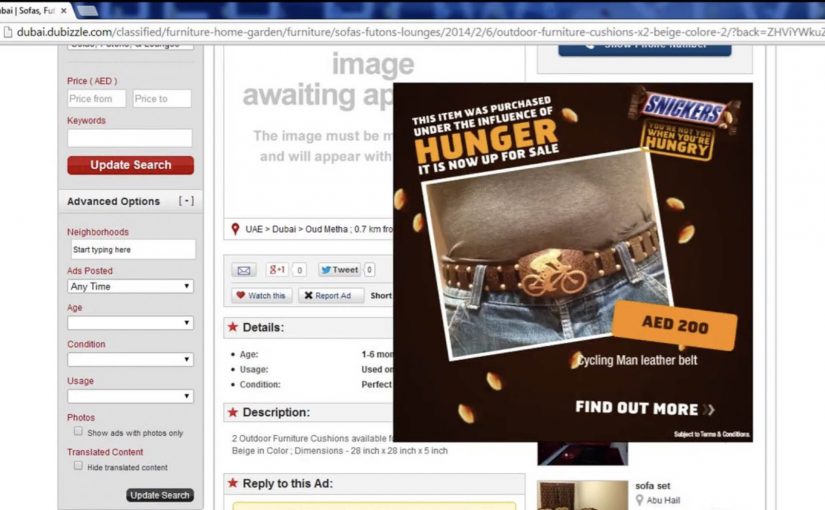
The insight is simple. During big sales, people often buy things they later regret. Snickers pins these shopping bloopers on hunger and, in partnership with Dubizzle.com, lets shoppers upload the items they want to sell straight into Snickers branded banners that appear on the site’s homepage. Clicking the banner takes people directly to the classified listing so the item can be sold on.

Turning regret into a media unit

The clever bit is that the ad is not just an ad. It becomes a functional resale slot that people actually want, because it helps undo a mistake. This is the stronger move, because utility gives the audience a reason to use the format, not just notice it.

In high-velocity retail environments, the best digital ideas piggyback on existing intent surfaces, meaning the places where people are already ready to browse, compare, or buy, then give people a reason to interact that is bigger than “engage with our brand”.

The real question is how to turn a brand platform into a useful action inside the exact behavior it is commenting on.

Why it lands

The better approach here is to make the platform behave like a service, not a message. The audience is already on a classifieds site to browse, compare, and transact. By turning remorse into a shareable listing, the campaign earns attention inside the exact behavior it is commenting on.

Extractable takeaway: If your brand truth is behavioral, do not just illustrate it. Build a mechanic that lets people enact it in a familiar environment, and make the brand the enabler of a useful outcome.

What the results are described to show

Campaign reporting describes over 200 submissions in a week. It also describes the interactive banners achieving a click-through rate almost five times the industry standard, with 80% of posted items sold the same day.

What commerce teams should steal from this

  • Make the ad do a job. Utility beats persuasion when attention is scarce.
  • Put the idea where intent already exists. Classifieds, marketplaces, and search are “ready-to-act” contexts.
  • Let users supply the proof. Real submissions and real listings create credibility you cannot script.
  • Keep the action one-step. Upload, appear, click, sell. No extra hoops.

A few fast answers before you act

What is “Hungry Purchase Resale”?

It is a Snickers activation in Dubai where shoppers can upload regretted purchases into Snickers branded homepage banners on a classifieds site, linking directly to the resale listing.

What is the core insight behind it?

People often make irrational purchases during sales and later regret them. The campaign frames hunger as the trigger for those mistakes.

Why partner with a classifieds site?

Because it is where resale intent already lives. The campaign becomes actionable in-context instead of being a standalone brand message.

What makes the idea feel credible?

It routes real items from real people into a real marketplace flow, so the audience can see behavior, not just hear a claim.

How can another brand replicate the pattern?

Choose a partner platform that already hosts the behavior you are talking about, then build a simple mechanic that turns your brand message into a useful action.

Apotek Hjärtat: Blowing in the Wind

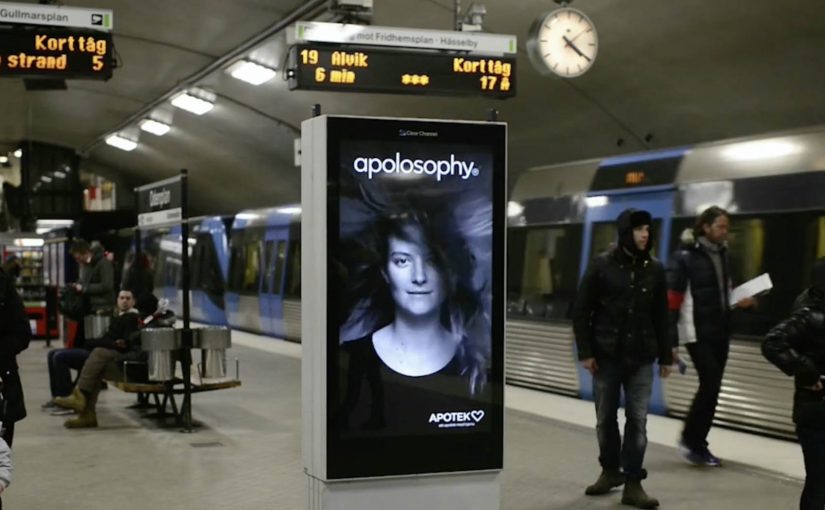
A subway platform in Stockholm. A digital screen. A model with a lush mane. Then the train arrives and her hair starts to whip around, perfectly timed to the rush of air you can feel on the platform.

To introduce a new line of hair products, Swedish pharmacy Apotek Hjärtat worked with Åkestam Holst to fit the platform screens with ultrasonic sensors. When those sensors detect an incoming train, the film switches into a “blowing in the wind” sequence, creating the illusion that the turbulence from the train is affecting the model on the screen.

The trick behind the timing

This is reactive outdoor done with restraint. Here, reactive outdoor means the screen responds to a real environmental trigger instead of running the same sequence on a fixed loop. There is no complex interface and no extra instruction for commuters. The environment provides the trigger, the sensor provides the cue, and the creative provides the payoff. The moment is over in seconds, which is exactly how long you get on a platform before attention snaps back to schedules and crowds.

In high-traffic transit environments where attention is scarce, reactive outdoor works best when it synchronizes with a real-world moment everyone already notices.

Why commuters stop

The effect feels “impossible” because it is contextual and precise. People experience the wind and see the wind at the same time. That sensory alignment is what makes it memorable, and it makes the product claim feel physical instead of cosmetic.

Extractable takeaway: If you want outdoor to earn attention, link the creative to a shared environmental trigger, and make the response immediate enough that viewers can connect cause and effect without being told.

What the brand is signaling

The story is not really about sensors. It is about vitality. The real question is whether the public moment makes the product promise feel physically true before the commuter moves on. The ad implies the product brings hair to life, then proves that idea through a living, timed reaction in a public space. You remember the feeling first, then the brand name attached to it.

What to steal for reactive outdoor

  • Pick a trigger that already exists. Trains arriving, doors opening, crowds gathering.
  • Make the payoff instantly legible. One glance should be enough to get it.
  • Use craft to hide the tech. The illusion matters more than the explanation.
  • Design for repeat viewing. Platforms are perfect for loops, because people wait.

A few fast answers before you act

What is “Blowing in the Wind”?

A reactive DOOH installation for Apotek Hjärtat where ultrasonic sensors detect an approaching subway train and trigger a film effect that makes the model’s hair appear to blow in the train’s turbulence.

What is the core mechanism?

Sensor detects train arrival. Creative switches at the same moment the real airflow hits the platform. The viewer experiences both together, which sells the illusion.

Why does it feel more persuasive than a normal screen ad?

Because it is synchronized with the physical environment. That alignment makes the message feel like something happening, not something being played at you.

What is the most common mistake when copying this pattern?

Overbuilding the interaction. If viewers need instructions, or if the trigger is unreliable, the magic disappears and the screen becomes just another screen.

Why does the product claim feel more real than in a standard beauty ad?

Because the demonstration is tied to a real physical cue on the platform. That makes the benefit feel observed in the moment, not merely claimed in the creative.