

Canadian Tire: Christmas Spirit Tree

Canadian Tire wanted to re-energize Christmas spirit and reinforce its position as Canada’s leading Christmas store. So they built a public symbol of the season that behaves like a live dashboard for holiday cheer.

The result was a 30-foot Christmas tree wrapped with 3,000 individually programmed LED lights, powered by the nation’s collective online Christmas spirit. Social monitoring tools scanned blogs, forums, social networks, and news sites for Christmas keywords, then software translated that data into real-time light patterns on the tree.

Turning sentiment into a light show

The mechanic is a clean loop. Capture real-world language at scale. Reduce it to signals a system can interpret. Visualize those signals instantly as a physical experience people can gather around. That translation layer is the whole idea, because it makes something intangible, “spirit”, visible and shared. Here, the translation layer is the software bridge that converts online holiday language into visible light behavior.

In large-scale retail brands, public installations like this can turn social chatter into a measurable, collective ritual that reinforces seasonal ownership.

Why it lands

It gives people a role that feels meaningful without feeling like work. You do not have to download an app or learn a new behavior. You just post a message the way you already would, and the tree responds. That cause-and-effect is what makes the story travel, because the installation feels like it is listening, not just broadcasting.

Extractable takeaway: If you want “community” to feel real, build a visible feedback loop where everyday audience behavior directly changes a shared public object. Then make the transformation obvious enough that people can connect their action to the outcome.

What the campaign is really optimizing for

The objective is not only brand warmth. It is reclaiming seasonal leadership by creating a national-scale proof point that Canadian Tire can own, film, and redistribute. The real question is how to make seasonal sentiment visible in a way only Canadian Tire can own. The tree becomes a repeatable centerpiece for earned media, social sharing, and store association without having to lead with price.

What to steal for your own seasonal playbook

  • Make the idea self-explanatory. “Messages make lights” is a one-sentence mechanic people can repeat.
  • Turn digital into physical. Physical experiences feel more “real” than dashboards or microsites, even when the inputs are purely online.
  • Design for spectators and participants. The best public work rewards both the person who posts and the person who just watches.
  • Build a content engine. If the installation produces fresh patterns continuously, you get ongoing footage and reasons to talk about it.

A few fast answers before you act

What is the core idea of the Christmas Spirit Tree?

A large LED Christmas tree that lights up in response to holiday messages detected online, turning seasonal sentiment into a live public experience.

Why use social monitoring as the “power source”?

Because it makes the audience feel like the energy behind the display. The installation becomes a collective mirror, not a one-way broadcast.

What makes this more effective than a standard Christmas film?

The live feedback loop. People can influence the outcome, and that influence creates participation, talk value, and repeat attention.

Why does the physical tree matter more than a digital counter?

Because a public object turns online sentiment into something people can gather around, film, and talk about. The physical response makes the mechanism feel shared rather than abstract.

What is the biggest execution risk?

If the response feels delayed, random, or unconnected to real posts, the magic breaks. The system must feel immediate and believable.
IKEA: A New Kind of Catalog

Every year, the IKEA Catalog inspires people around the world to create homes they love. For the 2013 edition, IKEA takes the inspiration one step further by bringing technology to the paper catalog and creating a more seamless connection to purchase.

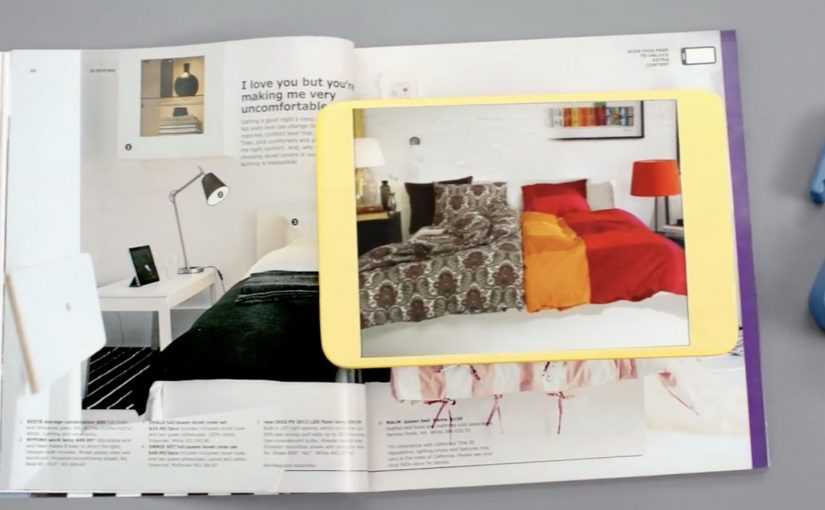
IKEA worked with McCann New York to re-imagine the catalog via a visual recognition app that brings select pages and the offerings within to life. The experience is positioned around inspirational videos, designer stories, “X-ray” views that peek inside furniture, and more.

How the catalog becomes an interface

The mechanic is page recognition. You point your phone at a printed page and the app identifies the exact spread, then overlays or opens the matching digital layer. That is what “visual recognition” means here. The camera view is used to recognize the image itself, so the print can stay clean without obvious codes taking over the layout.

This is interactive print done as a product layer, not as a QR code workaround. The page remains a premium editorial surface, and the interactivity is unlocked through recognition rather than visible markers.

In global retail organizations with massive print distribution, recognition-based layers let brands turn a static catalog into a measurable, updateable experience without redesigning the entire print grammar.

The real question is whether your print can behave like an interface without sacrificing the editorial feel that makes people pick it up in the first place.

Why “X-ray” and stories beat a pure commerce push

What makes this approach land is that it does not start with “buy now.” It starts with curiosity. Here, the “X-ray” layer is a simple cutaway view that lets people see inside furniture to understand utility. Peek inside a unit. Watch the product in context. Hear the thinking behind a room setup. Those are the moments where browsing becomes intent.

Extractable takeaway: If you want print-to-digital to stick, lead with reassurance and curiosity, not a commerce CTA. Use interactivity to remove uncertainty in one fast payoff, not to add a menu of options.

The “X-ray” idea is also a smart translation of a physical store behavior. People open drawers and cupboards in-store to understand utility. This gives a lightweight version of that reassurance from the page.

What IKEA is really building with this

At face value, it is an augmented catalog. Underneath, it is a bridge between inspiration and action. A catalog is already a decision-shaping channel. Adding tappable layers makes it a trackable channel and creates new points where IKEA can educate, reassure, and nudge the path to purchase.

Copyable moves for print-to-digital catalogs

  • Keep the print clean. If the page looks like a code sheet, you lose the lifestyle premium.
  • Use interactivity to remove uncertainty. Show how it works, what fits inside, how it looks in a room.
  • Design for quick wins. One scan should yield something useful immediately, not a long menu.
  • Make the layer repeatable. If it can work on many pages, it becomes a system, not a stunt.

A few fast answers before you act

What is a “visual recognition” catalog app?

An app that recognizes a printed page using the phone camera, then unlocks related digital content tied to that exact spread.

Why is recognition better than QR codes for premium catalogs?

Because it preserves design. Recognition can keep layouts clean and still enable interaction, while QR codes often force visible markers into the page.

What is the “X-ray” feature actually communicating?

Utility and confidence. It helps people understand storage and function without needing to visit a store or guess from a single photo.

What is the main business value of interactive print?

It turns inspiration into measurable engagement and creates additional moments to guide purchase decisions, especially for considered categories like furniture.

What is the biggest risk with print-to-digital layers?

Friction. If scanning is slow, unreliable, or the payoff is thin, people abandon the habit after one try.

Audi City London: Future of Auto Retail

To solve space challenges at its retail outlet in Piccadilly Circus, Audi has used groundbreaking technology to present its growing model line-up.

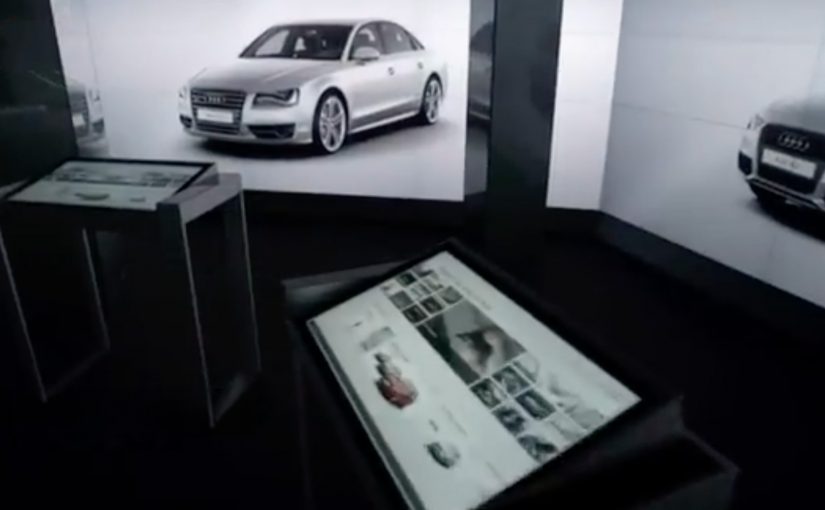
Visitors can now digitally select their vehicle from several hundred million possible configurations and experience it in realistic 1:1 scale on special powerwalls. Here, “powerwalls” are wall-sized, high-resolution display surfaces built for life-size visualization.

Various details such as drivetrain, bodyshell, LED light technology etc are presented with interactive gestures, touch and physical sample recognition methods. Physical sample recognition means the system detects physical samples as an input. The whole immersive experience helps make the innovations understandable on an intuitive level.

The future of automotive retail is here and Audi is leading the way, with plans to roll out the experience at 20 locations in major international cities by 2015.

Why Audi City matters beyond “wow”

This is not digital for digital’s sake. It is a retail operating model that turns limited floor space into effectively unlimited shelf space, without forcing the customer to imagine the product from a brochure or a small screen.

Extractable takeaway: When physical space is scarce, move your long tail of options into a high-fidelity interface so the store sells decisions, not inventory.

  • Scale without inventory. Hundreds of millions of combinations without storing hundreds of cars.
  • Confidence through realism. A 1:1 representation reduces the gap between selection and purchase.
  • Innovation made tangible. Drivetrain, bodyshell, and lighting become understandable through interaction.

The showroom becomes an interface

Audi City treats the store like an interface layer between customer intent and product complexity. Gesture, touch, and physical sample recognition are not gimmicks. They are interaction patterns designed to help people explore, compare, and decide.

That is the critical shift. Instead of staff explaining everything verbally, the environment itself becomes the explainer. The real question is whether your showroom is optimized to help customers decide, or just to show what you have in stock. Because the interface externalizes complexity into something people can manipulate, it shortens the explanation loop and increases decision confidence.

In global automotive retail, immersive configuration experiences matter most when they reduce decision friction without expanding showroom footprint.

What this signals about the future of automotive retail

If Audi rolls out this concept across major cities, the implication is clear. Physical retail will not disappear. It will evolve into fewer, smaller, higher-impact locations that are designed for configuration, education, and decision-making, while fulfilment happens elsewhere.

  1. Fewer cars on the floor. More options in the system.
  2. More guided discovery. Less brochure-driven selling.
  3. More consistent global experience. Less dependence on local store size.

What to take from this if you run retail or CX

  1. Use digital to remove physical constraints. The business problem here is space, not “innovation theatre”.
  2. Design interaction for comprehension. Gestures, touch, and samples work when they help people understand complexity quickly.
  3. Make exploration feel premium. 1:1 scale and high fidelity visuals create confidence and desire.
  4. Separate “experience” from “inventory”. Let stores sell decisions, not stock.

A few fast answers before you act

What is Audi City London?

It is an Audi retail concept in Piccadilly Circus that uses large digital powerwalls to let visitors configure vehicles from hundreds of millions of combinations and view them in realistic 1:1 scale.

Why does 1:1 scale matter in a configurator?

It reduces uncertainty. People can judge proportions, design choices, and visual details more confidently than on a small screen.

How does the experience help explain innovation?

By presenting components like drivetrain, bodyshell, and LED lighting through interactive exploration using gestures, touch, and physical sample recognition.

What business problem does Audi City solve?

It addresses limited showroom space while still presenting a broad and growing model line-up and configuration depth.

What is the transferable lesson for other retailers?

Use immersive digital interfaces to expand choice and understanding without expanding physical footprint, and design interactions that make complex decisions feel intuitive.