
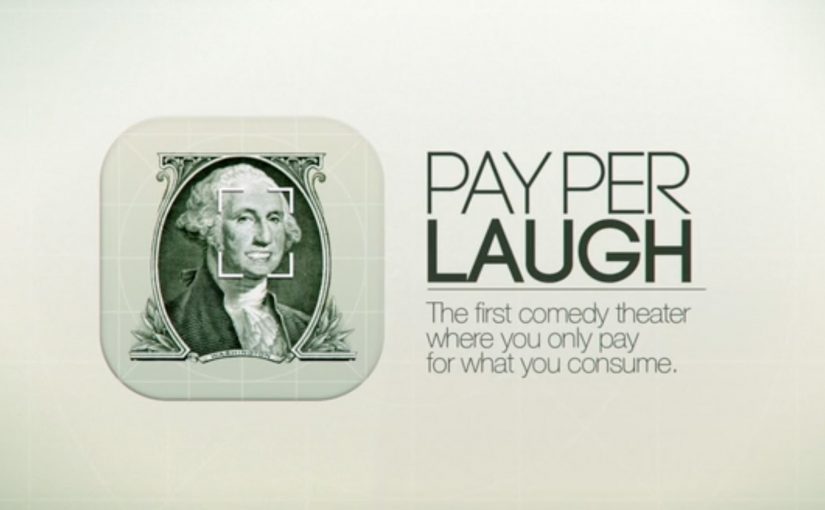
Teatreneu: Pay Per Laugh

Teatreneu: Pay Per Laugh

In mid-2013, Spain’s theatre scene is described as taking a hit when taxes on theatrical shows reportedly rose from 8% to 21%, with audiences thinning out as a result. Teatreneu, an independent comedy theatre in Barcelona, responds with a pricing idea that sounds like a joke until you sit down.

Entrance is free. You only pay when you laugh. Every laugh costs €0.30, capped at €24 for 80 laughs. If the show is not funny, you pay nothing. If it is, you pay for what you consumed.

The mechanism: pricing tied to visible emotion

The model is made possible by fitting each theatre seat with a system that detects smiles during the show and increments the charge. The experience is framed as transparent and immediate. Laugh, the counter moves. Stay straight-faced, the bill stays still.

In European live entertainment, pricing experiments that align payment to perceived value can reset attention fast, because they turn a ticket into a story people want to debate.

Why this lands

This works because it reframes the risk. Instead of “pay up front and hope it’s good,” the audience gets an “only pay if it works” promise. Because the charge only rises when people visibly enjoy the show, the pricing mechanic feels fairer before the first joke lands. The smile-detection counter also adds tension and theatre inside the theatre, because everyone knows their reaction has a price. The result is a show that sells itself through the mechanic as much as through the jokes. The real question is whether performance-linked pricing can turn hesitation into trial without making the experience feel punitive. The stronger idea here is not the sensor but the risk reversal.

Extractable takeaway: If your category suffers from perceived value risk, attach payment to an observable outcome, then cap the downside so people feel safe trying it once.

What the numbers are trying to prove

Reported results claim that the average ticket yield increased by around €6 compared to the prior model, and that attendance rose by about 35% as the concept became widely talked about. Whether or not each figure holds precisely, the intent is clear. Make pricing the headline, and use that attention to refill seats.

What to steal from performance-based pricing

  • Make the deal easy to repeat. “Free entry, pay per laugh” is instantly explainable.
  • Instrument the experience. The detection system makes the promise measurable, not rhetorical.
  • Protect the customer with a cap. A maximum price keeps the mechanic playful rather than punitive.
  • Let controversy do distribution. A pricing model people argue about spreads faster than a standard poster campaign.

A few fast answers before you act

What is “Pay Per Laugh”?

It’s a comedy show pricing model where entry is free and spectators are charged €0.30 per laugh, capped at €24, using smile detection to meter reactions.

How is laughter detected?

The theatre fits seats with a system that detects smiles during the show and counts them toward the final charge.

Why set the cap at €24?

It limits downside and keeps the mechanic in the range of a normal ticket, so the idea feels like a playful wager, not an open-ended penalty.

What problem is this solving?

It addresses audience drop-off and price sensitivity by shifting risk away from the customer and turning ticket pricing into a reason to attend.

What’s the biggest risk with this approach?

Trust and fairness perception. If people doubt the accuracy of detection or feel pressured to suppress laughter, the experience can backfire.

KPT/CPT: Smileball

KPT/CPT: Smileball

Since June 2010, I had seen smile detection technology used in vending machines and Facebook apps to create innovative engagement with target audiences.

Now, in this example, KPT in Switzerland decides to show that it has the happiest health insurance clients. To demonstrate that, they create Smileball, a pinball machine controlled by smiles.

Unlike normal pinball machines where the two paddles are controlled by buttons on either side, Smileball uses motion sensing technology to detect changes in a person’s smile and map that input to the respective paddles. By playing the game, participants get a chance to win a trip to a comedy show in New York.

A pinball machine that rewards the emotion it wants

The twist is that the game cannot be mastered by tense concentration. You need to keep smiling. That forces the behavior the brand wants to claim, and it makes the proof visible to anyone watching, because the input is literally on the player’s face.

How the mechanism works

The machine replaces buttons with a camera-based smile input. Smile more on one side and the corresponding flipper becomes easier to trigger. Relax your face and you lose precision. The interface quietly trains you into the brand message through play, not persuasion.

In Swiss health insurance marketing, turning an intangible promise like “happier customers” into a visible, shared moment can outperform any satisfaction statistic.

The real question is whether the interface makes a soft brand claim believable in public.

Why it lands

It is self-explaining, socially contagious, and it creates a public demonstration loop. People walk up because it is a pinball machine. They stay because it behaves differently. The crowd laughs because the control method is human and slightly absurd. In the end, the player’s smile becomes the performance, and the brand gets credit for orchestrating it.

Extractable takeaway: If your proof point is an emotion, design an interaction where that emotion is the input. When the audience can see the input in real time, the claim stops sounding like marketing.

What health brands can steal from Smileball

  • Make the proof visible to bystanders. Spectators are your free distribution channel.
  • Replace a standard control with a brand-relevant one. The control method is the message.
  • Keep the first 10 seconds obvious. If people do not “get it” instantly, they will not try.
  • Add a lightweight reward. A prize gives hesitant people a reason to step up.

A few fast answers before you act

What is Smileball?

A pinball machine where the flippers are controlled by changes in the player’s smile instead of physical buttons.

Why is smile-based control a strong branding choice for a health insurer?

Because it turns “happy customers” into a visible behavior. The player’s smile becomes proof in the moment, not a claim in copy.

Does this store or profile people’s faces?

The campaign is presented as in-the-moment smile detection used only to control the game interface. No storage or profiling is described in the original framing.

What is the biggest risk in executions like this?

Calibration. If the smile detection feels inconsistent, people assume the game is rigged and the experience collapses.

How could a brand apply this pattern without face-based input?

Keep the principle. Make the brand’s desired behavior the control input, then make that input visible so the claim proves itself in public.

Prigat: User Generated Orange Juice

Prigat: User Generated Orange Juice

Prigat, a leading company in the Israeli fruit juice market, launched one of the more inventive Facebook mechanics of its era. It invited people to squeeze real orange juice by doing something absurdly simple. Smile at your webcam.

The idea was packaged as “User Generated Orange Juice (UGOJ).” A Facebook application that translated user participation into a physical outcome you could actually watch.

The mechanism: your smile triggers a real machine

A custom Facebook app developed by Publicis E-Dologic used webcam-based smile detection to trigger a real, oversized juicer. When the app detected a smile, it activated the juicer and squeezed fresh oranges. Users could watch the machine live 24/7, so the cause-and-effect was visible rather than implied.

Campaign coverage also described a personalization touch where the participant’s name appeared on the machine during use, and that the resulting juice was directed to a charity choice.

In social platform marketing, physical proof loops outperform abstract engagement prompts because they give people a reason to believe and a reason to share.

Why this lands

This works because it turns a universal emotion into a measurable input. Smiling is effortless, socially contagious, and camera-friendly. The live feed makes the outcome undeniable, and that “I did this” ownership nudges people to recruit friends so their smiles compound into more visible results.

Extractable takeaway: If you want participation at scale, connect a low-friction action to a real-world output that people can witness in the moment, then make sharing feel like extending the impact, not like promoting the brand.

What Prigat is really doing

The campaign turns Facebook from a place for liking into a place for doing. The real question is how to turn a passive social audience into a participant who can see, trust, and share the brand experience. This is stronger than a standard Facebook giveaway because the proof is built into the interaction itself. It converts attention into a visible production line, then uses the live stream as credibility and the smile photos as distribution. Prigat gets warmth by associating the brand with positive emotion and generosity, while the machine supplies a visible proof point that keeps the story believable.

What to steal from the Prigat participation loop

  • Design a simple input. The easier the action, the more likely people repeat it and recruit others.
  • Show the output live. A real-time feed reduces skepticism and increases share-worthiness.
  • Make participation legible. If the user can see their effect immediately, they trust the loop.
  • Attach a social good endpoint. A charity destination converts novelty into meaning.

A few fast answers before you act

What is “User Generated Orange Juice” (UGOJ)?

It’s a Facebook app activation where users smile at a webcam and trigger a real juicer that squeezes fresh oranges, visible via a live stream.

How does the smile activation work?

The app uses webcam-based smile detection to decide when to trigger the juicer. The user’s action becomes the on-switch.

Why include a 24/7 live view of the juicer?

It provides proof. People can watch the result of participation, which increases trust and makes the story easier to share.

What kind of results were reported?

Reported results include around 30,000 new likes, over 20,000 photos uploaded, and roughly 40,000 oranges squeezed.

What’s the key risk if you copy this concept?

Trust and privacy perception. You need clear, simple communication that the webcam is used only to detect the smile for the interaction, and that the experience is safe and transparent.